
First meetings
How to introduce two dogs on neutral ground
The first meeting sets the tone for everything that follows, and most bad starts happen at the front door or in a crowded dog park. This page covers the meeting itself: the place, the gear, the sequence and the signals. What to do once both dogs live together is a separate guide.
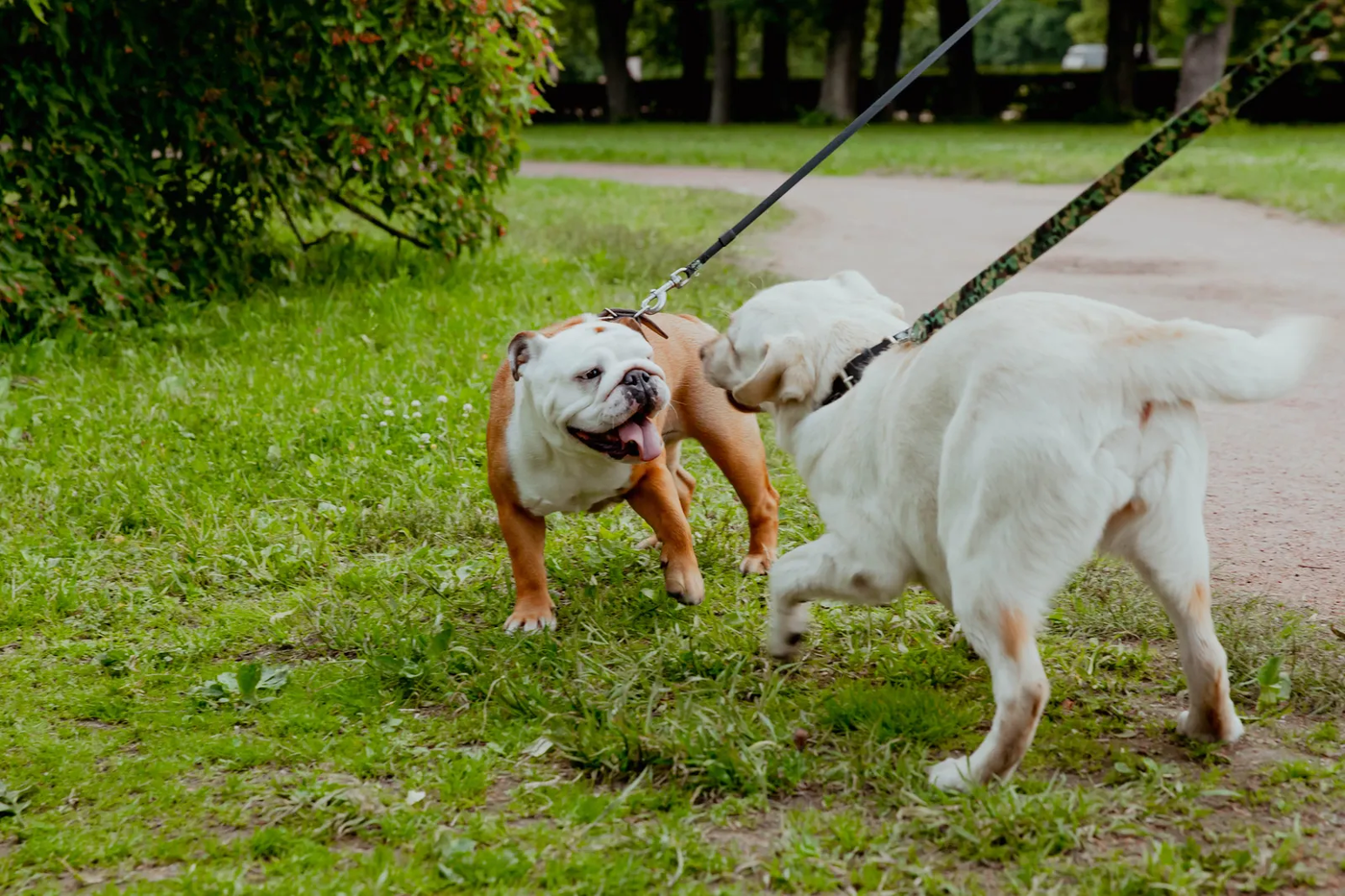
Pick the place
Neutral ground means a quiet open space neither dog has claimed, not a dog park.
Your dog treats your street, your yard and the trail you walk every morning as home territory. Meeting a stranger there invites guarding. A dog park is the other extreme: loose dogs, noise and nowhere to retreat. You want somewhere in between, quiet and open, where both dogs can see each other from far away.
Good options include an empty office park on a weekend, a wide trail at an off-peak hour, a sports field where leashed dogs are allowed, or a street across town. Check posted rules before you go. Scout it alone first, so you know where the squirrels, the cyclists and the shady spot to pause are.
- Neither dog walks there regularly
- Room to keep twenty feet or more between dogs
- Few other dogs, bikes or children
- Shade, water and a clear path back to the car
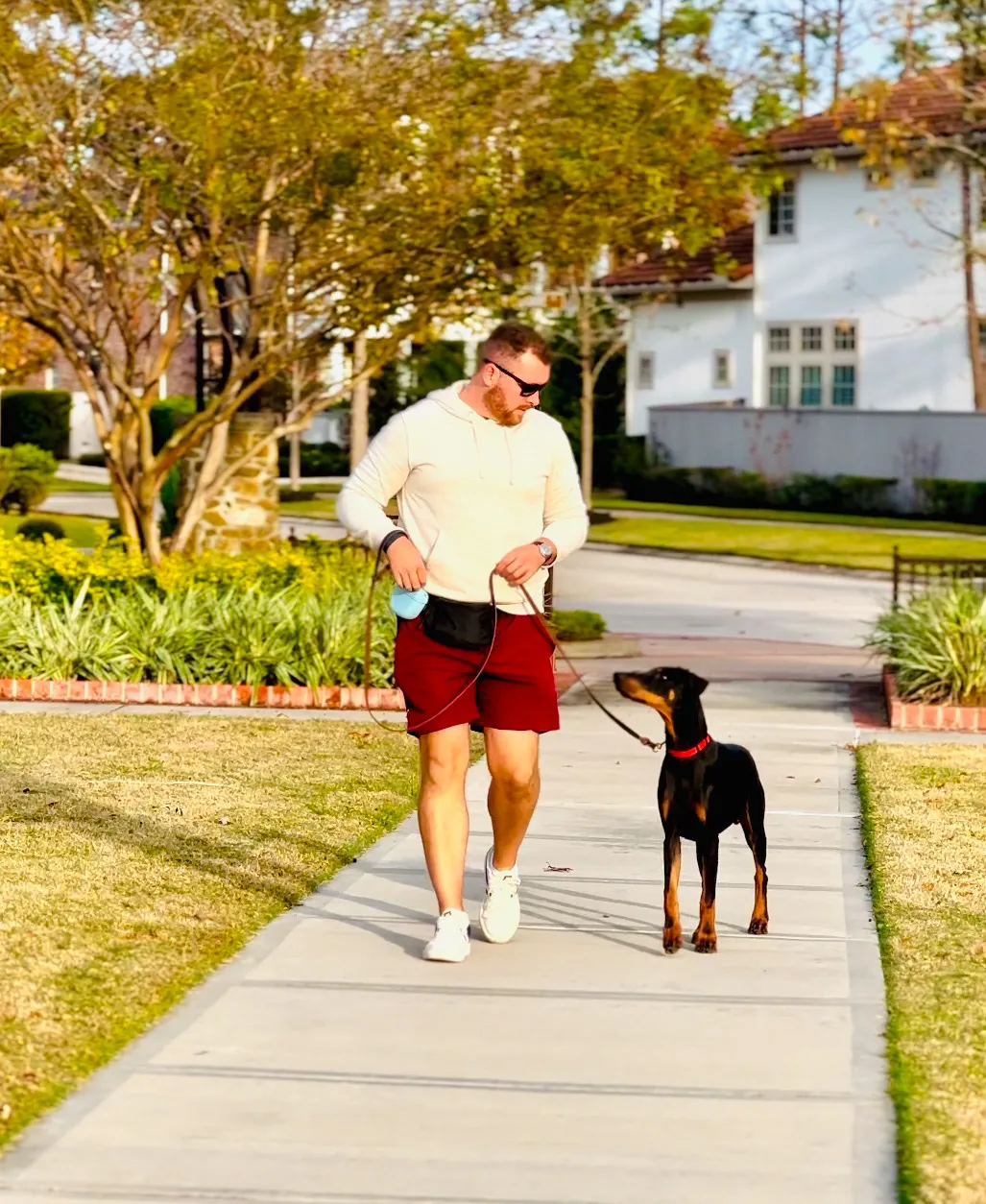
People and gear
Bring two calm handlers, two flat leashes and a plan for the worst case.
One handler per dog, every time. If you try to hold two leashes alone, the moment one dog stiffens you lose control of both. Use six-foot flat leashes and well-fitted collars or harnesses, not retractable leads, which tangle and give a dog speed. Bring high-value treats and a bag for each handler.
Be honest about history. If either dog has ever bitten or injured another dog, or fights rather than snaps, do this first meeting with an in-person professional on site, and condition that dog to a basket muzzle for several weeks beforehand. A muzzle the dog is comfortable in is not a punishment. It is what lets everyone stay relaxed enough to read the dogs.
The method
Run the meeting in this order and do not skip ahead.
Each stage has one job: let the dogs gather information while they are calm enough to use it. If either dog stops taking food, go back a stage.
- Arrive separately and park apart. Let each dog sniff and settle out of sight of the other for five minutes.
- Start a parallel walk in the same direction with a wide gap, such as opposite sides of a road or field. Both dogs should be able to sniff the ground and take treats.
- Narrow the gap a few feet each pass. Swap sides, and let one dog walk behind to sniff where the other has been.
- When both are loose and curious, allow a greeting: approach in a curve, not head-on, with slack leashes. Count three seconds.
- Call both dogs away in a happy voice, walk a few steps apart, reward, and repeat the greeting two or three times.
- Finish with ten minutes walking side by side, then stop while it is still going well.
Reading the dogs
Loose and wiggly means continue; stiff and silent means add distance now.
Watch bodies, not just tails. Good signs are curved approaches, sniffing the ground, turning the head away, play bows, a soft open mouth and a wag that moves the whole back end. Raised hackles on their own usually mean arousal, not aggression, so look at what the rest of the body is doing.
Warning signs are freezing, a hard stare, a closed mouth, a tail held high and stiff, weight leaning forward, or one dog placing its head over the other's shoulders. When you see them, say your cheerful cue and walk the dogs apart. Do not yank the leash. A tight leash pulls a dog upright and forward, which is the posture of a fight.
- Continue: sniffing, soft eyes, curved bodies, play bows
- Pause: freezing, staring, a stiff high tail
- Stop: lip lift, a growl with stillness, lunging, a dog hiding behind its handler
If it goes badly
A rough first meeting is information, not a verdict.
If one dog snaps or the greeting turns tense, separate calmly, end the session and try again another day from more distance with more walking. Some pairs who start stiff relax over a few more walks. If there was contact, punctures, or a dog who kept going after being pulled away, stop the home trials and get an in-person trainer to assess both dogs.
For everything short of that, a $99 virtual session by phone or Zoom helps. Our head trainer goes through both dogs' histories with you, sets the distances, and tells you what to film on the next walk. Families near Houston can also book an in-person private lesson.
The programs
Plan the meeting with a trainer.
A $99 virtual session by phone or Zoom anywhere in the US, or in-person private lessons for families in the Greater Houston area.
$99per session
Phone or Zoom, anywhere in the US
Virtual consultation with our head trainer
One-on-one guidance for behavior, a new dog, introductions or a new puppy.
How long should the first meeting on neutral ground last?
Twenty to forty minutes is plenty, and most of it should be walking rather than greeting. The face-to-face part is a few three-second hellos. End while both dogs are still relaxed, even if it feels too short. A calm, brief first meeting is worth more than a long one that ends in a growl.
Should I let the dogs off leash to play?
Not at the first meeting. Off-leash play can come later in a securely fenced area once both dogs have walked together calmly several times. When you do drop leashes, let them drag for a session so you can separate the dogs without grabbing collars, and keep play sessions short with pauses.
My dog barks and lunges at dogs on walks. Can I still do this?
Yes, but the distances need to be much larger and the plan more gradual, often over several sessions before any greeting. Leash reactivity does not always mean a dog will fight, though it does mean you need help reading the difference. A trainer, virtual or in person, should help you set this one up.
Can I introduce two dogs by myself?
It is not recommended. With two leashes in two hands you cannot reward, step away or separate quickly, and dogs read your tension through the leash. Ask a friend or family member the dogs are comfortable with to handle one dog, and brief them on the plan and the stop signals beforehand.
Is neutral ground needed for a puppy?
It helps less, because most adult dogs are less territorial about a young puppy, and an unvaccinated puppy should not be walked where unknown dogs go. Puppies usually meet a resident dog in a clean, quiet yard instead, with a different set-up that protects the adult dog's patience.
Virtual session, $99
Want both dogs' histories looked at first?
Book a $99 virtual session by phone or Zoom. Our team sets the distances, the stop signals and the order with you before the first walk.