
Reading two dogs
What are the signs two dogs will not get along?
Most dogs grumble at each other sometimes, the way roommates do. The skill is telling ordinary friction from a relationship that is getting worse. This page walks through what to watch at the first meeting, what to watch at home and how to respond before a pattern sets in.
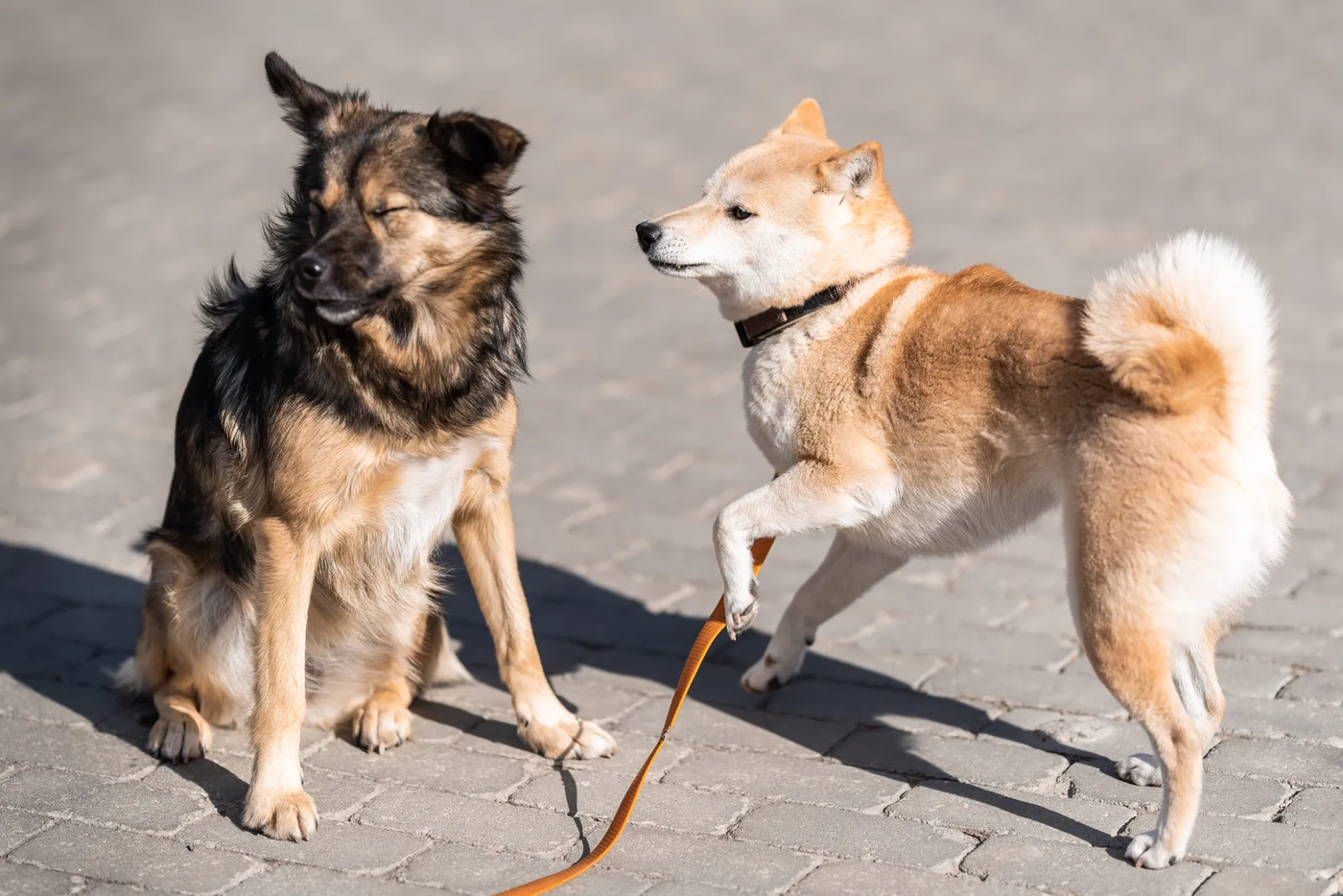
At the first meeting
Stiffness and stillness are the earliest warnings.
Trouble usually looks quiet before it looks loud. Watch for a dog who goes still with his weight forward, holds a fixed stare and closes his mouth tight. Hackles alone do not mean much, since many dogs raise them when excited, but hackles plus a frozen body and a high, slow tail wag is a dog thinking hard about the other one.
The other dog's response matters as much. A dog who turns away, sniffs the ground or yawns is trying to defuse the moment. If the first dog ignores those signals and keeps pressing in, the two are not speaking the same language, and the meeting should end calmly with more distance before anyone tries again.
- Frozen body with weight shifted forward
- Fixed, hard stare with a closed mouth
- Head or paws placed over the other dog's shoulders
- One dog ignoring the other's calming signals
Play or trouble
Healthy play is bouncy, loose and takes turns.
Rough play can look alarming and still be perfectly fine. The difference is in the details: loose, wiggly bodies, open mouths, play bows, and dogs who swap roles between chaser and chased. Trouble play is one-sided, with one dog always on top or always pinning, and the other trying to leave. The table compares the two side by side.
| What you see | Healthy play | Warning sign |
|---|---|---|
| Body | Loose, bouncy, curved | Stiff, upright, still |
| Mouth | Open, relaxed, soft | Closed tight or lips pulled forward |
| Roles | Dogs take turns chasing and pinning | Same dog always on top |
| Pauses | Frequent breaks, both come back | No breaks, or one dog keeps escaping |
| Sound | Playful growls with bouncy movement | Low growl with a frozen body |
At home
Guarding, cornering and avoidance are the patterns to watch.
Inside the house, the warning signs are often about control of things and space. One dog stands over the water bowl and stiffens when the other approaches. One dog blocks the hallway so the other cannot reach the back door. One dog shoves in every time the other gets petted. A single episode is information. The same move, at the same spot, every day, is a pattern.
Avoidance is easy to miss because it is quiet. A dog who has stopped coming into the kitchen, who waits until the other is asleep to eat, or who spends all day behind the couch is not settling in. That dog is coping, and stress that builds this way can come out later as a sudden fight that seems to arrive from nowhere.
- Guarding food, water, toys, beds or a person
- Blocking doorways, hallways or stairs
- One dog avoiding shared rooms or meals
- Disagreements that are longer than they were a week ago
What to do
Separate, simplify and slow the introduction down.
When you see a pattern, do not wait to see if it fades. Reduce the pressure so neither dog has to keep defending something. These steps lower the temperature in most homes within a few days and give you a calmer baseline to work from.
- Separate meals completely, in crates or different rooms, and pick up bowls and chews when the dogs are together.
- Use gates or closed doors so the dogs share space only when you are actively watching.
- Put both dogs on a predictable schedule for walks, meals and rest so there is less to compete over.
- Return to parallel walks on leash, where the dogs share time without facing each other.
- Film short clips of the moments that worry you, so a professional can see exactly what is happening.
Honest limits
Repeated fights or injuries need an in-person professional.
If the dogs have fought more than once, if either has needed a vet after a fight, or if you have been bitten breaking them up, the situation is beyond coaching by video. Two dogs in that state need a professional in the room who can read them live and set up safe training. Talk to your veterinarian as well, because pain can make a dog suddenly short-tempered with a housemate.
For earlier warning signs, a $99 virtual introduction consultation by phone or Zoom is a practical step. Our head trainer reviews your clips and history, tells you which signs matter most and sets a management plan. Sometimes the honest conclusion is that two dogs would be happier in separate homes, and our team will say so.
The programs
Have our team look at the warning signs.
Send video, then talk it through on a $99 introduction consultation by phone or Zoom.
$99per session
Phone or Zoom, anywhere in the US
Virtual consultation with our head trainer
One-on-one guidance for behavior, a new dog, introductions or a new puppy.
Is growling between my dogs a bad sign?
Not by itself. A growl is a warning that lets one dog say back off without a fight. It becomes a concern when the growl escalates to snapping, when it happens over the same thing every day, or when the other dog ignores it. Never punish the growl, since that removes the warning but not the feeling.
Can two dogs who fight ever live together?
Some can, with strict management and training, especially when fights are tied to one trigger like food. Others cannot, especially two dogs who fight often or cause injuries. The answer depends on the dogs and the household, and it needs a professional assessment, in person if there have been injuries.
Why do my dogs suddenly not get along?
Common reasons include pain or illness in one dog, a younger dog maturing and testing limits, a change in the household, or a new resource like a favorite bed. Start with a vet visit for any sudden change in behavior. If health checks out, look at what changed in the weeks before the trouble began.
How do I safely separate two dogs that are fighting?
Avoid reaching for collars or heads, which is how most owners get bitten. A loud noise, a board or cushion pushed between them, or water can interrupt many fights. If two adults are present, each can lift a dog's back legs and walk backward. Then keep the dogs apart and get professional help.
Can a virtual session tell if my dogs will get along?
A virtual session cannot read your dogs in the room, but our head trainer can review video of their interactions and your household routine, then explain what the body language suggests and what to change. For dogs with a history of injuring each other, the right next step is an in-person professional.
Virtual session, $99
Not sure what you are seeing between your dogs?
Book a $99 virtual consultation by phone or Zoom from anywhere in the US. Send the clips, talk through the history and get a clear read on what to do next.