
Toys between dogs
How to stop toy guarding between dogs
Toy guarding between dogs looks like a stiff stand over a ball, a growl when the other dog walks past, or a sudden scuffle over a squeaky toy that nobody was even playing with. It is common, it is fixable in most homes, and it starts with the toy box.
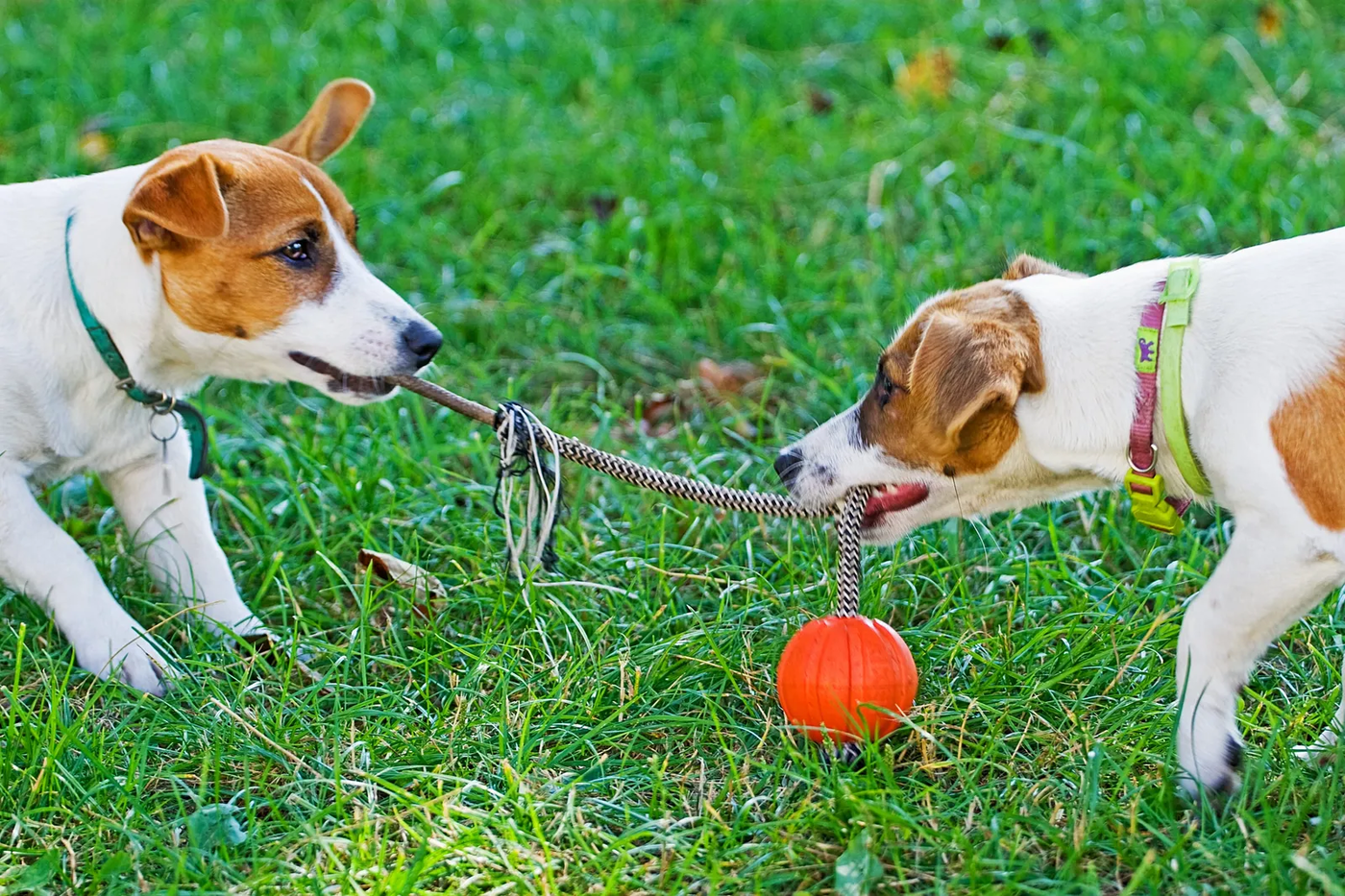
What it looks like
Toy guarding between dogs is usually quiet before it is loud.
The early version is easy to miss. One dog carries a toy to a corner and lies with his body curled around it. He stops chewing and goes still when the other dog walks in. His eyes track the other dog without his head turning. Some dogs guard a toy they ignored all afternoon, only because the other dog showed interest.
This page is about guarding between dogs. If your dog guards toys, food or furniture from people, that is a different problem with different risks, and our guide on resource guarding from people covers it. Many dogs guard from one and not the other, so watch each relationship separately.
- Freezing or stopping chewing as the other dog approaches
- Hard eye contact, tight mouth, lifted lip
- Body curled over the toy or blocking a corner
- Taking a toy only after the other dog wants it
Management
Take the toys away before you train anything.
Every time a guarding episode plays out, the guarding dog learns that stiffening works and the other dog learns to be wary. So the first job is to stop the rehearsal. Pick up every toy, ball and chew in the house and the yard. Give them back only when the dogs are separated by a crate, a gate or a closed door, and collect them before the dogs are together again.
This feels drastic, but it often lowers tension within days. Dogs who no longer have anything to defend tend to relax around each other. Keep one rule for the whole household: no toys loose on the floor when both dogs are out. A full toy basket in the living room undoes the plan.
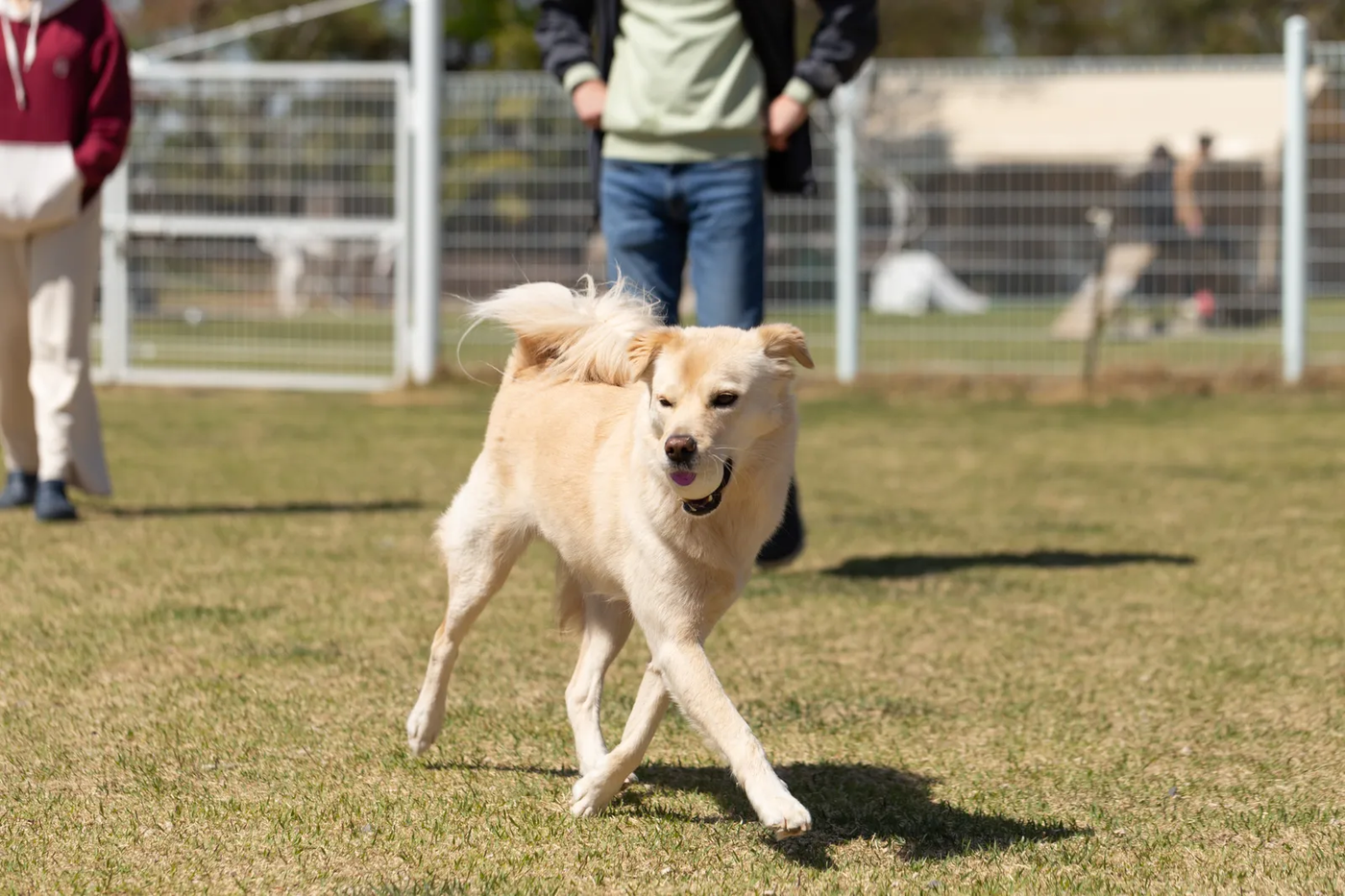
The method
Rebuild toy time in short, structured steps.
Work through these steps in order and move on only when both dogs stay loose at the current step for several sessions. Keep each session to a few minutes and end before anyone gets excited. If you see the freezing or staring described above, go back one step.
- Teach each dog drop and leave it alone, in a separate room, by trading the toy for a treat and returning the toy most of the time.
- With the dogs on leash or behind a gate, a few yards apart, let each chew a boring toy while you reward calm glances at the other dog.
- Hold one toy yourself and play a turn-taking game: one dog gets a short tug or a toss while the other holds a sit or place and earns a treat, then switch.
- End each round by asking for drop, putting the toy away and giving both dogs a treat at the same time from opposite hands.
- Gradually allow one low-value toy on the floor while you supervise, and pick it up before either dog settles down with it.
- Keep the most prized toys and chews for crate or solo time, permanently if your dogs need it.
Common mistakes
Avoid the moves that make guarding worse.
Punishing the growl is the most common mistake. The growl is the guarding dog telling the other dog to back off, and if that warning is punished away, the next step may be a snap with no notice. Taking the toy away from the guarding dog and handing it to the other dog is the second; it confirms that the other dog is a threat to his things.
Letting them work it out is the third. Some pairs do settle, but many escalate, and the dog who loses repeatedly can become anxious or start fights elsewhere. Your job is to make guarding unnecessary rather than to let the dogs decide who wins.
- Do not punish growling
- Do not take a toy from one dog and give it to the other
- Do not leave toys loose with both dogs unsupervised
- Do not let the dogs settle it alone
When to get help
Get in-person help if guarding comes with fights or injuries.
If the dogs have fought hard enough to puncture skin, if fights happen over things you cannot always control, or if one dog is now afraid of the other, management at home is not enough. Work with a qualified professional in person. A sudden onset of guarding in a dog who never did it can also signal pain, so a vet visit comes first.
For milder cases, a $99 virtual session by phone or Zoom lets our head trainer look at video of your dogs, help you read the signals and set the pace for reintroducing toys. Families near our Cypress, Texas training home can also choose in-person private lessons.
The programs
Help for guarding between your dogs.
Start with a $99 virtual session by phone or Zoom. In-person lessons are available in the Greater Houston area.
$99per session
Phone or Zoom, anywhere in the US
Virtual consultation with our head trainer
One-on-one guidance for behavior, a new dog, introductions or a new puppy.
Why does my dog guard toys only from the other dog?
Dogs often treat people and dogs differently. Your dog may trust you to hand toys back but see the other dog as competition who keeps what he takes. That is why this is managed between the dogs: control access, teach drop, and run supervised turn-taking games.
Should I just get rid of all the toys?
For the first weeks, yes, at least whenever both dogs are out. You do not need to stop toys forever. Each dog can still enjoy toys in a crate or behind a gate, and you can reintroduce low-value toys together slowly once both dogs stay relaxed.
How long does it take to stop toy guarding between dogs?
Management works right away because the dogs simply stop practicing. Rebuilding shared toy time usually takes several weeks of short sessions, and some pairs never share their favorite toy. That is a reasonable outcome as long as the house is calm and fights have stopped.
Is it okay to let the dogs work it out?
It is risky. Some dogs settle a disagreement with a growl and move on, but others escalate, and repeated losses can make the other dog anxious or defensive. Supervise, interrupt early with a calm cue, and set the house up so guarding is unnecessary.
Can virtual training help with toy guarding?
Yes, for dogs who guard without injuring each other. A $99 session by phone or Zoom covers the management setup, the drop and leave it training, and the pace for turn-taking games, using video you share. Fights with injuries need an in-person professional.
Virtual session, $99
Make toy time calm again.
Book a $99 virtual session by phone or Zoom. Our team will look at how your dogs interact around toys and help you set the steps and the pace.