
Two dogs, two bowls
How to feed two dogs without fights
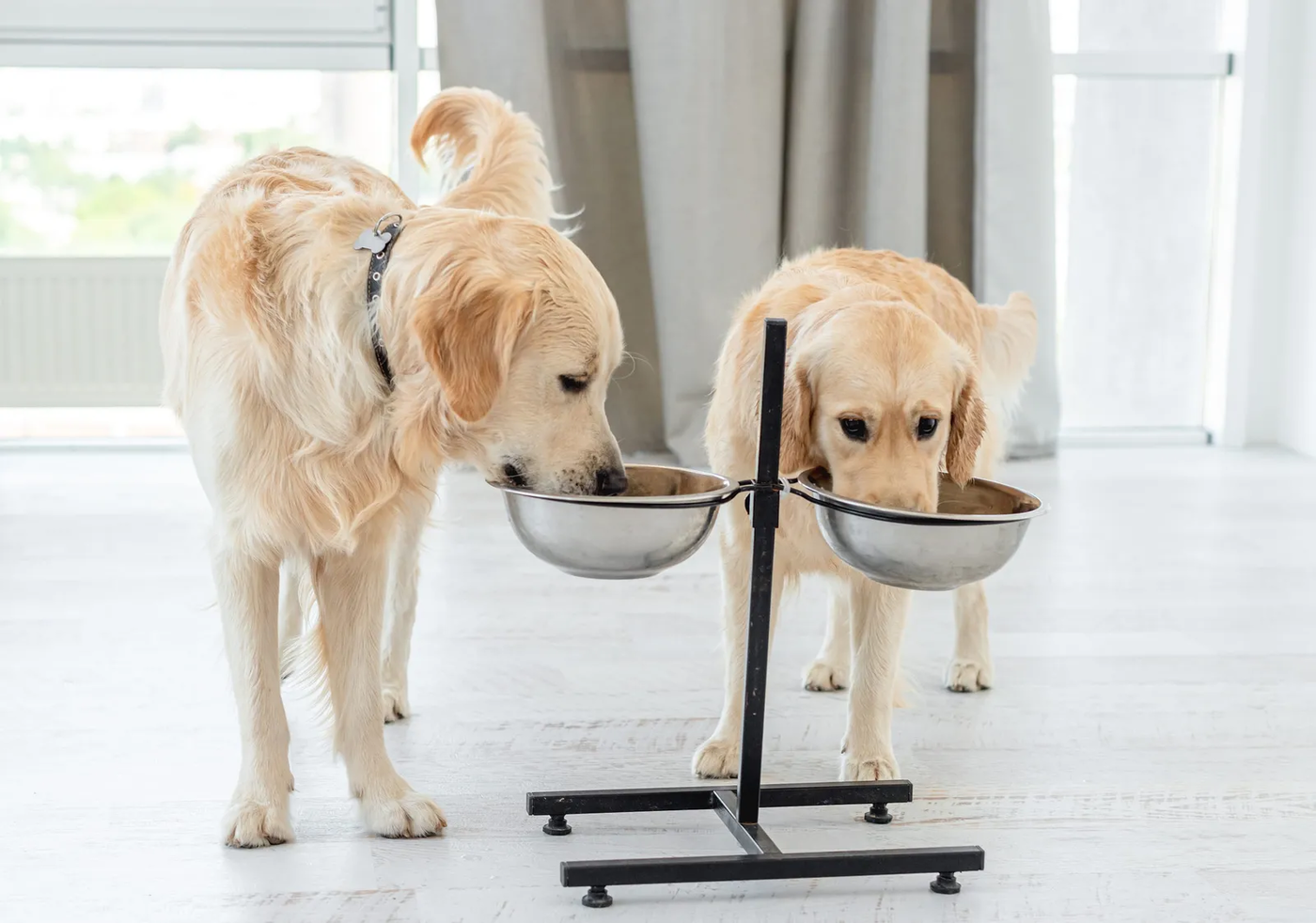
Food is the resource dogs argue over most, and the argument usually happens in the last ten seconds: one dog finishes and wanders toward the slower eater. Most mealtime fights are prevented by layout and routine rather than obedience.
Why it happens
Mealtime fights are about distance and timing, not bad dogs.
Two dogs eating three feet apart in a busy kitchen is a setup most dogs would struggle with. The fast eater finishes, looks up, sees food, and walks over. The slow eater freezes, growls or snaps. Repeat that twice a day and both dogs start arriving at meals already tense, gulping and watching each other instead of eating.
The fix is to remove the chance to compete. Separate stations, a predictable order and bowls that disappear the moment they are empty take away every reason to approach. Once neither dog expects the other to come over, the tension usually drops on its own. It is management first, training second.
- Freezing or eating faster when the other dog moves
- Hovering near the other bowl after finishing
- Growling, lip lifting or snapping at the bowl
- Guarding the empty bowl or the floor where it sat
The routine
Set up a feeding routine both dogs can predict.
Run this routine at every meal, with every person who feeds. Consistency is the whole point: a dog who knows exactly where his bowl lands and that nobody will approach it has nothing left to defend. Expect a few awkward days while both dogs learn the pattern.
- Choose two stations out of sight of each other: two rooms, two crates, or opposite sides of a baby gate with a solid barrier.
- Prepare both bowls on the counter while both dogs wait on place or sit; if one breaks the wait, the bowls go back up.
- Walk the slower or more worried dog to his station first, set the bowl down, then do the same for the other dog.
- Stay in the room between the two dogs, or at the gate, until both are finished. Do not leave to answer a phone.
- Pick up each bowl the moment it is empty, before the dog turns around to look for more.
- Release the dogs one at a time, a minute apart, and keep the kitchen floor clear of crumbs and dropped kibble.
Station layout
Crates and gates make the safest feeding stations.
Feeding in crates is the simplest layout for most homes. Each dog walks in, eats with the door closed, and nobody can wander over. If one dog finishes in twenty seconds and the other takes five minutes, the fast eater simply waits. Crates also help in small apartments where two rooms are not an option.
If you prefer open stations, use a solid barrier rather than a wire gate the dogs can stare through. Many tense eaters calm down simply because they cannot see the other dog. Slow-feeder bowls or a snuffle mat for the fast eater can help even out the timing, which takes away the most common trigger.
- Crates with doors closed until both dogs finish
- Separate rooms with the door shut
- A solid barrier rather than a see-through gate
- A slow feeder for the dog who gulps
Other food moments
Treats, chews and dropped food need rules too.
Mealtime is not the only food moment. A dropped piece of cheese, a bully stick, or a treat handed to one dog while the other watches can start the same argument. Give long-lasting chews only when the dogs are separated, and collect them before the dogs share space again. During training, give treats to each dog in turn, saying each name, so neither has to grab.
Snack time with kids deserves attention. A toddler walking through the living room with a cracker at dog height pulls both dogs toward the same spot, and one may snap at the other. Keep dogs gated during family snacks until the feeding routine has been calm for several weeks.
Safety and help
If a fight happens, keep your hands out and get help.
Never reach between two fighting dogs or grab collars near their heads; that is how owners get bitten. A loud noise, a board or a cushion pushed between them, or pulling each dog away by the back legs or a leash is safer. Afterward, separate the dogs completely, check both for punctures, and see a vet for any wound.
One scuffle does not mean the dogs cannot live together, but it does mean the routine needs tightening. A $99 virtual session by phone or Zoom can help you redesign stations and timing for your layout. Repeated fights, injuries, or a dog that guards food from people as well need in-person professional help, and a sudden change in appetite or temper deserves a vet visit first.
The programs
A feeding plan for your home.
A $99 virtual session by phone or Zoom covers your layout, your dogs and your schedule.
$99per session
Phone or Zoom, anywhere in the US
Virtual consultation with our head trainer
One-on-one guidance for behavior, a new dog, introductions or a new puppy.
How far apart should two dogs eat?
Far enough that neither dog can reach the other's bowl, and ideally where they cannot see each other. Separate rooms or crates are best at first. Some calm pairs can later eat in the same room several feet apart, but only after weeks of relaxed meals with a person supervising.
Should I feed the older dog first?
Feed the more worried or slower dog first, which is often but not always the older one. The point is a fixed order that both dogs can predict, not rank. Keep the same order every meal and with every person who feeds.
Can I free-feed two dogs?
Free-feeding usually makes things harder because there is always a bowl to guard and you cannot see who is eating what. Scheduled meals, picked up when finished, let you manage tension and notice if one dog's appetite changes, which can be an early sign of illness.
One dog eats the other dog's food. What do I do?
Separate them so it cannot happen, then stay present until both finish. Crates are the easiest solution. A slow feeder for the fast eater helps even out the timing. Once the habit has been impossible to practice for a few weeks, most dogs stop trying.
Is a growl at the food bowl a reason to worry?
It is a warning, not a crisis, and it means the current setup asks too much. Do not punish the growl, because that can remove the warning and leave only the bite. Increase distance, use barriers and feed in crates. If growls turn into snaps or fights, get in-person help.
Virtual session, $99
Make mealtime boring again.
Book a $99 virtual session by phone or Zoom and our team will help you lay out stations, order and timing that fit your home and your two dogs.