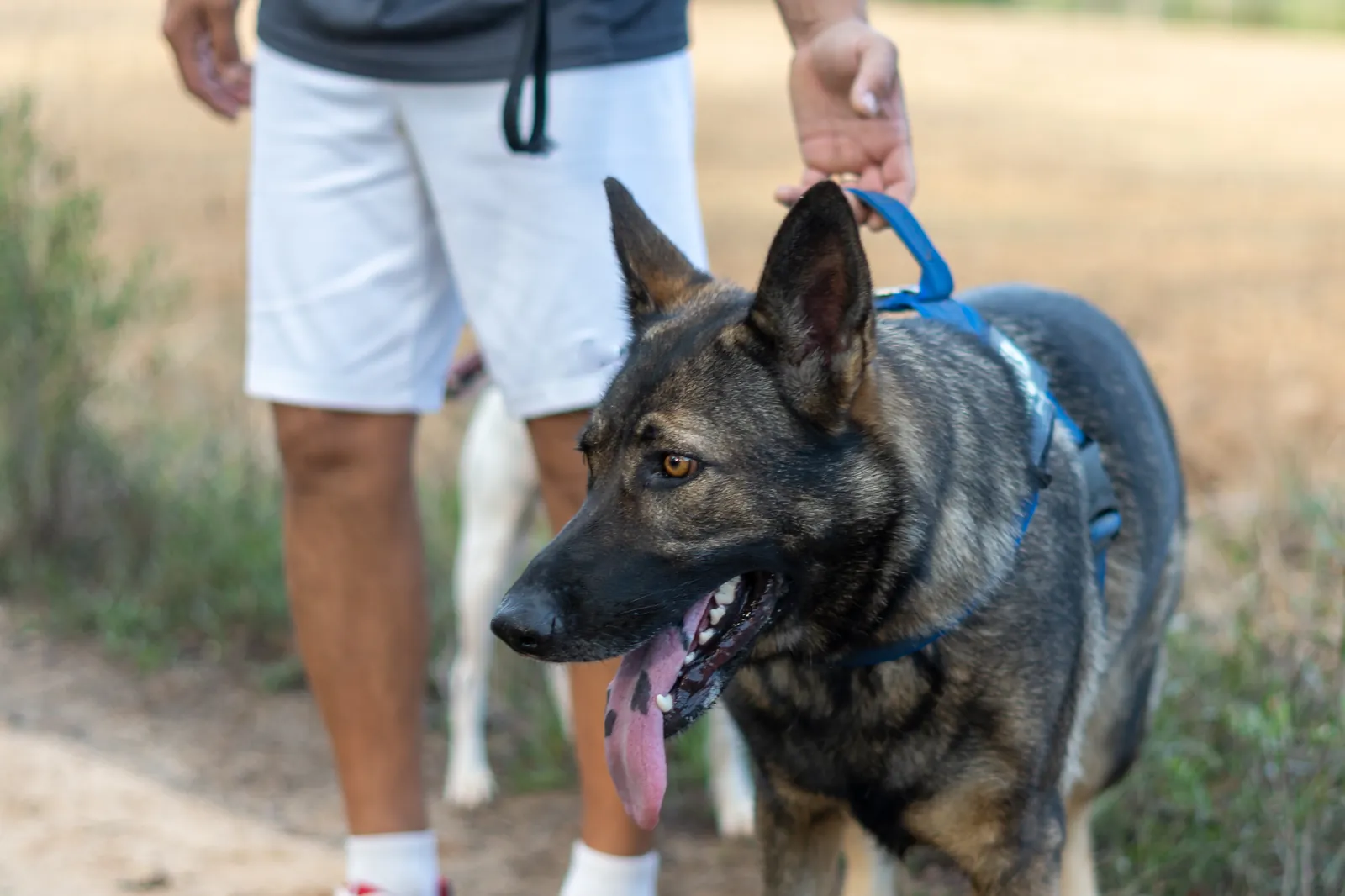
Our training methods: what we use, what we never do, and why it holds at home.
We use a balanced approach: rewards for the behavior we want, fair and consistent boundaries for the behavior we do not, and the right tool for the dog in front of us. Here is what that means in practice, tool by tool.
Six principles
How every stay is run.
1
Teach first, then hold the dog to it
Every command is taught with food, praise and repetition until the dog understands it in a quiet room. Only then does a boundary exist, and a boundary is a fair, consistent consequence the dog can predict, never a surprise. A correction for something the dog was never taught is the one thing we do not do.
2
Reward what you want, generously
Calm at the door, a loose leash, a dog that chooses its bed while dinner cooks: all of it is paid, with food early and with freedom and praise later, so the behavior survives the day the treats run out.
3
The right tool for the dog in front of us
A soft young Lab and a hard-headed adult shepherd do not need the same equipment. We choose from a flat collar, a slip lead, a prong collar or an e-collar based on the dog, fit it correctly, and teach you to use it before the go-home session ends.
4
Real places, real distractions
A command that only works in a kitchen is not trained. Platinum and VIP dogs practice on Cypress sidewalks, in pet and hardware stores, at the lake and around other dogs, so the calm you see on the Friday video is the calm you get on your own street.
5
A home, one trainer, a limited number of dogs
Dogs live in our trainer’s own house, learn place while life happens around them and wait at real doors. The same trainer works your dog from drop-off to the handover, which is why the handover works.
6
The family learns the method too
The go-home session, the follow-up lessons in Gold, the unlimited lessons in Platinum and the in-home lessons in VIP exist because the dog is only half of the job. We show you the leash handling, the place routine and what to do the first time the dog tests you.
The tools
Five tools, chosen per dog.
1
Food and praise
The first tool, for every dog.
Every new skill starts with food, marked at the exact moment the dog gets it right, and praise that means something. Food fades as the skill matures; praise and freedom do not.
2
Leash and slip lead
Clear information through a short line.
A six-foot leash on a flat collar or a slip lead placed high on the neck gives the dog a clear, brief signal and an immediate release. The structured walk is built on it: dog at your side, slack in the line, attention available on request.
3
Place cot
The calm command.
Place is a raised bed the dog goes to on cue and stays on until released, with duration, distance and distraction built over days. It is the cornerstone of every program from Gold up and the reason a graduate can lie quietly while guests arrive.
4
Prong collar
For some dogs, fitted high and snug, used as designed.
A prong collar fitted correctly and used as a brief, even pressure the dog learns to turn off by moving with you communicates more clearly and with less force than a flat collar being hauled on. Fitted loose, worn low, left on unsupervised or yanked by a frustrated handler, it can hurt, like any collar. We fit it, we teach it, and we take it off the dogs that do not need it.
5
E-collar
Included in VIP; introduced low, late and only after understanding.
A modern e-collar from a reputable maker, introduced at a level the dog can barely feel, only after the dog already understands the command, by a person who has been taught to use it, is how off-leash reliability is finished safely. It is never used to punish fear, and never on a dog that does not know what is being asked. The Mini-Educator is included in the six-week VIP program; families in other programs who want it are taught it in a lesson.
Private lessons at $160 in Cypress or $220 in your home teach you the same method on your own street, and the Puppy Development Bundle starts it before the habits form.
Questions
About the method.
Is balanced training cruel?
Balanced training, as we practice it, is not: it rewards the behavior you want generously, sets clear and fair boundaries for the behavior you do not, and chooses tools for the individual dog, with the teaching always coming before any correction. Cruelty in dog training is force without teaching, and it exists under every label.
Do you use treats?
Yes, for every dog and every new skill. Food is how a dog learns what a word means. It fades as the skill matures and is replaced by praise, play and freedom, which is why a graduate still listens when your pockets are empty.
Will my dog come home on a prong collar or an e-collar?
Only if your dog needs one and you have been taught to use it. Many dogs finish on a flat collar or a slip lead. VIP dogs come home with the Mini-Educator and an in-home handover; other families who want the e-collar learn it in a lesson.
Can training fix aggression or reactivity completely?
For obedience and manners, nearly every healthy dog learns the skills. For reactivity and aggression the honest answer is that the behavior is reduced and managed, not deleted, and the family’s handling afterward matters as much as the stay. That is why Platinum includes unlimited lessons.
What is a structured walk?
A walk with rules: the dog at your side on a loose leash, no pulling to smells or other dogs, attention available when you ask, and sniff breaks given on your release rather than taken. It is the first thing every board and train dog learns and the thing families notice first.
Free consultation · 10% off this fall
Ask our team how we would train your dog.
Tell us the breed, the age and what is happening at home. The free consultation is a direct call with the people who do the training.