
Leash and walks
How to walk two dogs at once
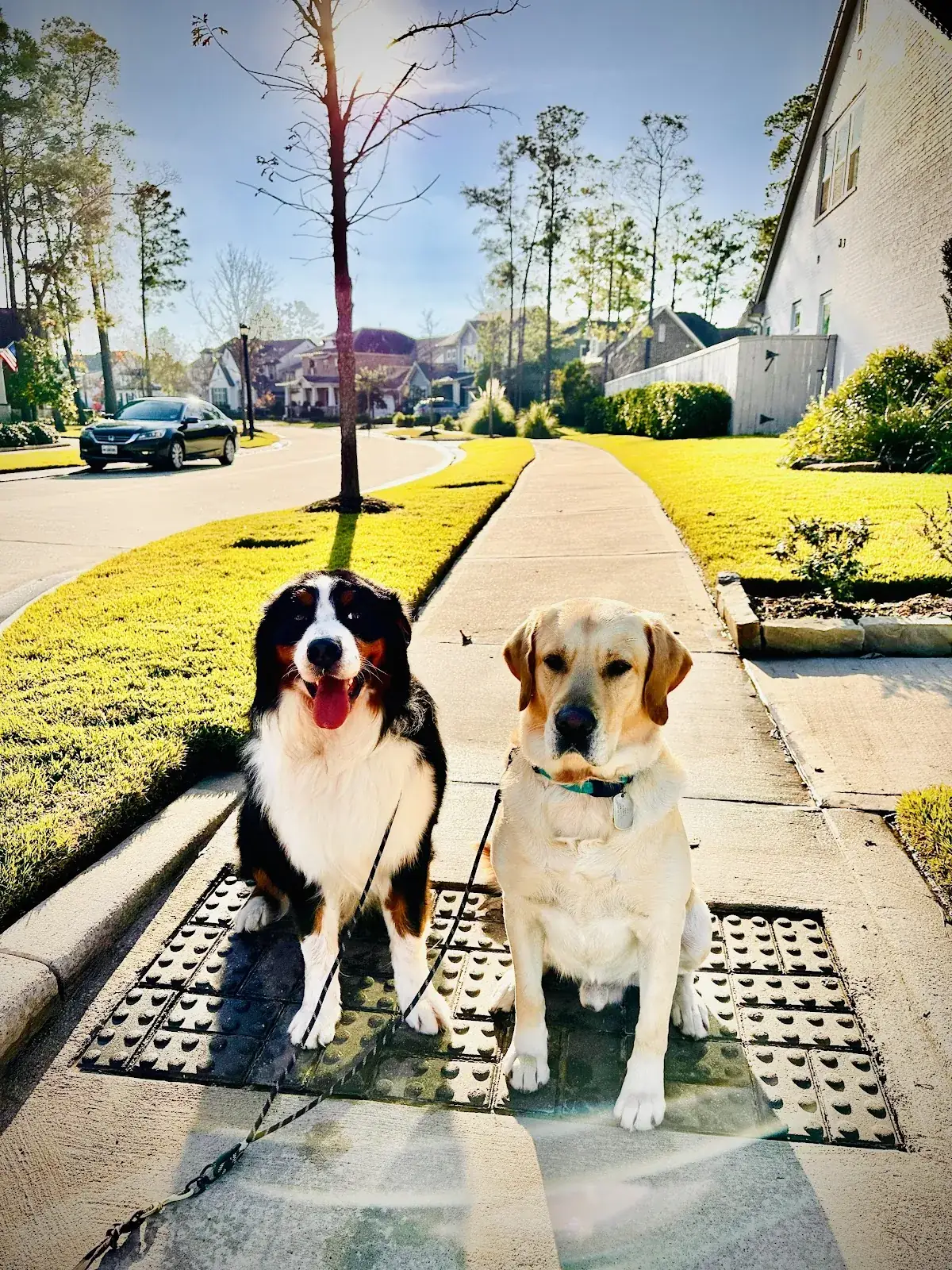
Two dogs on one walk is the most common request from Houston households with two dogs and the fastest way to teach both of them to pull, because each pulls the other. Here is the order our trainers use, the equipment, and the honest cases where the double walk never happens.
Last reviewed September 11, 2026 · by the Best Dog University Team
Why it fails
Two dogs teach each other to pull, and arousal doubles.
A dog walked with another dog is not walking with its person; it is walking with the other dog, and it pulls toward whatever the other one pulls toward. The excitable one winds up the calm one, the calm one gets dragged into the lunge, and the person on the end of two leashes has no way to correct either. Arousal in dogs is contagious, and a pair that sees another dog reacts as a pack, which is why two dogs that are each fine alone can be a disaster together. The pair walk is built by building two single walks first, each dog with its own heel and its own neutrality, and then combining them on easy streets where nothing tests it. The double walk is for the calm parts of the neighborhood; the single walk is for everything hard.
- A dog with another dog walks with the dog, not the person
- Arousal is contagious
- A pair reacts as a pack
- Two single walks first, then the easy streets
The method
Seven steps, and the first four are one dog at a time.
Budget a month of single walks before the first double, longer for a pair with a reactive dog in it. The double walk is added on the easiest street you have, at the quietest hour.
Each dog walked alone daily on a structured walk, at your knee, paid for the position, on quiet streets, for two weeks
Each dog proofed alone past other dogs at a distance it can hold, paid for looking at you, with the distance closing over weeks
Each dog taught a sit at the curb, a wait at the door and a release word, so the pair can be managed at thresholds
Each dog given a side and kept to it, left or right, on every single walk, so the pair does not cross and tangle
The first double walk: both dogs on the same side, one leash in each hand or both in one, on the easiest street at the quietest hour, for five minutes, paid for the position, and home while it is still calm
Longer and busier over weeks, with the single walks continuing for anything hard: the trail, the busy hours, the pass by a reactive dog
A coupler, if you want one, only once the pair walks calmly on separate leashes, and never on a pair with a reactive dog in it
The mistakes
Starting together, the coupler as a shortcut, the retractable leash, and the pass that turns into a pack.
Starting the double walk before either dog walks alone builds two pullers at once. The coupler used as a shortcut tethers a calm dog to an excitable one and teaches the calm one to pull. The retractable leash with two dogs is a tangle and a rope burn waiting to happen. And the pass by another dog on the double walk, before each dog has been proofed alone, turns two dogs into a pack in a second, and the person on the end of two leashes cannot stop it; the pair crosses the street or the single walk handles that route. Two dogs that fight each other on the leash, redirecting onto each other in the excitement of a pass, walk separately for good, and our team says so rather than selling a fix.
The person matters too: a double walk is for someone who can hold both dogs if both lunge, and a child or a smaller adult walks one.
- Never start together
- No coupler as a shortcut
- No retractable leash with two dogs
- No passes on the double walk until each is proofed alone
- A pair that redirects onto each other walks separately
Proofing around Houston
Two-dog households everywhere, a dog every fifty yards on the trails, and a summer that limits the walk anyway.
Houston's master-planned sections are full of two-dog households and the trails in Bridgeland and Cinco Ranch put a dog every fifty yards, so the double walk gets tested constantly; our trainers build it on the quiet Cypress streets near the training home and proof it on the paths at dawn, with the single walks handling the busy hours for months. Summer limits the walk to dawn and dusk anyway, and a pair that has twenty minutes of walking a day in July needs two ten-minute single walks more than one double. The two-dog household guide on this site covers the crates, the meals and the place beds that make a pair calm indoors, which is where the calm walk starts.
- Quiet streets first, the paths at dawn
- Single walks for the busy hours for months
- Two short single walks in summer
- Calm indoors first, on the two-dog household page
When to call
A pair that redirects onto each other, a reactive dog in the pair, or two dogs that have never walked alone.
A pair that fights each other on the leash during a pass is a serious sign and needs an consultation, and the honest answer for most is separate walks for life. A pair with a reactive dog in it needs that dog worked alone first, on the leash aggression page, and a Platinum stay at $3,750 for that dog with lessons afterwards that include the double walk. Two dogs that have never walked alone are often a board and train for two case, where both dogs come to the training home and each gets its own walk built before the pair walk is proofed on field trips. In-home lessons at $220 set up the sides, the thresholds and the first double walk on your own street.
The programs
Programs for a two-dog walk.
Platinum for the reactive dog in the pair, a stay for two for the pair that has never walked alone, lessons at home to set up the double walk.


Asked and answered
Questions people ask about this.
Is it better to walk two dogs together or separately?
Separately until each walks well alone, then together on easy streets and separately for anything hard. Two dogs on one walk teach each other to pull and react as a pack, and the double walk is a gear for calm parts of the neighborhood, not the whole walk.
Should I use a coupler to walk two dogs?
Only once both dogs walk calmly on separate leashes, and never on a pair with a reactive dog in it. A coupler used as a shortcut tethers the calm dog to the excitable one and teaches the calm one to pull. Separate leashes, both dogs on the same side, are the training setup.
My two dogs pull in different directions. What do I do?
Give each dog a side, left or right, and keep it on every single walk for two weeks so the position is fixed before the pair walk. Then both dogs on the same side of you on the double walk, paid for the position. Two dogs crossing in front of you have not had the single walks.
My dogs fight each other when they see another dog on a walk. Can that be fixed?
Redirecting onto each other during a pass is a serious sign, and the honest answer for most pairs is separate walks for life, with each dog's neutrality worked alone. Get an consultation; a pair that has drawn blood on each other is managed, not fixed on the sidewalk.
Keep reading
Free consultation · 10% off this fall
Two single walks before any double.
Tell our team how each of your dogs walks alone. The free phone consultation is a direct call.