
Manners and obedience
How to teach a dog to heel
A structured heel is the skill that turns a dragging walk into a quiet one past every dog on the Heights trail, and it is built standing still in a kitchen. Here is the method our trainers use, the turns that make it stick, and the reason a heel should not be the whole walk.
Last reviewed September 11, 2026 · by the Best Dog University Team
Why it matters
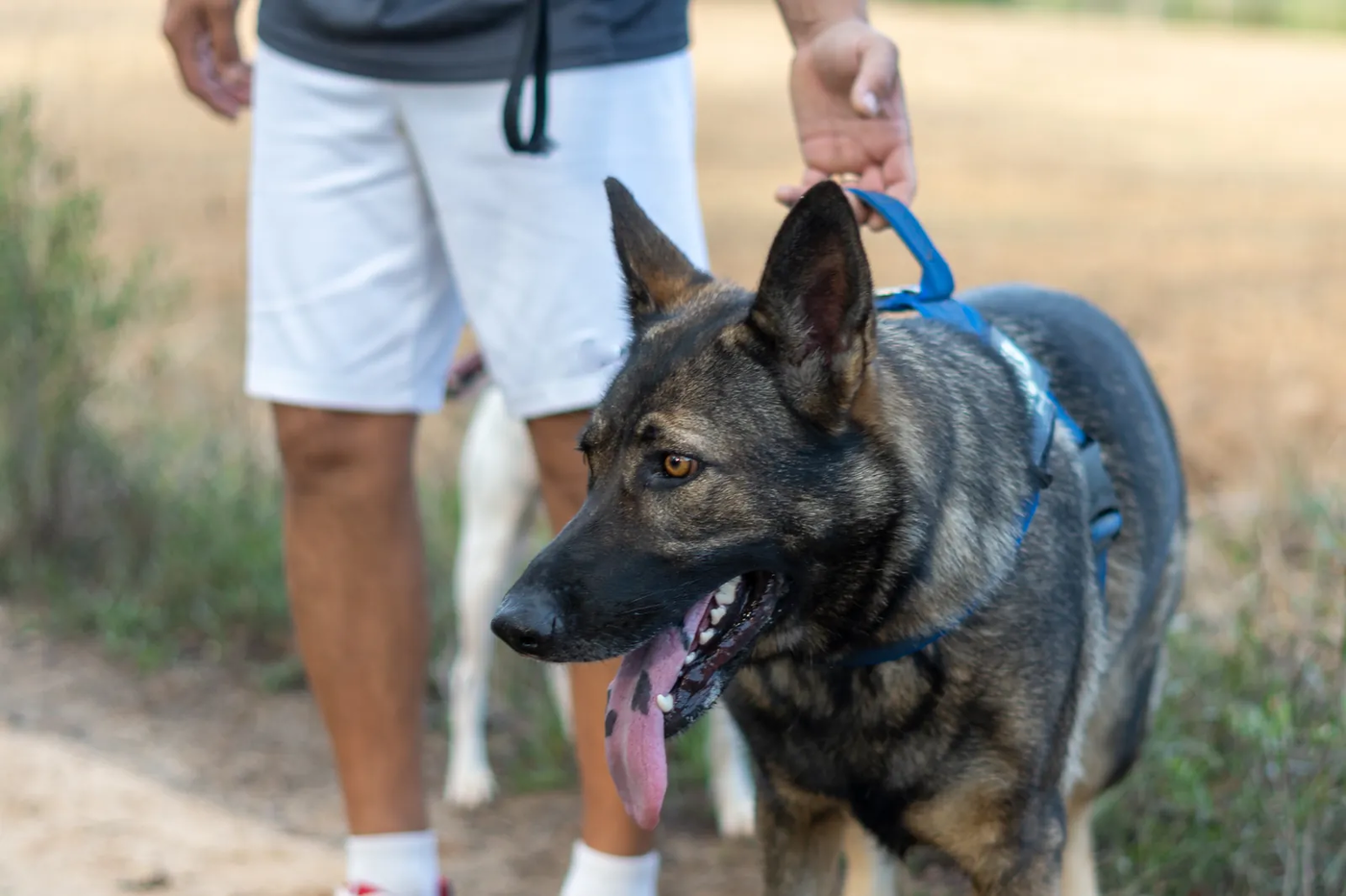
A heel is a gear, not a walk.
Dogs pull because the interesting things are in front and the walk stops when the leash tightens only if someone stops it. A heel gives the dog a job at your knee that pays, and a dog with a job has less attention for the squirrel. It is the position for the hard parts of a walk: the road crossing, the narrow sidewalk, the pass by another dog, the store aisle, the last hundred yards home. It is not the position for the whole walk, because a dog needs to sniff and a heel for forty minutes is a punishment for both ends of the leash. Teach the heel, teach a release to a loose leash and a sniff, and use the heel like a gear you shift into.
- The position: shoulder at your left knee
- Paid at the knee until the dog parks there
- The gear for crossings, dogs, aisles and narrow sidewalks
- Released to sniff in between
The method
Seven steps from standing still to a heel past another dog.
Start indoors with the dog on a leash and food in your left hand, held at the seam of your trousers so the reward arrives at the knee. Two-minute sessions, many a day.
Stand still and feed the dog at your left knee every time it is there; step away, wait for it to come back to the knee, feed; repeat until the dog parks itself there and looks up
Take one step forward and feed the instant the dog's shoulder arrives at your knee; then two steps, then five, feeding on arrival each time
Add a marker word on the arrival and start thinning the food, every second arrival, then every third, keeping the rate high in new places
Add turns: a right turn away from the dog so it hurries to catch up, a left turn into the dog so it yields and slows, an about-turn; feed on each recovery, because the turns teach the dog to watch your legs
Add changes of pace, slow and fast, feeding when the dog matches
Put the word on it, heel, when the dog reliably offers the position, and add the release word to a loose leash and a sniff
Take it outside in stages: the driveway, the quiet street, the store aisle, the trail at a quiet hour, then the trail past a dog at a distance
The mistakes
Rewarding in front, walking in straight lines, and heeling the whole walk.
Feeding from the right hand across your body pulls the dog in front of you; the reward has to arrive at the left knee. Walking in long straight lines lets the dog drift ahead and forget you; the turns are what build attention. Pulling the dog into position with the leash teaches it that the leash does the work; the leash stays loose and the food and the turns do it. And heeling for the whole walk burns the dog out and turns the skill into drudgery; the heel is for the hard hundred yards and the release is for the rest. A dog that forges ahead needs more left turns; one that lags needs more right turns and a faster pace.
Equipment matters less than the method at this stage: a flat collar or a slip lead and a six-foot leash. Our team chooses anything else for the individual dog, after the walk exists.
- Reward at the left knee, never in front
- Turns, not straight lines
- A loose leash; the food and the turns do the work
- A gear, not the whole walk
- Left turns for forging, right turns for lagging
Proofing around Houston
The store aisle, the trail past a dog, and a Bridgeland crossing.
The heel is proofed where a Houston dog will use it: the pet and hardware store aisles along 290 with carts coming the other way, the Bridgeland paths at a quiet hour with a dog at a distance, the Memorial Park loop with runners, and a road crossing in a master-planned section with a bus coming. Our trainers run each on field trips, starting the food rate high in every new place. In summer the outdoor work is at dawn and dusk and the aisles carry the afternoons, and a heel on hot pavement is never asked for; the pavement test at the door comes before the heel.
- Aisles with carts coming the other way
- A trail with a dog at a distance
- A crossing with traffic
- Dawn, dusk and the aisles in summer
When to call
A dog that lunges is not a heel problem, and a strong dog can hurt you before the heel exists.
A dog that barks and lunges at other dogs on the walk needs neutrality work before a heel will hold past them, and that is a behavior case; the reactive dog guide on this site covers it. A strong dog that has pulled for years can injure a shoulder before the heel is built, and a stay is the faster route. A Gold stay, two weeks at $2,500, builds the structured walk in the training home and proofs it on field trips, and the go-home session hands the family the turns and the food placement; Platinum at $3,750 adds the neutrality work for the lunger. In-home lessons at $220 fix a heel that has stalled on your own street.
The programs
Programs that build the heel for you.
Gold for the structured walk and the heel, Platinum for the dog that lunges as well, lessons at home for the stalled walk.


Asked and answered
Questions people ask about this.
Which side should a dog heel on?
The left is traditional and it is what our trainers teach, but either side works as long as it is the same side every time. Pick one, feed at that knee, and never switch mid-walk. A dog that has been paid on both sides ends up in front.
Should my dog heel for the whole walk?
No. A heel is the gear for the hard parts: crossings, narrow sidewalks, passing dogs, store aisles. The rest of the walk is a loose leash with a release to sniff. A dog heeled for forty minutes has no outlet and the skill becomes drudgery.
How long does it take to teach a heel?
A week of two-minute sessions indoors for the position and the turns, two to four weeks to take it outside in stages, and months to proof it past real dogs and traffic. A strong adult with years of pulling takes longer, and a stay shortens it.
What is the difference between heel and loose-leash walking?
Loose-leash walking means the leash stays slack wherever the dog is; a heel means the dog is in a fixed position at your knee. Loose leash is the everyday walk; heel is the precise gear you shift into for the hard hundred yards. Teach both and use the release word between them.
Keep reading
Free consultation · 10% off this fall
Pay at the knee, turn often, release to sniff.
Tell our team what your dog does on the walk. The free phone consultation is a direct call.