
Strength is not the skill
How to walk a dog that is stronger than you: tools, technique and the first week
Our trainers are not bigger than the cane corsos and Great Danes they walk. They win on timing and on tools, and the dog learns that pulling stops the walk long before it ever gets to test anyone's strength. This is the version of that method an owner can run at home.
Last reviewed September 29, 2026 · by the Best Dog University Team
Before you start
Choose the tool for the dog, and have a trainer check the fit.
A flat collar gives a strong dog something to lean into, and a harness with a back clip can turn a big dog into a sled puller. In balanced training the right tool depends on the dog: a slip lead worn high on the neck, a prong collar fitted snugly behind the ears, or, for some dogs, an e-collar introduced properly. Any of these works only when it is fitted correctly and used with quick, light communication, so a lesson with a trainer before you start is worth the time.
The Houston caveat is the walk itself. From May to September, strong dogs overheat quickly when they fight the leash, so walk at dawn or after dark, test pavement with the back of your hand, and carry water. Pick routes without surprises for the first week: a cul-de-sac in Fairfield or a quiet loop at Bridgeland rather than a busy trail on a Saturday.
- A fixed six-foot leash, never a retractable
- A tool fitted for your dog by a trainer
- Shoes with grip, both hands free of phones
- Dawn or evening walks from May to September
- A quiet route for the first seven days
The steps
Stance, turns and a first week that teaches the rules.
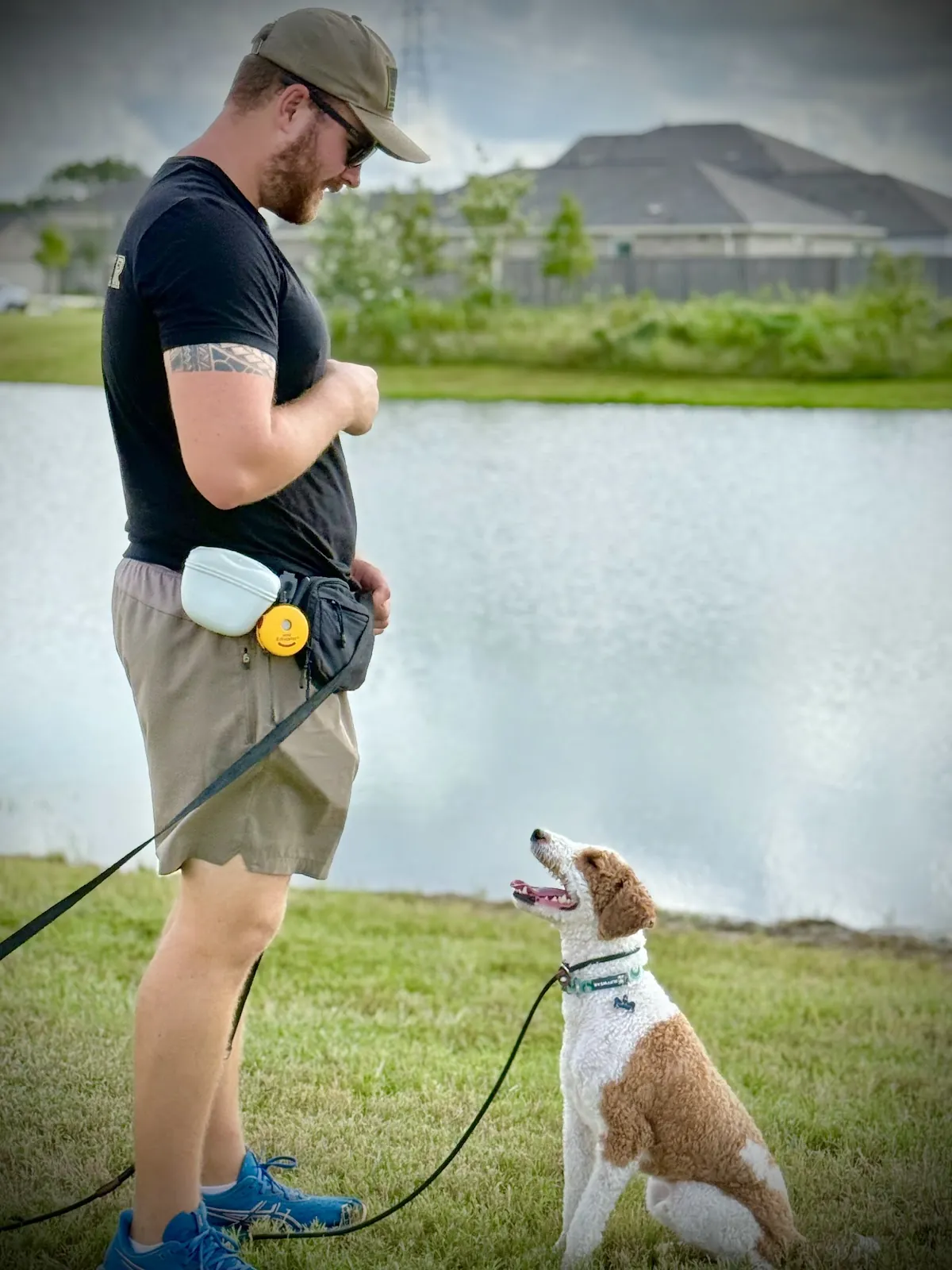
Each session is ten to fifteen minutes. You are teaching one idea: tension does not move the walk, and staying beside you does. Once the dog understands that, the tool does the rest with a light touch, and your arm stops doing the work. Keep a pouch of food on your left hip so the reward always lands at the spot you want the dog to be.
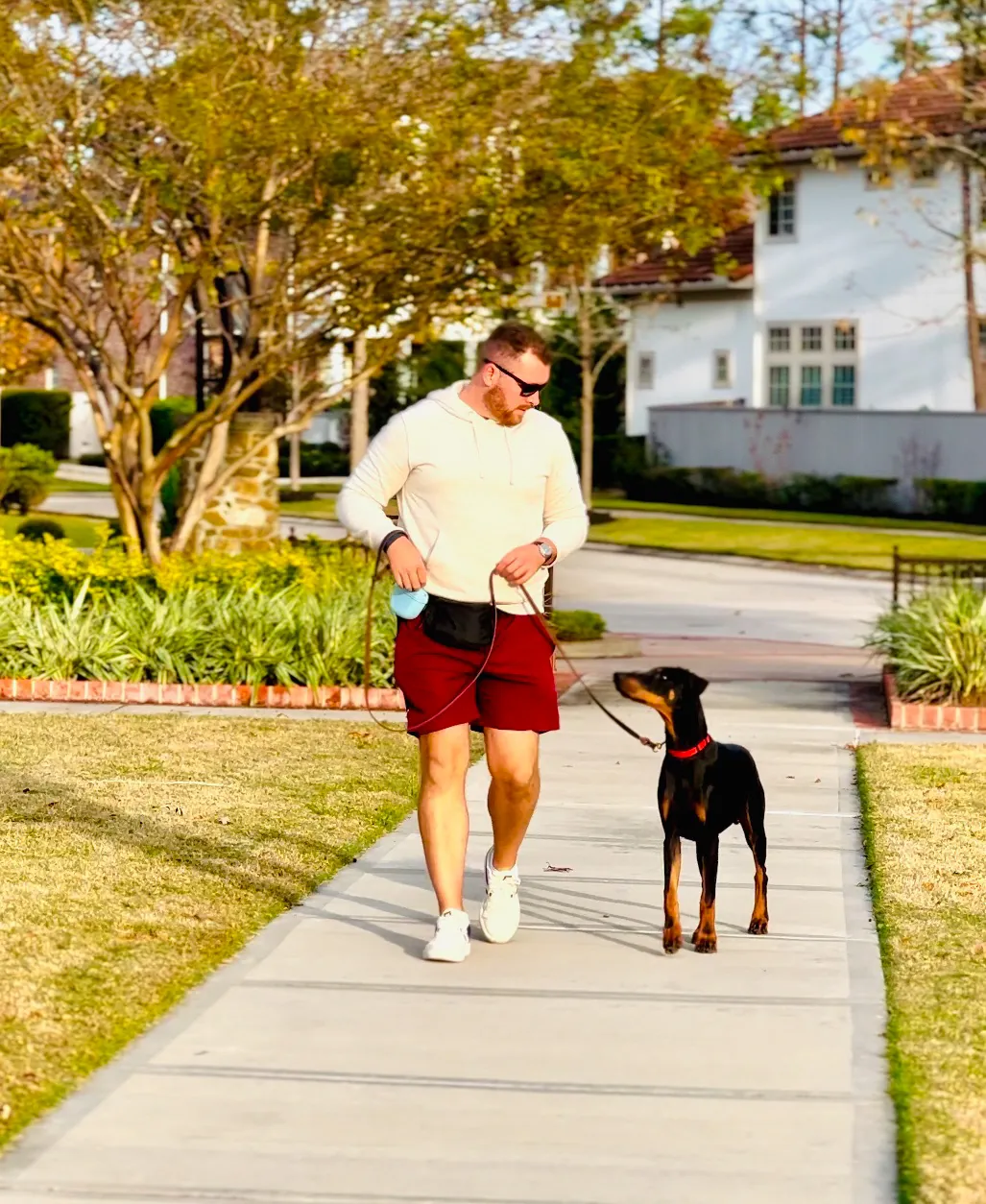
Hold the leash handle in your right hand and the slack in your left, both hands near your belt buckle, elbows bent. Never wrap the leash around your wrist.
Stand with your feet apart and knees soft, so a sudden lunge rocks you rather than pulls you over.
Start walking with the dog at your left knee. The instant the leash tightens, stop, turn right and walk the other way at a brisk pace.
When the dog catches up to your knee, mark with "yes" and pay with food at your leg.
If the dog lunges at something, give a quick pop and release with the leash, turn away, and increase your distance from the trigger.
Days one to three: your street only. Days four to five: a neighboring block. Days six and seven: a quiet park path at an off-peak hour.
Finish every walk with a release word and a minute of sniffing, so the structured part has a clear end.
When it is not working
Three reasons you are still being dragged after a week.
The first is a tool that is fitted wrong. A prong hanging low on the neck or a slip lead that slides down to the chest gives the dog leverage instead of taking it away, and a loose tool can slip off. Have a trainer check the fit. The second is pulling back. Holding steady tension teaches the dog to lean harder; a quick pressure and release, followed by a turn, is what communicates.
The third is too much, too soon: the dog went from your driveway to a busy trail on day two, met a squirrel, and relearned that pulling works. Go back to the quiet street for three good days, then add difficulty in smaller steps: one new block, then one new time of day, then one new kind of distraction.
- A tool sitting too low or too loose
- Steady tension instead of pressure and release
- A busy route before the quiet one is solid
- One person enforcing the rules, others letting it pull
Safety when the dog outweighs you
Some dogs should not be walked by one person until the training is done.
A dog that lunges at other dogs, people or cars with real force is a safety problem, not a manners problem. Until that is trained, walk it only on quiet routes, avoid narrow sidewalks where you cannot turn, and keep children and older family members from holding the leash. A leash tied to a waist belt feels secure but can pull you off your feet; hold the handle in your hand.
If your dog has pulled you over or dragged you across a road, pause solo walks and call a trainer. Families with older owners or a new baby often find a board and train safer than weeks of trying to hold a big dog on their own. The dog comes home already walking on a loose leash, and the handover teaches the family to keep it that way.
When to get help
Platinum builds the heel; VIP adds the e-collar and off-leash reliability.
Platinum Board & Train, three weeks at $3,750, includes a structured heel, impulse control, behavior modification for reactivity and field trips on real sidewalks, then a comprehensive handover and unlimited private lessons so you learn to handle the dog yourself. For owners who want service-dog-level reliability, the six-week VIP program at $10,000 includes a Mini-Educator e-collar, transport home and in-home lessons.
Private lessons at $160 in Cypress or $220 in your home are the right place to have a tool fitted and your technique checked. Many owners find that one well-fitted tool and one corrected habit, usually the wrapped leash or the steady pull back, change the walk within days. Our team can talk you through the choice on the free consultation call.
The programs
Programs for big, strong dogs.
Platinum for a structured heel and reactivity, VIP for off-leash reliability with an e-collar included, lessons for tool fitting and technique.


Asked and answered
Questions people ask about this.
What is the best leash for a dog that pulls hard?
A fixed six-foot leash with a comfortable handle. Retractable leashes keep constant tension and give a strong dog momentum. Pair the leash with the tool that suits your dog, fitted correctly, and hold the handle in your hand rather than on a waist belt.
Is a prong collar safe for a strong dog?
Fitted snugly behind the ears and used with brief, light pressure and release, a prong gives clear communication with less force than a flat collar. Fitted too loose or yanked, any collar can hurt. Have a trainer fit it and show you how to use it.
Should I use a harness on a big dog that pulls?
Many back-clip harnesses make pulling easier, because the dog can lean its whole chest into them. Some owners find a front-clip harness helps a little. For a dog stronger than you, a properly fitted training tool and a clear method usually work better.
How long until my strong dog walks nicely?
Most dogs understand the stop-and-turn rule within a week of short, consistent sessions. Walking nicely on busy trails, around dogs and squirrels, usually takes a few more weeks. A dog that lunges with real force may need a trainer's help before it is safe to walk alone.
Can a small person handle a big dog?
Yes, with the right tool, the right technique and a trained dog. Our trainers regularly walk dogs heavier than a teenager. The trick is timing and structure, not strength. Until the training is in place, choose quiet routes and avoid situations where the dog can build momentum.
Keep reading
Free consultation · 10% off this fall
Walk the dog, not the other way round.
Tell our team how big your dog is and what makes it pull. The free consultation is a direct call, and we will recommend a lesson, Platinum or VIP honestly.