
Slip lead mechanics
How to use a slip lead: placement, pressure and release
The slip lead is the everyday tool in our training home and on field trips, and most dogs go home on one. It is simple, and easy to use badly, so here are the mechanics exactly as our trainers teach them at the go-home session.
Last reviewed September 29, 2026 · by the Best Dog University Team
Before you start
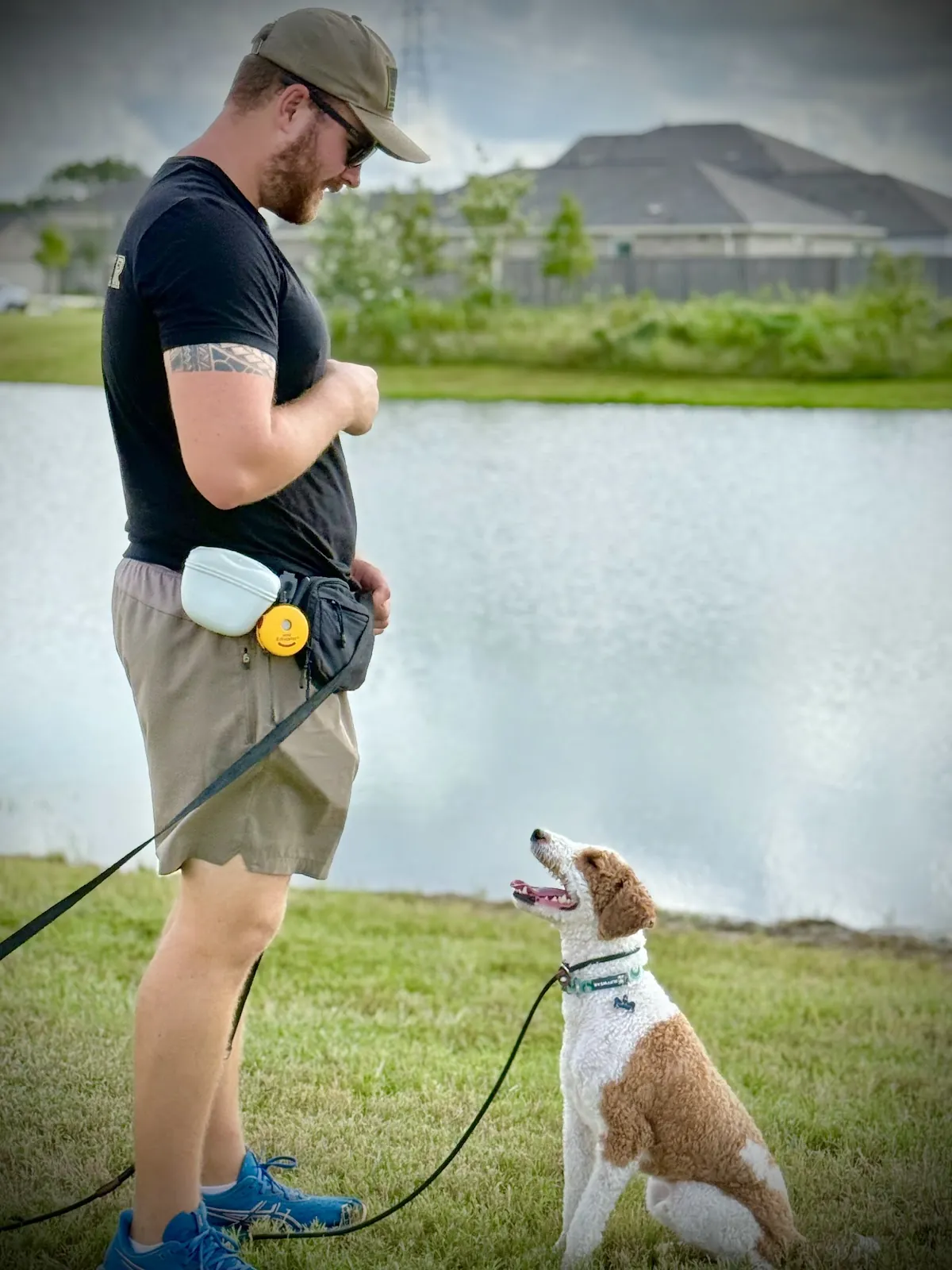
Before you start: the right lead, a stopper, and treats on your hip.
Choose a slip lead of soft rope or flat nylon, about four to six feet long, with a sliding stopper or a leather tab that can be pushed down so the loop cannot open too wide. Thin cord cuts into your hand and slides too fast; a lead that is too long ends up wrapped around your wrist. Carry pea-sized treats in a pouch on your left hip, because the slip lead gives direction and the food tells the dog it chose right.
The Houston caveat: a slip lead sits on bare skin behind the ears, and in July that skin is damp and warm, so keep summer walks short and early and check thick-coated breeds for rubbing. Do the pavement test before you leave, palm on the concrete for seven seconds. And a slip lead is a walking tool, not a tie-out; it comes off when the walk ends and is never used to leave a dog tied to a patio table.
- Soft rope, four to six feet
- A stopper that limits the loop
- Treats in a pouch on your hip
- Never a tie-out, off after the walk
The steps
Six steps: loop, placement, stopper, walk, cue, release.
Practice the first three steps in the kitchen with a calm dog until you can do them in a few seconds without looking. Most slip lead mistakes happen before the walk starts, with the loop twisted or sitting at the base of the neck, and the dog then pulls into a loop that tightens and never lets go. Get the setup right and the walk gets easier for both of you.
Make the loop: with the dog on your left and facing you, hold the loop so it forms the letter P, with the free end running over the top of the dog's neck toward your hand, so it loosens by itself when the leash goes slack
Slide it over the head and move it up, high on the neck just behind the ears and under the jaw, where a light cue is clear
Slide the stopper down until the loop is snug but not tight, so it cannot drop to the shoulders or open wide enough to slip off
Start walking with a J-shaped curve of slack between your hand and the dog; the loop should be doing nothing
When the dog drifts ahead or wide, give a quick, light tighten-and-release in the direction you want it to go, about the weight of a tap on the shoulder
The instant the dog comes back to your side, the loop goes slack again; mark and pay at your knee, then keep walking
Pressure and release
Pressure is a single word, not a conversation: brief, then gone.
A slip lead works because the dog learns that pressure has an off switch, and that the dog controls it by moving with you. That only happens if the pressure is short and the release is instant. A handler who keeps the leash tight the whole walk turns the lead into a steady squeeze the dog leans against. A handler who snaps it hard turns a cue into a punishment. Both teach less than a light tap followed by slack and a treat.
Watch the loop as you walk. If it has slid down the neck, stop, move it back up and reset the stopper. If the dog coughs or gags, the lead is too low or too tight and you are pulling. A dog that pulls into the lead constantly does not understand the walk yet; go back to food at your knee on a quiet street, and talk to a trainer before you add anything stronger.
- Short pressure, instant release
- No steady tension, no snapping
- Slid down: stop and move it up
- Coughing means too low or too tight
Troubleshooting
When it is not working: the loop is backwards, too low, or your arm is locked.
When a slip lead is not helping, it is almost always one of three things. The loop is on backwards, so it stays tight after you release and the dog never feels the relief; take it off and form the P again. The loop has worked down to the base of the neck, where the dog can lean its whole chest into it; move it back up and snug the stopper. Or your arm is locked, and the leash is tight from the front door to the corner.
That last one is the hardest to fix, because tight hands are a habit. Drop your leash hand to your hip, let the leash hang in a J, and count the seconds it stays loose; pay the dog for them. A dog that pulls hard even with a clean setup and good timing may be a candidate for a different tool, and that choice belongs with a trainer who has seen the dog, not with a shop assistant.
- Backwards: form the P again
- Too low: move it up and snug the stopper
- Locked arm: hand to hip, J in the leash
When to get help
When to get help: a dog that pulls through it, or a family that wants the walk taught.
Every stay teaches the walk on a slip lead first. The one-week Silver Foundation Program at $1,500 covers loose leash walking and door boundaries, the two-week Gold at $2,500 adds pulling and impulse control, and the go-home session puts the lead in your hands with a trainer watching. A private lesson at $160 at our Cypress training home or $220 on your own street fixes the loop, the placement and your timing in a single session.
The programs
Programs that teach the walk on a slip lead.
Silver for loose leash walking and door boundaries, Gold for pulling and impulse control, a private lesson to fix the loop and your timing.


Asked and answered
Questions people ask about this.
Is a slip lead cruel?
Not when it is used as designed. Placed high, with a stopper, a slack leash and brief cues that are released instantly, it communicates clearly with very little force. It becomes unfair when it is left tight, jerked, worn low on the neck or used as a tie-out.
Which way does a slip lead go on?
With the dog on your left and facing you, the loop forms the letter P, so the leash runs over the top of the neck toward your hand. That way the loop loosens by itself when you release. If you walk the dog on your right, the loop is reversed.
Where should a slip lead sit on a dog's neck?
High, just behind the ears and under the jaw. That is where a light cue is clear and where the dog cannot lean its chest into the lead. If it slides down toward the shoulders during the walk, stop, move it back up and push the stopper down.
Is a slip lead good for a dog that pulls?
It is where the walk is taught, with food at your knee and brief cues. For a large dog that leans into it constantly, steady pressure on the neck helps nobody, and a trainer may choose a different tool after meeting the dog. Teaching the walk comes first either way.
Can I use a slip lead on a puppy?
Yes, with a very light hand and a soft lead, mostly to guide rather than to cue. A puppy learns the walk from food at your knee. Keep the loop high, the leash loose and the sessions short, and never let a puppy hang against it.
Sources
Keep reading
Free consultation · 10% off this fall
Loop high, leash loose, cue brief.
Tell our team what happens on your walks. The free phone consultation is a direct call, with no cost and no obligation.