
Neutral, not social
How to socialize an adult dog: neutrality, not a dog park
Families often call us about a two-year-old rescue that missed its puppy window, hoping a few playdates will fix it. The honest answer is that adult dogs rarely need more friends. They need practice at ignoring the world politely, and that can be taught at any age.
Last reviewed September 29, 2026 · by the Best Dog University Team
Before you start
Get the walk right at home before you take it to the world.
Neutrality rides on a walk the dog can do without pulling or scanning. If your dog drags you down the street or spins at every noise, spend a week getting a loose leash and a reliable sit on your own block first. Gather a six-foot leash, the collar or training tool your dog walks best on, a pouch of food, a portable place cot or mat, and a plan of three quiet locations to rotate through.
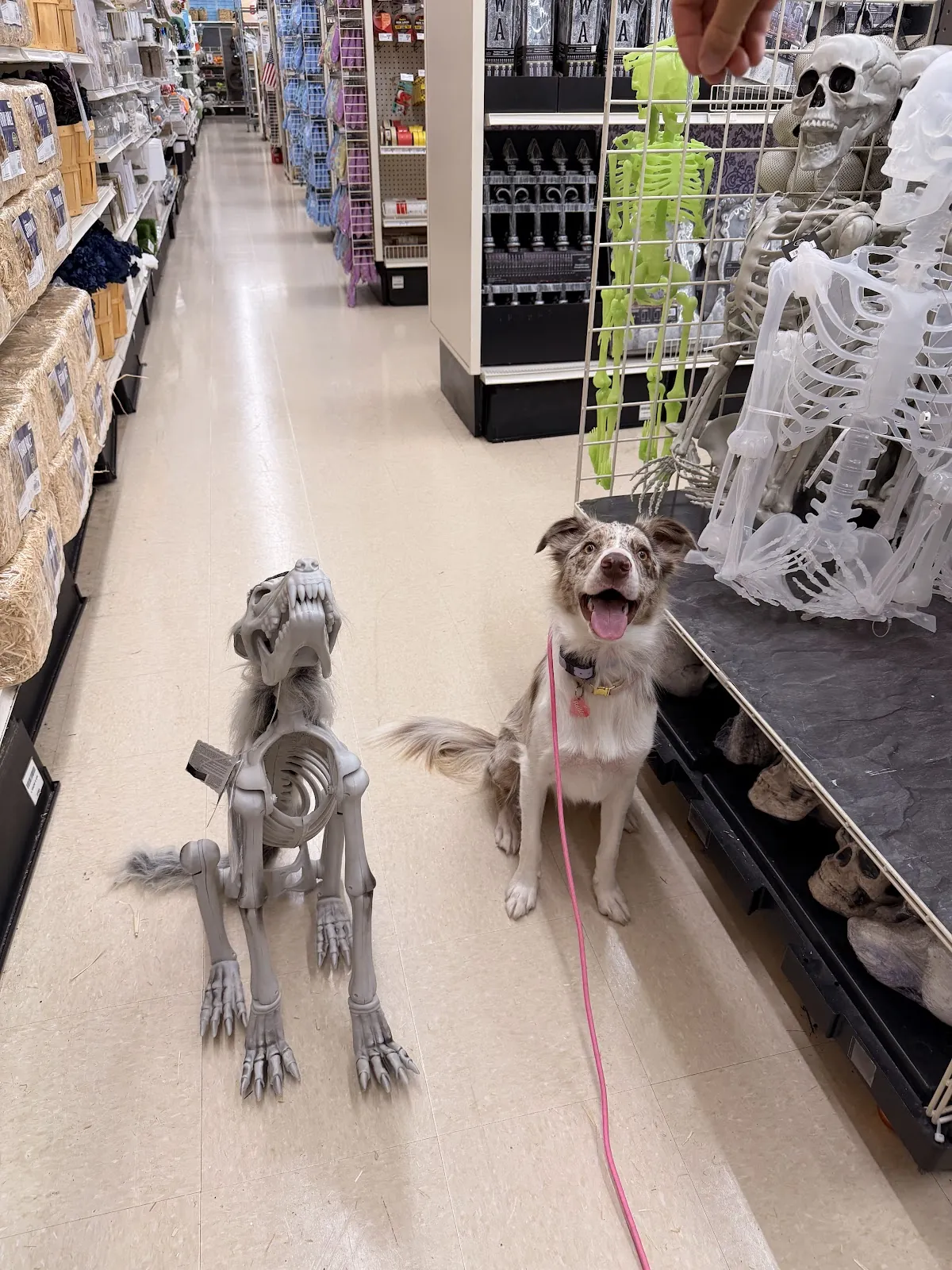
The Houston caveat is timing. From May to September, outdoor sessions go to early morning and evening, with the pavement tested by the back of your hand, and midday practice moves inside to air-conditioned pet and hardware stores. Weekday mornings in the aisles along 290, or at a quiet patio before the lunch crowd, give you real exposure without the weekend crush.
- A loose leash on your own street first
- A reliable sit and a settle on a mat
- Three quiet locations to rotate
- Early morning or indoor sessions in summer
- Food in a pouch for calm moments
The steps
Work distance first, then duration, then crowd.
Each outing should be short and end with the dog still calm. You are building a picture in the dog's head: new places are dull, people and dogs pass by, and the handler is the interesting part. Twenty calm minutes teach more than two hours of overload. Leave while the dog is still doing well, even if the outing feels too short to count.
Sit on a bench or tailgate outside a store at a distance where the dog can see people but stays relaxed. Pay any calm look back at you.
Walk the dog past the entrance in a wide arc, then a little closer on each pass, with a sit for payment each time it ignores a passer-by.
Take the first aisle walk at an off-peak hour. Short loops, a sit at the end of each aisle, and out before the dog tires.
Arrange a parallel walk with one calm, known dog and a second handler, starting across the street and closing the gap over several walks.
Settle the dog on a mat at a quiet patio for ten minutes, then twenty, paying calm and ignoring the passers.
Allow a greeting only when the dog is loose and calm and the other person or dog is steady. Keep it to three seconds and walk on.
Once the dog understands the routine, hold it to the heel or the settle calmly, with a leash correction if it needs one, instead of letting it drag toward every new thing.
When it is not working
Three reasons adult socialization stalls.
The first is too close, too soon. An adult dog that lunges, barks or freezes is over its limit, and practice there teaches the reaction, not calm. Add distance, even if it means starting across a parking lot. The second is greeting as the goal. Every time the dog is allowed to pull toward a person or dog to say hello, it learns that new things are for rushing at.
The third is the dog park. It is loose dogs, no structure, and fights that start faster than owners can intervene. An adult dog with gaps in its history needs controlled, predictable exposure, not a free-for-all, however friendly the regulars seem. Save play for one or two dogs you know well, in a yard, after the calm walk is solid.
- Distance too short for the dog's comfort
- Greetings treated as the reward
- Dog parks used as training
- Sessions that run long and end in overload
Rescues and late starters
An adult that missed its early exposure can still learn calm, at its own pace.
Dogs adopted at two or three often arrive with a thin history: a yard, a kennel, a single home. They are not broken; they simply have fewer references. Expect the first month to be slower, count calm looks as progress, and do not rush the first store trip. Some rescues warm to the routine fast once they understand it, and some stay cautious but manageable.
If the dog lunges, growls or snaps at people or dogs, the work shifts from socialization to behavior modification, and the plan needs a trainer's eye before you keep going. Our trainers see that pattern often in adolescent rescues, and it responds well to structure, a clear walk and a plan that keeps the dog below its limit while the work happens.
When to get help
Platinum includes field trips and public exposure every week of the stay.
Our Platinum Board & Train, three weeks at $3,750, builds the structured heel and impulse control first, then takes the dog on field trips into pet and hardware stores, sidewalks, parks and the lake, and ends with a comprehensive handover and unlimited private lessons so you can repeat the outings together. Gold, two weeks at $2,500, suits an adult that mostly needs manners and a calm walk.
Private lessons at $160 in Cypress or $220 in your home work well for a steady adult that needs a coach at the first few stores. Call for the free consultation and tell us how your dog handles a busy entrance, a passing dog and a stranger who reaches for it. Those three answers tell our team most of what they need to recommend a starting point.
The programs
Programs that teach neutrality in public.
Platinum for field trips and public exposure, Gold for manners and a calm walk, lessons to coach the first outings together.


Asked and answered
Questions people ask about this.
My dog is three. Is socializing it now too late?
No. Adult dogs cannot get back the puppy window, but they can learn neutrality at any age: calm in stores, on sidewalks and on patios. The work is slower and more structured than puppy socialization, and it relies on distance, short outings and a solid walk.
Should my adult dog go to the dog park to get socialized?
No. A dog park is a crowd of loose, unfamiliar dogs with no structure, which is the opposite of what an adult with gaps needs. Parallel walks with one calm dog and quiet store aisles teach far more with far less risk.
Does my dog need to play with other dogs?
Not to be well adjusted. Many adult dogs are happiest with a few known friends or none at all. What every dog needs is the ability to pass other dogs calmly on a walk. Play with a trusted dog is a bonus, not a requirement.
How do I know if my dog is over its limit?
It stops taking food, stares hard, freezes, lunges, whines or pulls toward or away from the trigger. Any of those means you are too close. Calmly add distance until the dog can eat and look at you, and start from there next time.
Does board and train include socialization for adult dogs?
Our Platinum program includes field trips and public exposure throughout the stay, and Gold covers the calm walk and impulse control underneath it. The go-home session and lessons show you how to keep running the same outings at home.
Keep reading
Free consultation · 10% off this fall
A dog that can go places.
Tell our team where your dog struggles in public. The free consultation is a direct call, and we will tell you plainly which program or lesson fits.