
Leash and walks
How to teach calm greetings on leash
Families ask how to let their dog say hello nicely, and our trainers' honest answer is that the nicest hello on a leash is usually none. Here is how to make the few greetings that do happen calm, the rule for people, the rule for dogs, and the reason the pass matters more than the hello.
Last reviewed September 11, 2026 · by the Best Dog University Team
Why it matters
Leash greetings teach pulling, frustration and fights, and the calm pass teaches none of them.
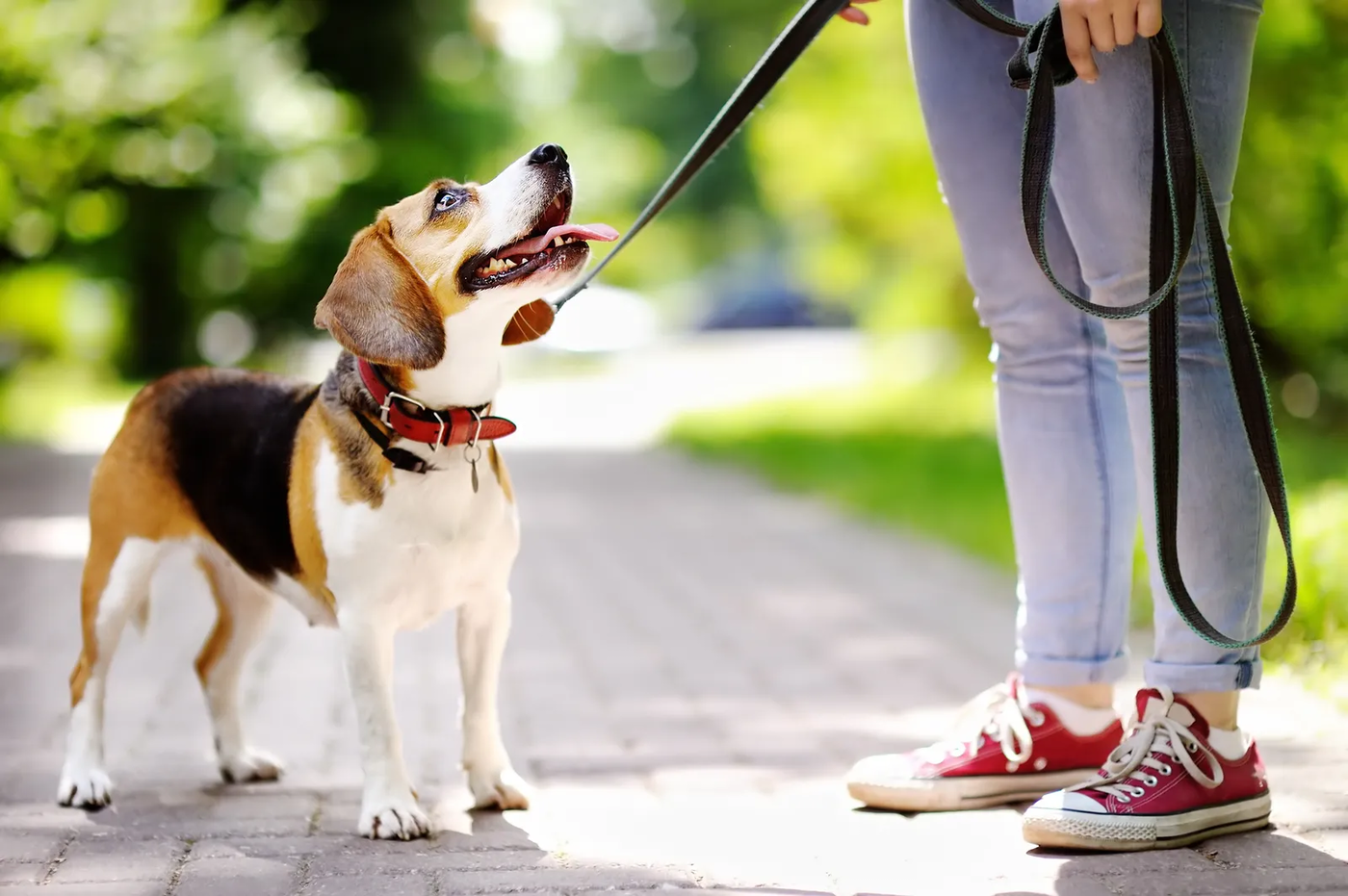
A greeting on a leash is a bad greeting by design: the dogs cannot circle, cannot leave and cannot read each other properly with tension on the line, and the owners are nervous, so the greeting is tense or overexcited and the dogs learn that other dogs mean a scene. Every greeting a dog gets on a walk also teaches it that the next dog is reachable, which is where the pull comes from, and every greeting it is denied after a hundred allowed ones teaches frustration, which is where the lunge comes from. A dog that has learned to pass other dogs calmly and greet on the rare occasion you decide, with a known dog, after a sit, is a dog you can take anywhere. Greetings with people follow the same logic with a lower risk: the sit first, the release, and the end at the first jump.
- Leash greetings are tense or overexcited by design
- Every greeting teaches that the next dog is reachable
- Denied greetings teach frustration
- The calm pass is the skill; the greeting is the exception
The method
Six steps for people, and five more for the rare dog greeting.
The sit and the release word come first, at home and on quiet streets, so the dog has a position to greet from and a word that ends it. Then the rules for people, which happen often, and the rules for dogs, which happen rarely.
The sit before any hello: the person waits until the dog is sitting, you release with a word, and the greeting begins; the dog learns that the sit produces the person
The greeting lasts as long as the dog stays calm: the first jump or mouth ends it, the person steps back, and the sit is asked for again
Tell every stranger the rule before they reach for the dog, and skip the greeting with anyone who will not keep it
For dogs, the parallel walk first: both dogs walking the same direction ten feet apart on loose leashes, for a few minutes, until both are relaxed
The three-second greeting: loose leashes, the dogs allowed to sniff for three seconds, then both called away with a cheerful word and paid for coming
Only with a known calm dog whose owner is running the same rules, never with a stranger's dog on a narrow sidewalk, and never with a dog that is stiff, staring or pulling
The calm pass as the default: dogs on walks are looked at, paid for and passed, and the greeting is the rare exception you decide on
The mistakes
Face to face on a tight leash, the long greeting, the stranger's dog, and the dog that is not a greeter.
The face-to-face greeting on tight leashes is the one that goes wrong: two dogs dragged nose to nose with no way to circle or leave, owners tense, leashes tangled. The parallel walk and the three seconds exist to avoid it. The long greeting, letting the dogs play on leash, ends in a tangle and a fight in a second. The stranger's dog, the one whose owner says he is friendly from across the street, is an unknown quantity and the calm pass is the answer. And some dogs are not greeters: a dog that stiffens, stares or has ever had a fight does not greet on leash, ever, and lives a full life passing calmly instead. A dog that cannot sit before a greeting because it is too excited needs the sit proofed before the greetings start.
Greetings with people have their own failure: the stranger who says the jumping is fine, and the leash that lets you enforce the rule anyway.
- No face to face on tight leashes
- Three seconds, then call away
- No stranger's dogs
- Some dogs never greet on leash, and that is fine
- The sit proofed before any greeting
Proofing around Houston
A stranger who wants to pet your dog every fifty feet, and a dog under every patio table.
Houston is friendly and a dog on the Heights trail or at the Towne Lake boardwalk is asked for a hello every fifty feet, which is a lot of chances to proof the sit-before-the-greeting rule and a lot of chances to break it. Our trainers proof the people greeting in the store aisles along 290, where a stranger every aisle wants to say hello, and the dog sits, is released and is greeted calmly, or is passed. The dog greeting is proofed with known calm dogs at the training home after parallel walks, and the calm pass is proofed on the Bridgeland paths at dawn and then at busy hours. The patio, with a dog under every second table in Rice Village, is where the no-greeting rule earns its keep.
- A hello every fifty feet on the trail
- The store aisles for the people greeting
- Known dogs after parallel walks for the dog greeting
- The patio as the no-greeting exam
When to call
A dog that lunges to greet, a dog that has had a fight, or a puppy whose greetings are setting the habit.
A dog that lunges and screams to reach every dog is a frustration case, on the pulling-toward-dogs and leash aggression pages, and a Platinum stay at $3,750 builds neutrality with field trips past real dogs and unlimited lessons afterwards on your own sidewalk. A dog that has had a fight on a leash greeting does not greet on leash again and is worked for the calm pass, which Platinum covers too. A puppy whose greetings are setting the habit is the easiest case: the puppy bundle at $550 or $750 in-home teaches the sit before the hello and the rule about dogs in the first sessions. A Gold stay at $2,500 builds the sit, the release and the structured walk into the foundation for the ordinary dog.
The programs
Programs that build the calm pass and the rare greeting.
Gold for the sit, the release and the pass, Platinum for the dog that lunges to greet, the puppy bundle before the habit forms.


Asked and answered
Questions people ask about this.
Is it ever fine for my dog to greet a dog on a leash?
Rarely, and only with a known calm dog, after a parallel walk, for three seconds on loose leashes before you both walk on. Leash greetings with strangers' dogs are where pulling, frustration and fights are learned. The skill worth teaching is the calm pass.
How do I stop my dog jumping on people who want to pet it?
The dog sits before any hello and is released with a word; the first jump ends the greeting and the person steps back. Tell every stranger the rule before they reach, and skip the greeting with anyone who will not keep it. A leash lets you enforce it when they do not.
What is the three-second rule for dog greetings?
Loose leashes, the dogs allowed to sniff for three seconds, then both called away with a cheerful word and paid for coming. Three seconds is long enough for a hello and short enough to end before arousal climbs. It follows a parallel walk and happens only with a known calm dog.
My dog is friendly. Why can it not say hello to every dog?
Because a friendly dog that greets every dog on a leash learns that every dog is reachable and pulls toward the next one, and the day it is held back from one it learns frustration, which becomes lunging. Friendly dogs play with known dogs in yards; on the walk they pass calmly.
Keep reading
Free consultation · 10% off this fall
Sit first, three seconds, walk on.
Tell our team how your dog greets people and dogs. The free phone consultation is a direct call.