
Leash handling basics
How to hold a leash correctly: hands, length and the loop
Most walking problems start at the handle. A leash held at arm's length, wound around a wrist or clutched tight at the collar tells the dog exactly the wrong things, and it is how owners end up with sprained fingers on a Towne Lake trail. The fix is mechanical and quick to learn.
Last reviewed September 29, 2026 · by the Best Dog University Team
Before you start
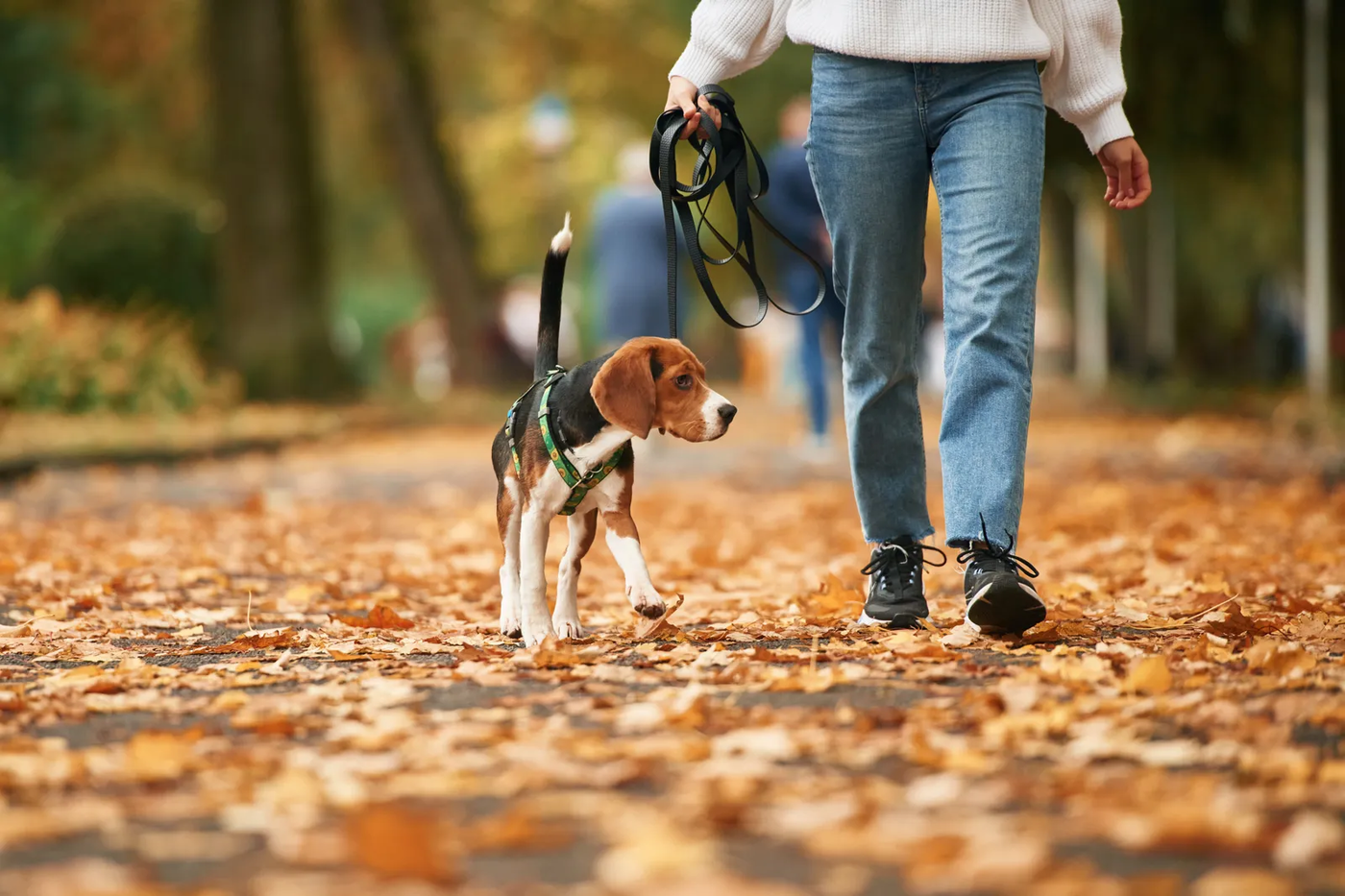
Before you start: a six-foot flat leash, a pouch on the hip and the dog on one side.
Use a flat leash about six feet long, leather or soft nylon, wide enough to grip without it cutting in. A retractable leash is not a training leash: it always pulls a little, which teaches the dog to pull, and its thin cord can burn a hand or a leg. Put a treat pouch on the hip on the dog's side. Pick one side for the dog, usually the left, and keep it there, because a dog that weaves side to side trips you and tangles the leash.
In Houston, plan walks for the cooler hours from May to September and carry water; a dog panting at the end of a tight leash in August pulls harder, not less. Plenty of neighborhood sidewalks run beside fast roads with no shade, and bayou trails fill with bikes and joggers early in the morning, so the moments that need a short leash arrive quickly. Practice the hold in the driveway before you need it at a crossing.
- A six-foot flat leash, not a retractable
- Treat pouch on the dog's side
- One side for the dog, every walk
- Water and cool hours in summer
The steps
Six steps to the grip, the length and the loop.
Stand still in the driveway with the dog beside you and go through the steps slowly, then walk ten yards and check your hands. The goal is a hold you can keep for an hour without thinking, one that gives the dog slack most of the time and lets you shorten the leash in a second when a bike or a loose dog appears around the corner.
Put your thumb through the handle loop and close your fingers over it; the loop sits across your palm, not around your wrist
Rest that anchor hand at your hip or belly button, on the side away from the dog, elbow soft; that is where it lives for the walk
Fold the extra leash into the same hand in flat loops, so the length to the dog leaves a loose J hanging below the collar
Let your other hand hold the leash lightly partway down, palm down, as a guide for turns and brief cues, relaxing again straight away
To shorten for a crossing or a narrow path, fold another loop into the anchor hand; to lengthen for a sniff, let a loop out
Keep your hands still and low; if you catch your arm straight out in front of you, stop, bring the hand back to your hip and start again
Safety
Never around the wrist, never around the fingers.
Winding a leash around your wrist or fingers feels secure and is one of the most common ways owners get hurt. A dog that bolts at a squirrel or a cat can break fingers, drag you off a curb or pull you down on a trail, and a wrapped leash does not let go when you need it to. The thumb-through-the-loop grip holds a strong dog because the pull goes into your hip and your core, not your wrist, and you can still let go if you are falling.
Children should walk a dog only with an adult holding a second leash, or not at all, if the dog is strong enough to pull them over. The same goes for anyone who is unsteady on their feet. A calm, trained dog on a loose leash is a pleasure for a grandparent to walk; a dog that lunges needs its training done before the leash is handed over.
- Thumb through the loop, never a wrap
- The pull goes into your hip
- Let go rather than fall
- Strong dogs are not walked by small children
Troubleshooting
When it is not working: the arm is out, the leash is short, or the dog was never taught.
If the hold is right and the walk is still a struggle, look at three things. Your arm has crept forward, so the leash is tight and the dog is leaning into it; bring the anchor hand back to your hip. The leash is too short, so the dog never gets slack and never learns what loose feels like; let out a loop. Or the dog has never been taught to walk beside you, and holding the leash well cannot replace teaching that.
That last reason is common. Good hands make the teaching possible, but the dog still has to learn that the spot beside your leg pays, with food at your knee, turns and stops. The leash pulling and heel guides on this site cover the teaching itself. If you walk two dogs, the hold is the same with one leash in each hand, and it takes a lot more practice before it feels natural.
- Arm out front: hand back to your hip
- Leash too short: let out a loop
- The walk itself still has to be taught
When to get help
When to get help: a dog strong enough to pull you over, or one that lunges.
A dog that has pulled you off your feet, or that lunges and barks at other dogs, needs more than a better grip. Lunging is a reactivity case, and the three-week Platinum Board & Train at $3,750 covers it with structured walks, field trips and unlimited private lessons. Pulling on its own fits the one-week Silver Foundation Program at $1,500 or the two-week Gold at $2,500, and every go-home session puts the leash in your hands and checks the hold with a trainer beside you.
The programs
Programs that teach the walk.
Silver for loose leash walking, Gold for pulling and impulse control, Platinum when the dog lunges at other dogs or people.



Asked and answered
Questions people ask about this.
Which hand should I hold the leash in?
With the dog on your left, the handle loop usually goes in your right hand as the anchor, and your left hand guides the leash lightly partway down. Some people prefer the reverse, and that is fine as long as the anchor hand stays at your hip and the leash never wraps your wrist.
How long should a leash be for walking?
About six feet for everyday walks, folded shorter in the anchor hand when you need it. A four-foot leash suits busy sidewalks and store aisles. Long lines of fifteen to thirty feet are for recall practice in open space, not for walking beside traffic.
Are retractable leashes bad?
For training and busy walks, yes. The constant light tension teaches the dog that pulling earns more leash, the cord can burn skin, and you cannot shorten it quickly in a crowd. They can be fine for a trained dog in open space, but not while you are teaching the walk.
How do I hold the leash with a strong dog?
Anchor hand at your hip, not out in front, so the pull goes into your body rather than your shoulder. Bend your knees a little when you feel the dog load up, and keep the guide hand ready to cue. If the dog can still move you, get help before someone is hurt.
Should the leash ever be tight?
Only briefly, as a cue, and then slack again. A leash that is tight for the whole walk teaches the dog to lean against it. Most of the walk the leash should hang in a loose J, and your job is to keep it there by paying the dog for staying close.
Sources
Keep reading
Free consultation · 10% off this fall
Good hands first, then the walk.
Tell our team what happens at the end of your leash. The free phone consultation is a direct call with our trainers.