
Leash and walks
How to walk a reactive dog safely
A reactive dog's walk is the hardest twenty minutes of its owner's day, and the version our trainers teach is shorter, more planned and much less eventful than the one most families are doing. Here is the kit, the route, the U-turn and the rule that keeps the walk a training session rather than a rehearsal.
Last reviewed September 11, 2026 · by the Best Dog University Team
Why it matters
Every lunge is a rehearsal, and the walk is where the rehearsals happen.
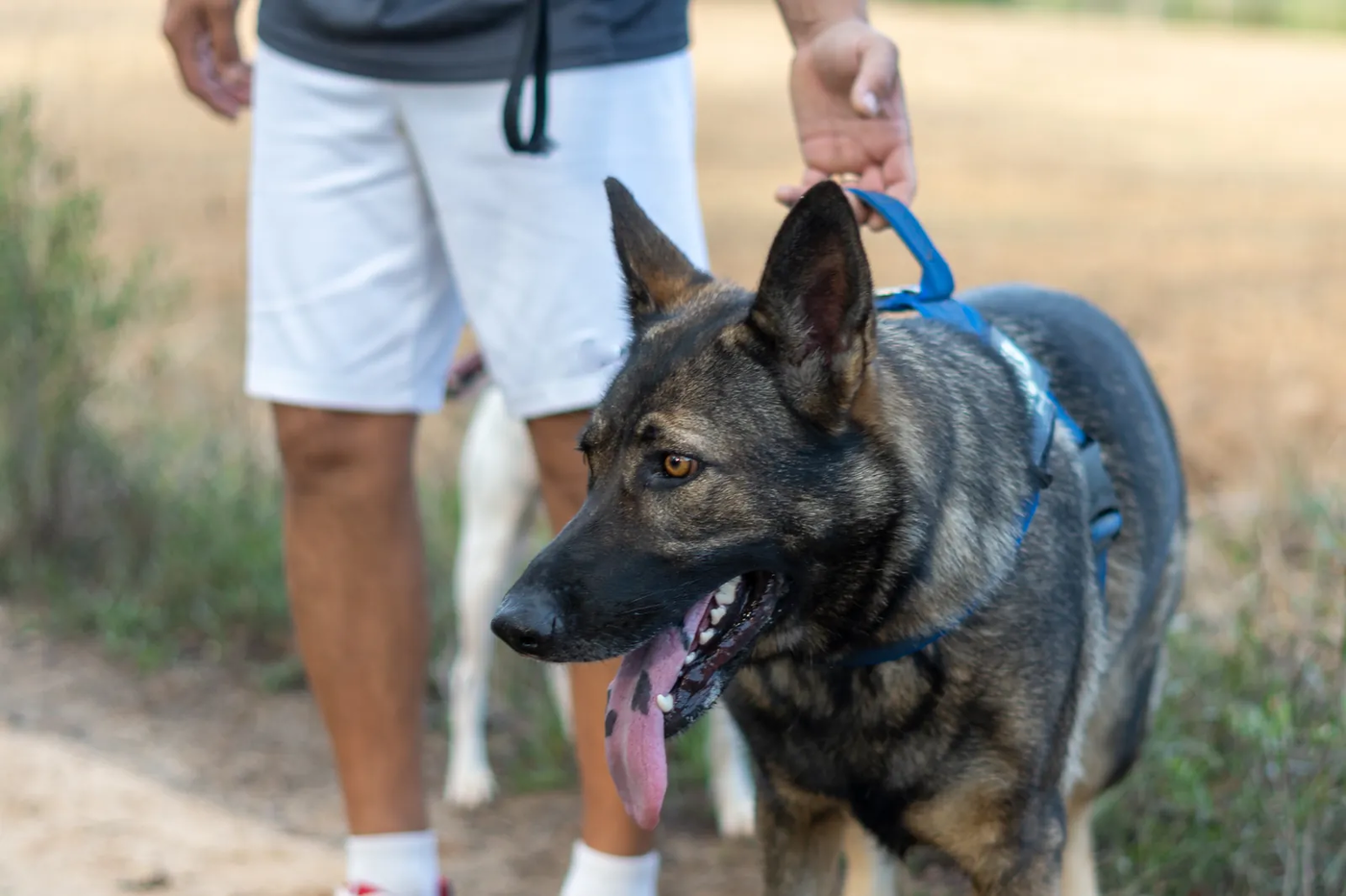
A reactive dog that lunges at three triggers on a morning walk has practiced reactivity three times before breakfast, and the stress hormones from the first lunge are still in its system when it meets the third. The walk, done the way most families do it, is the reason the dog is getting worse. Done as a training session, planned around the dog's threshold, with an exit for every surprise, it is where the dog gets better, because every trigger seen at a distance the dog can handle and paid for calm is a repetition in the right direction. Safety runs underneath all of it: equipment the dog cannot escape, a handler who can hold it, and a plan for the moment a loose dog comes around the corner.
- Every lunge is a rehearsal
- Stress hormones carry from one trigger to the next
- The walk as a session, planned around the threshold
- Equipment, a handler who can hold, and a plan for the surprise
The method
Seven parts of a reactive dog's walk, in the order they matter.
The kit and the route are decided before the leash goes on. The U-turn and the threshold rule are taught at home and on empty streets before they are needed. The walk itself is twenty minutes, at a quiet hour, on a route the handler has scouted.
The kit: a six-foot leash, never retractable; a collar or harness the dog cannot slip, fitted and checked; a second point of contact, a backup clip to a collar, for a strong dog; a basket muzzle the dog loves for any dog with a bite history; a pocket of high-value food
The route and the hour: quiet streets, wide sidewalks with escape routes, dawn or late evening, scouted for the fenced dog and the loose one, with the busy trail off the list until the threshold has closed
The U-turn taught as a game: say the word, turn, and run a few steps with the dog, paid on arrival, practiced fifty times with no trigger so it is reflexive when there is one
The threshold rule: the dog sees a trigger at a distance it can still eat at, is paid for looking at it and back at you, and you leave while it is still calm; a trigger that is too close gets the U-turn, not a test
Emergency exits: behind a parked car, up a driveway, across the street, a handful of food tossed on the ground for the dog to eat while the trigger passes
The loose dog: stop, put yourself between the dogs, a firm voice at the loose dog, a handful of food thrown at its face, and the U-turn; carry a small spray of citronella if the neighborhood has a repeat offender
Home while it is still going well, twenty minutes, and the training that changes the dog done at the threshold on the next walk
The mistakes
The long walk, the busy trail, the tightened leash, the correction mid-lunge, and the flexi.
The long walk for a reactive dog is a long rehearsal; twenty planned minutes beat an hour of triggers. The busy trail, the Memorial Park loop at nine on a Saturday, is the final exam and the dog is not ready for it. The tightened leash as a trigger approaches tells the dog something is about to happen, and the dog agrees; the leash stays loose and the food comes out. The correction mid-lunge teaches the dog that triggers predict pain and makes fear reactivity worse; the correction, if the dog's program uses one, is for a dog that knows the rule and is choosing, and it is never the plan for a dog over threshold. And the retractable leash, on a reactive dog, is a rope burn, a tangle and a dog twenty feet away when the trigger appears.
A reactive dog's walk is also the owner's walk, and an owner who is tense makes the dog tense; the U-turn practiced as a game gives the owner something calm to do.
- Twenty planned minutes, not an hour
- No busy trails until the threshold has closed
- A loose leash and food, not a gathered leash
- No correction mid-lunge
- No retractable leash, ever
Proofing around Houston
Fenced dogs on every block, loose dogs in some, a runner every thirty seconds on the loop, and the heat.
Houston gives a reactive dog a lot of walk to manage: a fenced dog that explodes on every block in the master-planned sections, a loose dog in the older neighborhoods and along the bayous, a runner or a bike every thirty seconds on the Memorial Park loop and the Heights trail, and a summer that shortens every dog's fuse from May through September. The route is scouted for the fenced dogs and walked at dawn, the loop and the trails are the last places a reactive dog goes, and the summer walks are short and early with water. Our trainers build the U-turn and the threshold work on quiet Cypress streets, proof them in the store aisles along 290 and on the Bridgeland paths at dawn, and hand them over on the family's own route at the go-home session.
- The route scouted for fenced dogs
- The loop and the trails last
- Dawn walks, short, with water, in summer
- The handover on the family's own route
When to call
A dog you cannot hold, a bite history, a threshold you cannot find, or no change after a month.
A reactive dog the handler cannot physically hold is a safety problem first, and a stay is the faster route. A dog with a bite history needs a muzzle plan and an consultation before the threshold work is run, and a trainer running it. A dog whose threshold the family cannot find, that reacts at any distance, needs a trainer to read it. And a month of correct threshold work with no change usually means the walk is still rehearsing somewhere. Reactivity is one of our specialties and Platinum, three weeks at $3,750, is the program: structure in the training home, exposure at the threshold on field trips that grow harder each day, and unlimited lessons afterwards on your own route with you holding the leash. The reactive dog training page describes it.
The programs
Programs for a reactive dog.
Platinum for the threshold work and the lessons on your own route, in-home lessons for the kit and the U-turn, VIP for the dog that must be reliable off leash around triggers.


Asked and answered
Questions people ask about this.
What is the best leash for a reactive dog?
A six-foot leash, never retractable, on a collar or harness the dog cannot slip, with a backup clip as a second point of contact for a strong dog. The equipment holds the dog; the threshold work and the U-turn change it. Tools beyond that are chosen for the individual dog by a trainer.
What do I do if a loose dog runs at my reactive dog?
Stop, put yourself between the dogs, use a firm voice at the loose dog, throw a handful of food at its face to break its approach, and U-turn away with your dog. Scout your route for the repeat offenders and walk elsewhere. A small citronella spray is a reasonable thing to carry in a neighborhood with a known loose dog.
How long should I walk a reactive dog?
Twenty planned minutes at a quiet hour on a scouted route, and home while it is still going well. A long walk for a reactive dog is a long rehearsal. The training that changes the dog happens at the threshold, in short sessions, not in the miles.
Should I correct my dog when it lunges?
Not mid-lunge, and not on a dog that is over threshold and afraid; that teaches the dog that triggers predict pain. The U-turn removes the dog from a trigger it cannot handle, and the threshold work at a distance it can handle is where the change happens. Corrections, where a program uses them, are for a dog that knows the rule and is choosing.
Keep reading
Free consultation · 10% off this fall
Plan the walk, keep the threshold, U-turn early.
Tell our team what your dog reacts to and how close. The free phone consultation is a direct call.