
Crates for grown dogs
How to crate train an adult dog: rescues and dogs that were never crated
Adult dogs and rescues arrive with a history the puppy method cannot account for: a shelter kennel, a crate used as punishment, or no crate ever. The method is slower at the start and faster at the end, because an adult's bladder and attention span are already grown.
Last reviewed September 29, 2026 · by the Best Dog University Team
Before you start
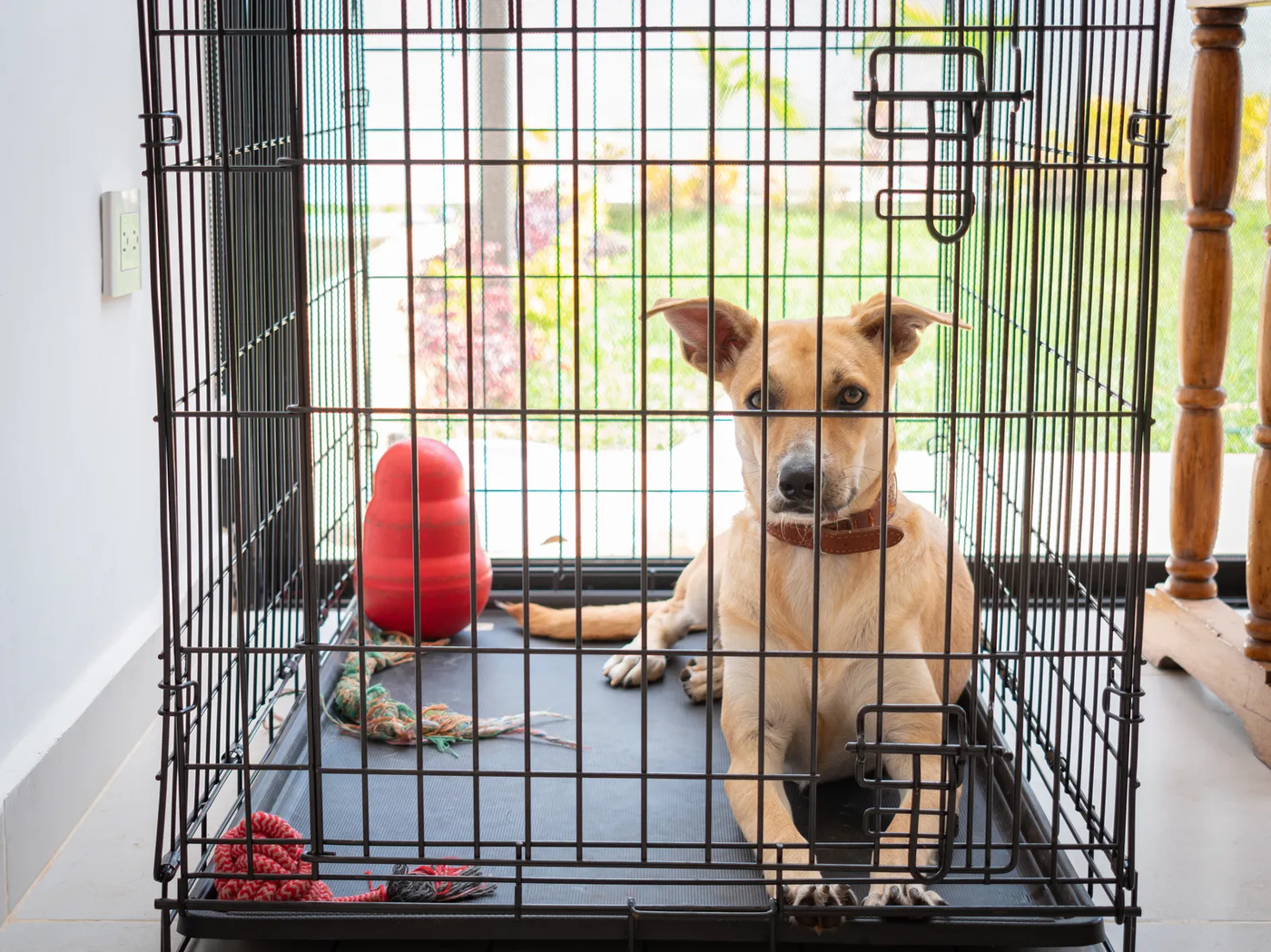
Before you start: the right size, the right room and a read on the dog's past.
Size the crate so the dog can stand without ducking, turn around and lie flat on its side; for a large adult that often means one of the biggest wire crates sold. A wire crate with a cover suits most dogs, and a plastic airline-style crate suits dogs that like a den and doubles as the travel crate. Put it in a room where the family spends time, not the garage or the laundry room, and never in a space without air conditioning in a Houston summer.
Then think about where this dog came from. A rescue that spent months in a shelter run may walk straight in, or may treat a closed door as a trap. A dog that was crated as punishment needs the crate rebuilt from scratch. A dog with no crate history at all is the easiest case. Knowing which one you have tells you how slowly to go, and a dog that has broken out of crates before tells you to stop and call a trainer.
- Room to stand, turn and lie flat on its side
- A lived-in room with air conditioning
- A cover for dogs that like a den
- Know the history before the door closes
The steps
Eight steps over one to three weeks, from an open door to a quiet afternoon.
Go at the dog's pace, not the calendar's. Each step moves on when the dog is relaxed at the current one: it walks in on its own, lies down, and does not stare at the door. Most adult dogs with no bad history move through all eight in about a week; rescues and dogs with a bad crate past can take three weeks or more, and that is fine.
Prop the door open, put a soft bed inside, and toss treats in several times a day without a word; let the dog wander in and out freely
Feed every meal at the back of the crate with the door open, so the dog has to walk all the way in to eat
Add a word as the dog steps in, 'crate' or 'kennel', and pay it once it is inside
Close the door while the dog eats and open it the moment the bowl is empty; build to a minute after the meal
Give a frozen stuffed chew inside with the door closed while you sit nearby, and open up while the dog is still calm
Leave the room for one minute, then five, then twenty, coming back before the dog protests
Leave the house for short errands, fifteen minutes and then an hour, with the chew and a trip outside first
Use the crate at night beside your bed, and keep a few ordinary daytime sessions going for life so the crate never only means you are leaving
Troubleshooting
When it is not working: too fast, a door opened for noise, or a crate that only means goodbye.
Three mistakes undo adult crate training. The first is speed: a dog closed in for two hours on day two learns that the crate is a trap, and the next attempt is harder. The second is opening the door because the dog is barking or whining, which teaches it that noise is the key; wait for a few seconds of quiet, then open. The third is using the crate only when you leave, so the sight of it predicts being alone.
Protest is not panic, and it helps to know the difference. A protesting dog barks or whines for a few minutes and then settles. A panicking dog drools, pants, bends the bars, chews the tray, breaks teeth or wets itself, and it does not settle. Stop crating a panicking dog while you are out and use a dog-proofed room instead, because forcing it through the panic makes it worse and can injure it.
- Too long, too soon
- Open the door only on quiet
- Crate time while you are home too
- Drool, bent bars or broken teeth mean panic
The Houston reason
Why a Houston dog needs a crate it trusts: storms, evacuations and the vet.
In hurricane season, June 1 to November 30, a family may evacuate on short notice, and hotels, shelters and relatives' houses all go more smoothly with a dog that rides and sleeps in a crate. Ready.gov's pet guidance puts a crate in the emergency kit for that reason. The same dog recovers from surgery in a crate, handles an overnight vet stay, and rests through the July 4 fireworks under a cover. Teach it now, in a calm week, not the day the storm gets a name.
When to get help
When to get help: a dog that panics, breaks out or has already hurt itself.
A dog that panics in the crate, breaks out or injures itself trying needs a trainer, because the panic is usually part of a larger anxiety, often separation anxiety. The two-week Gold Board & Train at $2,500 builds calm crate time for dogs that simply never learned it, and the three-week Platinum program at $3,750 fits when the crate is one piece of a dog that cannot be left alone. An in-home lesson at $220 lets our trainer see the crate, the room and the routine and set up the first week with you.
The programs
Programs for crate training an adult dog.
Gold for a dog that never learned the crate, Platinum when the crate is part of separation anxiety, an in-home lesson to set up the first week.


Asked and answered
Questions people ask about this.
Can you crate train an older dog?
Yes. Adult and senior dogs learn to like a crate, and many settle faster than puppies because they can already hold their bladder and they sleep a lot. Go at the dog's pace, keep the crate in a lived-in room, and give a senior a thick bed that is kind to its joints.
How long can an adult dog stay in a crate?
A healthy adult that is fully crate trained can rest in a crate for a few hours during the day and overnight while it sleeps. A full workday is too long without a midday break. Every dog needs exercise, training and time out of the crate every day, whatever the schedule looks like.
Should I cover my dog's crate?
Many dogs settle better with a cover over three sides, because it blocks the view of the room and makes the crate feel like a den. Leave the front open at first and keep air moving; in a Houston summer make sure the cover does not trap heat. Take it off if the dog chews it.
My rescue dog will not go near the crate. What now?
Take the door off or tie it open and use the crate as a feeding station only, meals at the front edge and then moving back over several days. Some rescues accept a plastic crate more easily than a wire one, or the reverse. If the dog still avoids it after two weeks, ask a trainer to look.
Is crating an adult dog cruel?
Not when the dog is taught to like it and the crate is used sensibly. A crate the dog chooses is a safe, quiet room of its own. It becomes unfair when it is used as punishment, for most of the day, or for a dog in panic, and none of that is crate training.
Keep reading
Free consultation · 10% off this fall
Build the crate before you need it.
Tell our team about your dog's history with crates. The free phone consultation is a direct call with our trainers.