
Saturday on the sidelines
The dog at the kids' games: fields, bleachers and a place to lie down
Saturday mornings in Cypress, Katy and The Woodlands are soccer, baseball and flag football, three games back to back and a dog in the car because nobody was home to watch it. A sideline dog is a real skill. Here is how to build it and when not to bother.
Last reviewed September 29, 2026 · by the Best Dog University Team
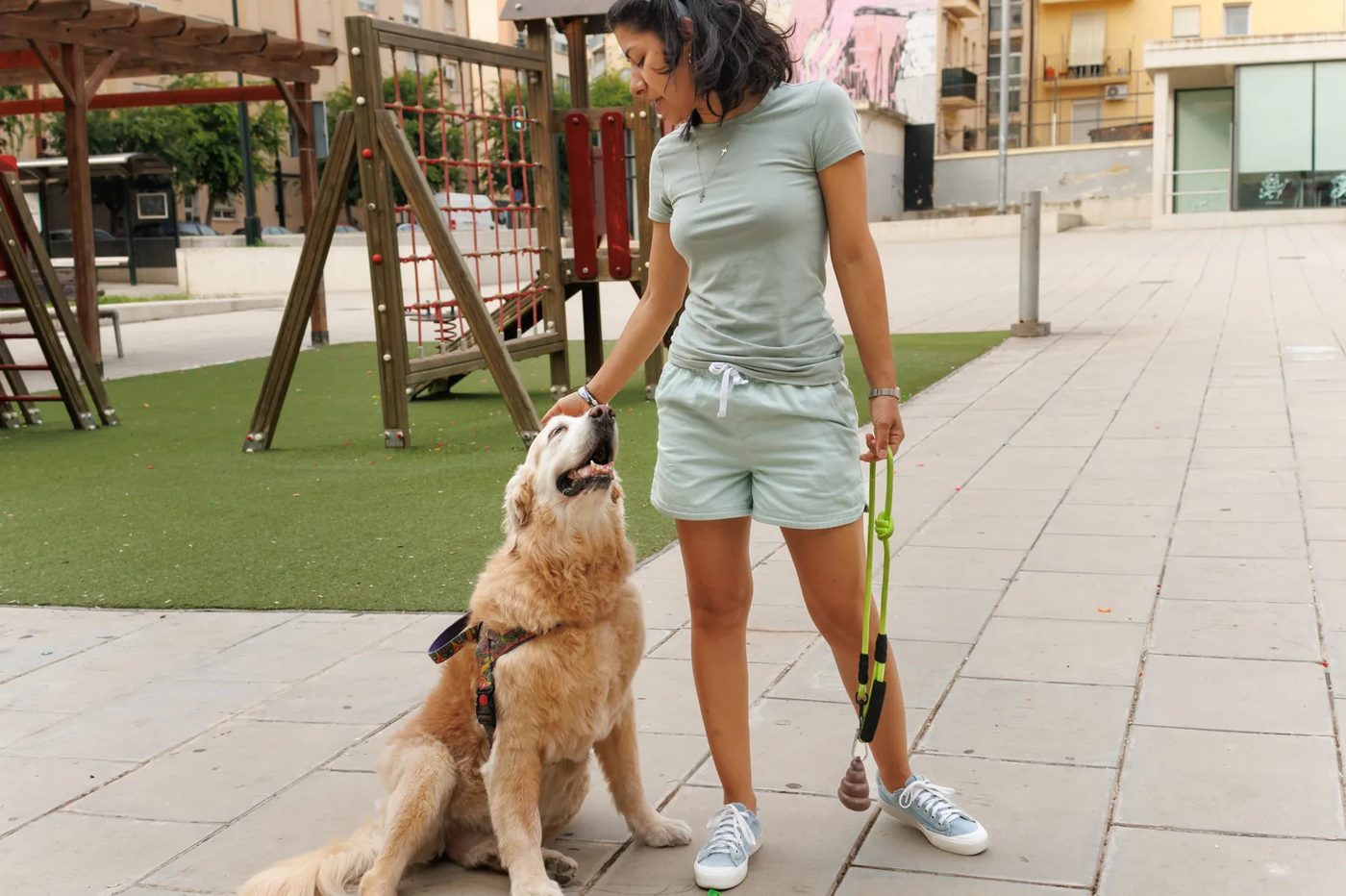
What changes
A field is a hundred kids, a ball that never stops and nowhere for the dog to be right.
A youth sports complex is the hardest place most family dogs will ever be asked to relax. Balls roll past, kids sprint and scream, whistles blow, a toddler wanders over with a juice box, and the whole thing lasts hours. Herding breeds want to chase the ball or the kids; retrievers want the ball; guarding breeds want the toddler kept back. And you are watching the game, not the dog, so the leash goes slack at the wrong moment.
The dog also has nowhere to go: a patch of grass beside a folding chair, with feet passing on both sides. Without a place command that means lie here and stay here, the dog paces, whines, wraps the leash around chair legs and ends up in someone's lap. The dogs that do well have one job, the mat, and a handler who is not the parent coaching.
- Lunging at the ball or the runners
- Pacing and whining beside the chair
- Greeting every child that walks over
Six weeks
Place at home, place in the yard with a ball, place at an empty field, then one quarter of a real game.
Weeks one and two are place at home: a mat that travels, a down on it that holds for thirty minutes while you sit nearby and ignore the dog. Weeks three and four take the mat to the backyard and add the game: a ball bounced past, a child running the fence line, a whistle. Reward the dog for staying; put it back calmly when it leaves. If it cannot hold the mat with your own kids running, it cannot hold it with forty strangers' kids.
Weeks five and six go to a real park, first on a weekday evening when the fields are empty, then a practice, then one quarter of a game with the leash tethered to your chair or your belt, never held loosely. Sit at the far end of the sideline, mat on the shady side, water bowl down, and leave before the dog gets restless. A good first game is fifteen minutes and a calm walk to the car.
Weeks 1 to 2: a travel mat at home; thirty minutes of down with you ignoring the dog
Weeks 3 to 4: the mat in the yard with balls, running kids and a whistle
Week 5: an empty field on a weekday evening, then a practice
Week 6: one quarter of a game, tethered, at the far end of the sideline
Season: a half, then a game, always leaving before the dog is done
Always: leash tethered to you, mat in shade, water down, no greetings on the mat
Houston fields
Rules, heat and fire ants: the sideline realities from Cypress to Katy.
Check before you load the dog. Many leagues and field complexes around Houston do not allow dogs; the county precincts and the cities publish their rules, so Harris County Precinct 4 and Houston Parks and Recreation are the sites to check for their fields, and a private complex has its own sign at the gate. Where dogs are allowed, a leash is required, and a dog on a mat at the end of the sideline is more welcome than a dog in the goal mouth.
Heat is the deciding factor from May to September. A game at eleven on a Saturday in July is hot enough that the AVMA's heat guidance says a dog should not be lying on the ground beside it, mat or no mat. Bring the dog only to games that start before nine, or leave it in the air conditioning. Fire ant mounds along sidelines are common, so check the ground before the mat goes down, and keep the dog out of the drainage ditches after rain.
- League and field rules checked before you go
- Leash always, mat at the far end of the sideline
- Summer games before nine or the dog stays home
- Fire ant check before the mat goes down
When to get help
A dog that cannot hold a mat in your own yard, or lunges at a running child, is a program before it is a sideline dog.
If the dog is holding the mat through week four with your own kids running, keep going; the field is a bigger version of the yard. If it still breaks every time a ball moves, has nipped at a running child, or growls when a stranger's kid reaches for it, the sideline is not the place to keep testing. A nip at a soccer game is a child bitten in public, and the consequences for the dog are serious.
The two-week Gold Board & Train, $2,500, builds the place-stay, the loose leash and the impulse control a sideline dog needs, with a go-home session and an extra lesson for the family. For a dog that chases or nips children, the three-week Platinum at $3,750 adds behavior modification and field trips to real busy places before the unlimited lessons at home. Some dogs are honestly better left home with a chew, and our team will say so on the free call.
- Holds the mat in the yard: keep building
- Breaks for every ball: Gold
- Nips or growls at kids: Platinum, and home until then
- Not sure: one practice, tethered, and an honest read
The programs
Programs for a sideline dog.
Gold for the place-stay and the leash, Platinum for a dog that chases or nips at running kids.


Asked and answered
Questions people ask about this.
Are dogs allowed at youth sports fields in Houston?
It depends on the field and the league. Some city and county parks allow leashed dogs on the grounds but not on the fields; many private complexes and school fields do not allow them at all. Check the operator's website or the sign at the gate, and ask the league, before you bring the dog. A league rule overrides a friendly referee.
How do I keep my dog calm when the ball comes near?
Distance and a job. Sit at the far end of the sideline, tether the leash to your chair or belt so the dog cannot reach the ball, and reward the dog for staying on its mat when the ball passes. Practice the same thing in the yard with your own ball first. A dog that has never held a mat with a ball moving will not start at the field.
What should I bring for the dog to a game?
A mat the dog knows, a water bowl and a bottle, a leash that clips to your chair, a chew that lasts, poop bags, and something for shade if the sideline has none. Leave the toys at home; a toy on the sideline invites every child on the field.
My dog is great at home but whines the whole game. Why?
Because the field is much harder than home and the dog has not been built up to it. Go back a step: an empty field, then a practice, then fifteen minutes of a game, leaving before the whining starts. Whining is the dog telling you it is over its threshold; the answer is a shorter session, not a longer one.
Can the dog watch my kid's game from the car?
No, not in Houston. A parked car heats up fast even with the windows cracked and even in spring, and the AVMA is clear that it is not safe. If the dog cannot be on the sideline, it stays home in the air conditioning with a chew.
Keep reading
Free consultation · 10% off this fall
Tell our team about Saturday mornings.
A free phone call with our team and no strings: the breed, what the dog does when a ball moves, and whether a Gold stay or a Platinum one will make it a sideline dog.