
Puppies and lessons
Why does my dog cry in the crate?
The first week with a puppy is a week of crying, and our trainers get the call on night three. The plan below is the one that ends it by night seven without teaching the puppy that crying works, and the version for an adult that has learned to hate the crate.
Last reviewed September 11, 2026 · by the Best Dog University Team
The short version
Four reasons, and the age and the sound tell you which.
A puppy in its first week cries because it has never been alone and the crate is strange, and the crying is loud, rhythmic and stops when the puppy falls asleep. A puppy that cries at 3am after sleeping quietly has a full bladder, and the crying is different, sharper, and stops the moment it is out. An adult that cries in a crate has a history with it: introduced in a day, used as a punishment, or where a storm happened. And a dog of any age that has learned crying produces a person cries with purpose, pauses to listen, and starts again. The plan for each is different, and the mistake in all of them is the same: opening the door while the dog is crying.
- A first-week puppy: loud, rhythmic, stops with sleep
- A 3am puppy: sharper, and stops when it is out
- An adult with a history: the crate means something bad
- A learned cry: pauses to listen, starts again
- Never open the door mid-cry
The reasoning
What the crying teaches, in both directions.
A puppy that cries and is let out learns, in one repetition, that crying opens doors, and a puppy that has learned that cries for an hour on night four because it worked on night three. A puppy that cries and gets nothing learns, over a few nights, that the crate is boring and safe, and it stops. The exception is the real need, and the way to handle it without teaching the cry is to wait for a pause, however short, then take the puppy out on a leash, let it relieve itself with no play and no talk, and put it straight back. The puppy learns that a pause gets a trip out and a trip out is not a party.
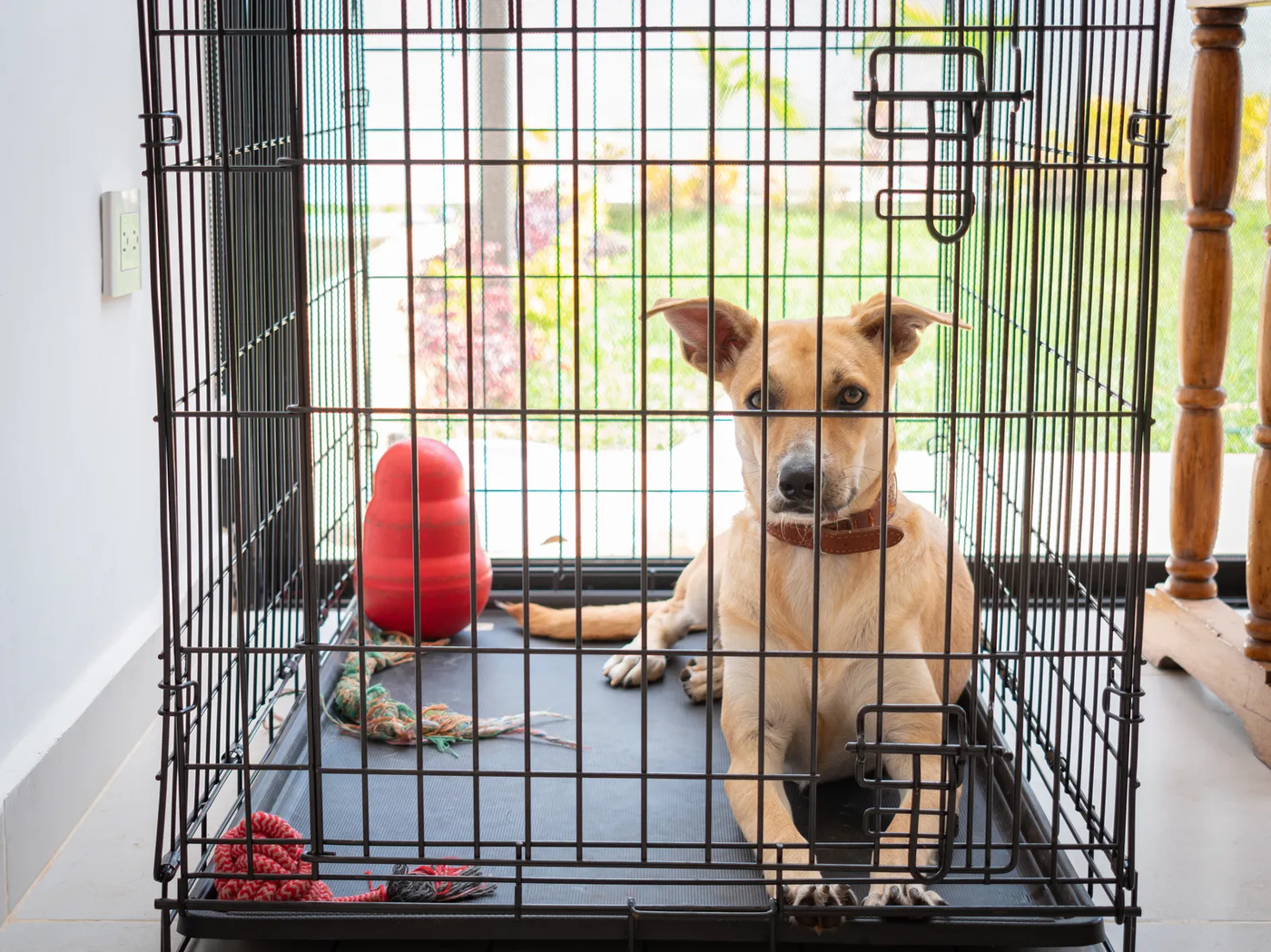
The crate's placement decides how hard the week is. A puppy in a crate in the bedroom, where it can hear and smell its people, cries less and settles faster than one two rooms away, and the family hears the difference between a habit cry and a real need.
- Let out mid-cry, and the cry is learned in one night
- Ignored, and the crate becomes boring and safe
- Wait for a pause, then out on a leash, no play, straight back
- The bedroom for the first weeks
What it means for your dog
The eight-week puppy, the adult with a history, and the dog that panics.
The eight-week puppy has a plan of about a week: the crate in the bedroom, meals eaten inside it, a trip out on a pause for a real need, nothing for the rest, and a covered crate with a chew and a worn shirt in it. An adult with a history needs the crate rebuilt from scratch, ideally a new one in a new room, with meals inside it and naps by choice before the door ever closes, and the crying does not get the chance to start. A dog that panics in the crate, salivating, breaking teeth on the bars, hurting itself, is not crying; it is in a separation or noise panic, and it needs that plan, a room instead of a crate in the meantime, and a veterinary conversation.
- The puppy: about a week, in the bedroom, nothing for the cry
- The adult: a new crate, rebuilt from scratch
- Panic: the separation plan, a room for now, the vet
The Houston factor
A hot crate, a storm on night two, and a puppy that arrived in June.
Most Houston puppies arrive in late spring and summer, so the crate has to be in the air conditioning, never a garage or a laundry room off the house, with water clipped to the door, and a puppy that is hot cries differently and longer. A spring storm on the first week is bad luck and worth planning for: the crate in an interior room with white noise, so the thunder does not become the crate's first memory. Our trainers put every puppy in a covered crate in the house from the first night of a stay and hand the family the routine at the go-home session, including where the crate lives and what the pause sounds like.
The crate in the bedroom, covered, in the air conditioning, with a chew and a worn shirt
Meals eaten inside it from day one
A trip out on a pause for a real need, on a leash, no play, straight back
Nothing for the crying: no voice, no light, no hand on the crate
A last trip out at bedtime and an alarm for the 3am trip for the first week
A new crate in a new room for an adult with a history, rebuilt slowly
The separation plan and the vet for a dog that panics
The program
The puppy bundle sets the crate up, and every stay rebuilds it for an adult.
The Puppy Development Bundle, four sessions at $550 in Cypress or $750 in your home, covers the crate and the night routine in the first session, which is the one most families need on day three. An adult that cries in a crate has it rebuilt as part of a Gold stay at $2,500, where every dog sleeps in a crate in the house, and a dog that panics is a Platinum case at $3,750 with the separation plan and lessons afterwards. The crate training page describes the method in full, and the free phone consultation is where our team asks what the crying sounds like.
The programs
Programs that end the crying.
The puppy bundle for the first week, Gold to rebuild the crate for an adult, Platinum for the dog that panics.


Asked and answered
Questions people ask about this.
How long will my puppy cry in the crate?
About a week, and less each night, if the crate is in the bedroom, real needs get a trip out on a pause, and the crying itself gets nothing. A puppy let out mid-cry on night three cries for an hour on night four. The routine decides it.
Should I ignore my puppy crying at night?
Ignore the habit cry, yes. A puppy that has slept quietly and starts crying sharply at 3am has a full bladder, and that gets a trip out on a pause, on a leash, no play, straight back. Learn the difference in the first two nights and the rest is easy.
Is it cruel to crate a puppy that cries?
No, if the crate is a good place, in the bedroom, in the air conditioning, with meals inside it and a real need answered. The crying is a puppy learning to be alone, and a puppy that never learns it becomes an adult with separation anxiety. A week of crying now prevents years of it.
My adult dog screams in the crate. Same plan?
No. An adult with a history needs the crate rebuilt from scratch in a new room with meals and naps inside before the door ever closes, so the screaming never starts. A dog that panics, salivates or hurts itself needs the separation plan and a veterinary conversation, and a room instead of a crate in the meantime.
Keep reading
Free consultation · 10% off this fall
Ignore the habit, answer the need.
Tell our team what the crying sounds like and when it happens. The free phone consultation is a direct call.