
Board and train · The daily plan
What does a board and train daily schedule look like?
The shape of the day is the method. Below is the day block by block, why each block is there, and how the day shifts across the weeks of a stay and across a Texas year.
Last reviewed September 29, 2026 · by the Best Dog University Team
The short version
Several short blocks beat one long session, because dogs learn in repetitions and keep them during rest.
A dog's attention for new work is short, and the learning sets while it rests. So a stay is not eight hours of drilling. It is a handful of focused blocks of a few minutes each, spread across the day, with the rest of the time spent living in a house where every door, meal and doorbell is also practice. The table below shows the pattern our trainers run, and every dog's version is shaped around its age, energy and goals.
Rest is scheduled as seriously as training. A dog that is worked all day becomes frantic and learns less; a dog that trains, rests in a crate or on a place bed, and trains again comes back to each block fresher. Puppies and seniors get more rest; young working breeds get more walking and more blocks.
| Part of the day | What your dog does | Why it is there |
|---|---|---|
| Early morning | Out of the crate calmly, a structured walk, breakfast earned with a sit and a release | Starts the day with rules and burns energy before the heat |
| Mid-morning | An obedience block on the week's skill, then place with duration | Fresh focus for new work, then calm to set it |
| Midday | Rest in a crate or on place in the air conditioning | Recovery, and calm practiced as a skill |
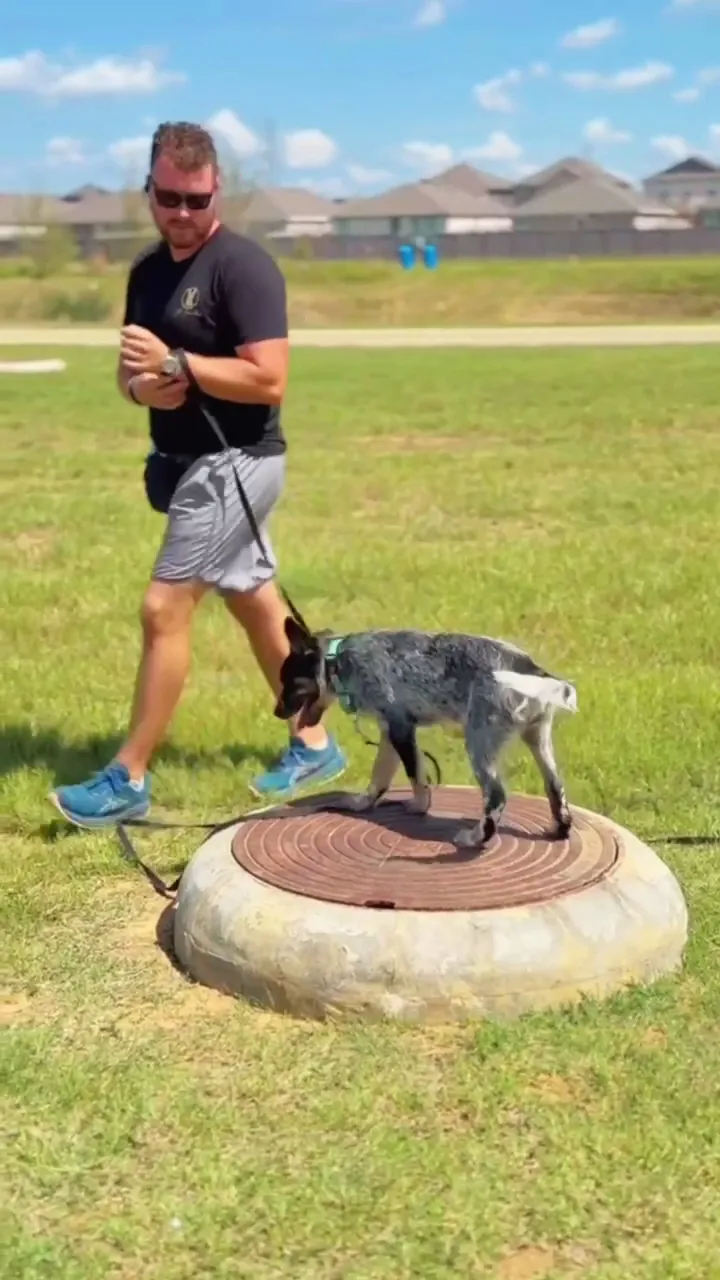
| Afternoon | A session in the yard, the house, a store aisle or on a field trip | Skills tested with real distraction |
| Evening | A second structured walk, dinner, a settle in the living room, then the crate for the night | Ends the day the way your home will |
Across the stay
The day keeps its shape, but what fills the blocks changes each week.
In the first days the blocks teach the framework: waiting at doors, the crate as a calm place, earned meals, place, a walk with rules. In the second week the same blocks build the commands with duration and distraction, and the house itself becomes harder, with guests at the door and dinner on the counter. The skills are sit, down, place, loose leash and the door, taught first and then held.
From the third week, in Platinum and VIP, the afternoon block moves into public: pet and hardware stores along 290 and Fry Road, neighborhood sidewalks, parks and the lake, chosen for each dog's triggers. A reactive dog's day might include a long, quiet session watching other dogs at a distance from a parking lot, which looks like nothing on video and is some of the most important work of the stay.
- First days: doors, crate, meals, place, the walk
- Second week: commands with duration and distraction
- Third week, Platinum and VIP: stores, sidewalks, parks, the lake
- Reactive dogs: long, quiet sessions at a workable distance
The Houston version
From May to September the day is turned inside out to protect your dog from the heat.
In a Houston summer the pavement fails the hand test by mid-morning, so the two walks and any outdoor work run at dawn and after sunset. The midday and afternoon blocks move inside the house and into air-conditioned stores, where carts, strangers and short sight lines make excellent distraction work. Water is down all day, and outdoor sessions end with a drink in the shade.
The rest of the year brings its own adjustments. Spring storms mean a dog that fears thunder rests in the quietest room with the television on. July 4 and New Year's Eve evenings are planned as indoor nights with food and a crate, because fireworks carry on for hours across northwest Houston. Hurricane season, June 1 to November 30, is when every dog's records and contacts stay ready.
Check the pavement with the back of your hand for seven seconds before any summer walk.
Walk at first light and after sunset from May to September.
Move the afternoon block indoors or into an air-conditioned store.
Keep water down all day and finish every outdoor block with a drink.
Plan fireworks nights and storm evenings as quiet indoor evenings.
What we do at Best Dog University
Every program follows this day; the number of days decides how far the dog gets.
Silver, one week at $1,500, runs this day long enough to install structure, a loose leash and door boundaries. Gold, two weeks at $2,500, adds the full obedience list and impulse control. Platinum, three weeks at $3,750, uses the extra week for field trips, public exposure and behavior modification, and is the program most families choose. VIP, six weeks at $10,000, stretches the day toward off-leash reliability and service-dog-level duration.
You watch the day happen in the Monday, Wednesday and Friday photo and video updates, and you can ask to see a particular block, such as the door or the evening settle. At the go-home session you get a version of this day for your own house, because the routine is what keeps the training, and the routine is yours to run from that evening on.
- Silver: structure, the leash and the door
- Gold: the full obedience list
- Platinum: field trips and behavior work
- VIP: off-leash reliability
- Every program: a home version of the day at handover
The programs
The same day, one to three weeks long.
Silver, Gold and Platinum all run this daily rhythm in our trainer's home in Cypress; the length decides how far it goes.



Asked and answered
Questions people ask about this.
How many hours a day does my dog train?
Formal blocks are short, a few minutes each, several times a day, with rest between them. But the whole day is practice: waiting at doors, earning meals, holding place while the house is busy. Counting only the formal blocks undersells it, and counting every minute oversells it. The honest answer is short focused sessions inside a structured day.
Does my dog get free time to play?
Yes, in a structured way. Dogs get time in the yard and, when it suits them, planned play with the other dogs in the house, introduced at a distance and pace each dog can hold. Play is also a reward in training. What there is not is a free-for-all yard session with dogs who have not met properly.
Is the schedule the same on weekends?
Ask our team on the consultation call how weekends run for your dates. What stays constant is the structure itself: meals, walks, rest and the house rules continue every day, because a dog learns the routine by living it without breaks. The photo and video updates go out every Monday, Wednesday and Friday.
Can I ask you to follow my dog's schedule from home?
Tell us what your dog's day looks like now, especially meal times and when it usually sleeps, and our trainer will fit the stay around the parts that matter, such as the number of meals or medication times. The training structure itself stays, because it is the schedule you will take home at the go-home session.
What does my dog do at night?
After the evening walk and dinner, the dog settles in the living room with the household, then sleeps in a crate in a quiet room of the house, in the air conditioning. A last trip outside comes before bed. Night is rest, not training, and a rested dog does its best work the next morning.
Keep reading
Free consultation · 10% off this fall
Ask our team what your dog's day would look like.
The free consultation call is where our team tells you how the day would be shaped for your dog. A $250 reservation deposit then holds the dates and comes off the program price.