
Board and train · Walks and exercise
How often are dogs walked at board and train?
Families picture two very different things: a dog stuck in a run all day, or a dog marched for miles. Neither is right. Here is how much walking your dog actually gets, why it is structured, and how it changes for a young Lab, a senior or a Houston August.
Last reviewed September 29, 2026 · by the Best Dog University Team
The short version
Two real walks a day, and the rest of the exercise comes from training, the yard and outings.
The two daily walks are the backbone. The morning walk comes straight out of the crate, before breakfast, and sets the tone for the day. The evening walk comes before dinner and the settle. Between them, your dog is moving through training blocks in the yard and the house, going up and down steps to place, practicing recall on a long line and, in the later weeks of Platinum and VIP, walking store aisles and neighborhood sidewalks on field trips.
That mix tires a dog more than a long aimless walk would, because thinking is tiring. A dog that has held place through a doorbell, walked past a barking fence and practiced a recall is usually happy to rest by lunchtime. Families are often surprised by how calm the dogs look in the midday videos; that calm is earned.
- A morning walk before breakfast
- An evening walk before dinner
- Yard sessions and long-line recall in between
- Field trips in the later weeks of Platinum and VIP
What a structured walk is
Every walk teaches: position, a loose leash and sniffing on permission.
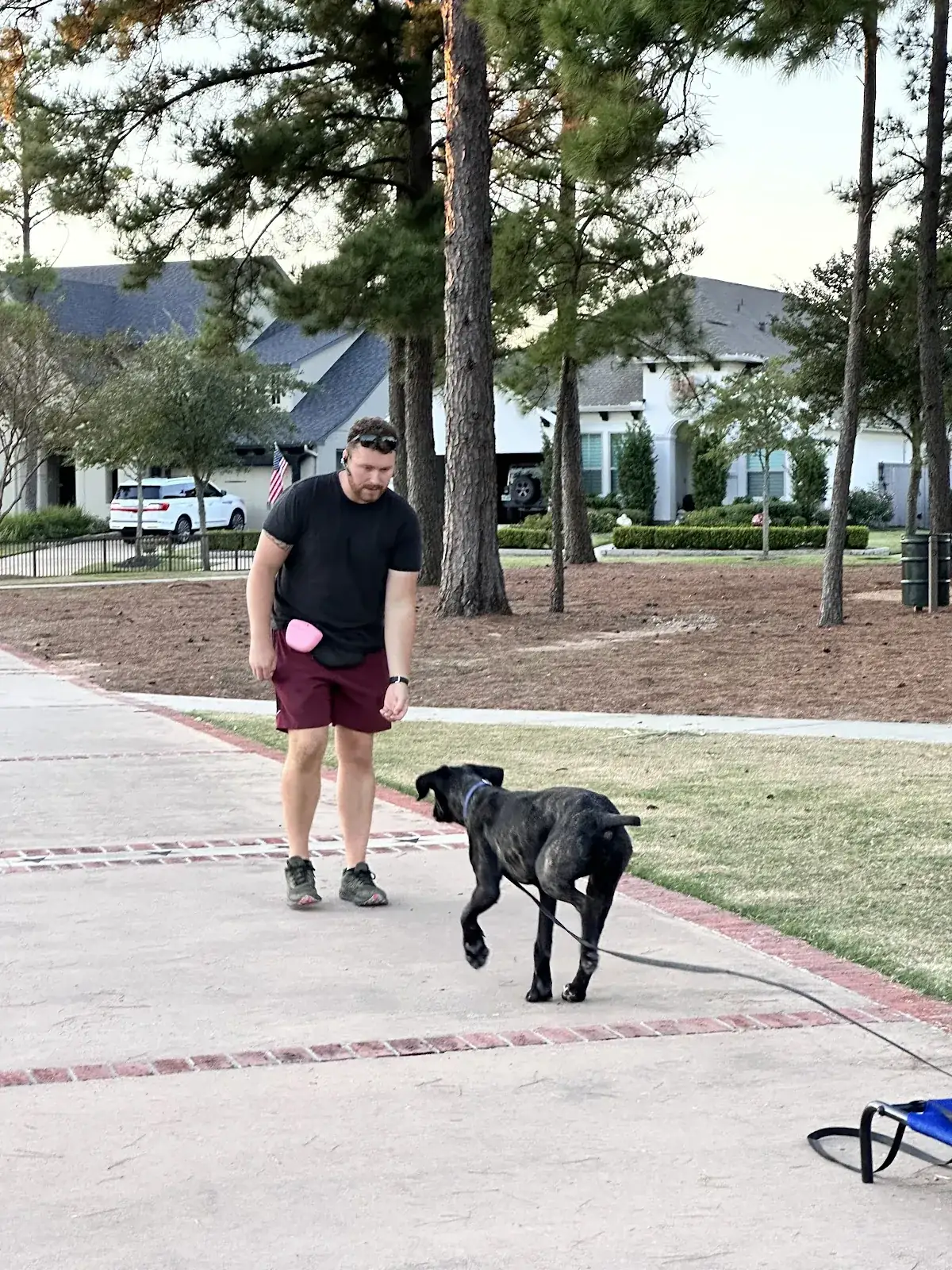
A structured walk has rules. Your dog walks at the handler's side with slack in the leash, does not pull toward smells or other dogs, and stops when the handler stops. Sniff breaks are real and frequent, but they are given with a release word rather than taken by dragging. It is the first thing every dog learns at the training home and usually the first change families notice in the updates.
Why so strict? Because a walk where the dog chooses the route and the pace rehearses pulling twice a day, and a walk with rules rehearses calm. The structure also gives nervous and reactive dogs something to do with their attention, which is why the walk is where a lot of reactivity work quietly happens.
- Position at the handler's side
- Slack in the leash
- No pulling toward smells or dogs
- Sniff breaks given on a release
Different dogs, different walking
A young retriever, a senior and a reactive dog all walk twice a day, but not the same walk.
A young, high-energy dog, the Labs, doodles, shepherds and Aussies common in Bridgeland and Towne Lake, gets longer walks and more active training blocks, because a dog with energy left over cannot settle on place. A senior gets shorter, gentler walks on softer ground, with more rest built in and the pace set by its joints. A puppy of four or five months walks in short bursts, since growing joints do not need distance.
A reactive dog's walks are planned around distance. Early in the stay they happen where other dogs appear at predictable, workable distances, and the distance closes only as the dog proves it can stay calm. Tell our team on the consultation call about any lameness, breathing trouble or vet restrictions, and the walking plan is shaped around them.
The Houston factor
In summer the timing moves, the pavement gets checked, and water comes on every walk.
From May to September Houston pavement is hot enough to hurt pads from late morning into the evening. Our trainers put the back of a hand on the concrete before a walk, and the two walks move to first light and after sunset, when the streets around the training home in Cypress are also busy with other dogs at predictable distances. Midday exercise moves indoors and into air-conditioned stores.
Fire ants are in every Cypress yard and park edge, so walks stay on paths and mown grass, and a dog is never left standing on a mound. Mosquitoes carry heartworm in every month of the Houston year, which is why we ask that your dog's heartworm prevention is current before the stay, and that you tell us if a dose falls due while your dog is with us so we can give it on the right date.
Put the back of your hand on the pavement before every summer walk.
Walk at first light and again after sunset from May to September.
Carry water and offer it halfway and at the end.
Keep to paths and mown grass to avoid fire ant mounds.
Keep heartworm prevention current all year.
Move extra exercise indoors on the hottest days.
What we do at Best Dog University
The walk you see in the updates is the walk you are taught at the go-home session.
Every program builds the structured walk. Silver, one week at $1,500, installs loose leash walking and door boundaries. Gold, two weeks at $2,500, adds pulling and impulse control to the full obedience list. Platinum, three weeks at $3,750, adds a structured heel, field trips and public exposure. VIP, six weeks at $10,000, finishes with off-leash reliability, which begins with thousands of good steps on a leash.
At the go-home session you take the leash yourself on the sidewalk, with the same tool and position your dog trained on, and our trainer coaches your hands. Keep two walks a day at home in the same shape and the leash manners hold; let the evening walk become a free-for-all and the pulling comes back.
The programs
Programs that build the structured walk.
Silver installs the loose leash, Gold adds impulse control, Platinum adds the heel and public field trips.



Asked and answered
Questions people ask about this.
Will my dog get enough exercise at board and train?
Yes. Two structured walks, training blocks through the day, yard time and outings tire a dog more than a long unstructured walk, because mental work is tiring. High-energy dogs get more activity and more walking. If your dog seems restless in the updates, tell our team and the plan changes.
Do dogs get off-leash time?
Recall is practiced on a long line in the yard and on outings, which gives a dog room to run safely. True off-leash reliability is the goal of the six-week VIP program. Leash rules apply in most Houston public spaces at the time of writing, so off-leash work only happens where it is allowed.
Can my dog swim at the training home?
Water work is part of some dogs' training, such as long-line recall at the lake, which also cools a dog in summer. Tell our team if your dog cannot swim, fears water or has an ear condition, and water stays out of the plan. Bayou and lake edges in Houston also have alligators, so water is always supervised.
How many walks should my dog get after coming home?
Keep two structured walks a day, at the same position and with the same tool as the go-home session. They can be shorter in a Houston summer if they stay structured. Add sniff breaks on a release, and use place indoors on the hottest days to keep the calm that the walks build.
Keep reading
Free consultation · 10% off this fall
Ask what exercise your dog would get.
Book the free consultation call and tell our team about your dog's energy, age and health. When the program fits, a $250 reservation deposit holds your dates and comes off the price.