
One step at a time
How to teach a dog to use the stairs: puppies, small dogs and the scared ones
Two-story houses in Cypress and Katy and three-story townhomes inside the loop mean plenty of Houston dogs have to learn stairs. Some take them in a day. Others freeze at the top, especially on open or polished steps. Here is how our trainers teach both kinds.
Last reviewed September 29, 2026 · by the Best Dog University Team
Before you start
Check the stairs, the dog and your vet's advice first.
Look at the stairs from the dog's side. Polished wood and tile are slippery, open risers show a drop that scares many dogs, and a turn halfway up can surprise them. Add stair treads or a runner if the steps are slick, and keep the area well lit. Bring soft treats, a short leash or a flat collar with a tab, and plan several sessions of two or three minutes rather than one long one.
The Houston caveat is the home itself. Many master-planned subdivisions from Bridgeland to Cinco Ranch are full of two-story homes, and townhomes in the Heights and Montrose often run to three floors with the living room in the middle. Garage stairs and outdoor steps up to a front porch count too; in summer, test outdoor steps with your hand before practicing, because concrete and stone hold heat.
- Treads or a runner on slick stairs
- Good light, especially at the top
- A short leash or a tab on the collar
- Soft treats in small pieces
- A baby gate for times you cannot supervise
The steps
Bottom step first, up before down, and never a drag.
The leash is there to steady and guide, not to haul. If the dog plants its feet, go back a step and make that step easy again. Short sessions ending on a success are the fastest route to a dog that runs up and down without thinking. Practice when the house is quiet, not while someone is carrying laundry past the dog.
Sit on the bottom step with a treat. Let the dog put its front feet up to take it, then pay again when it steps back down.
Lure the dog fully onto the first step, pay, then lure it down. Repeat until it steps up without hesitating.
Add the second step, then the third. Stay one step above the dog with the treat at its nose level.
Practice going down from the third step: stand below the dog, show the treat low, and pay each step.
Once the dog goes up and down a short run, add steps until it handles the full flight, with you beside it.
Add a word such as "steps" and ask the dog to wait at the top and bottom, so it never rushes past people.
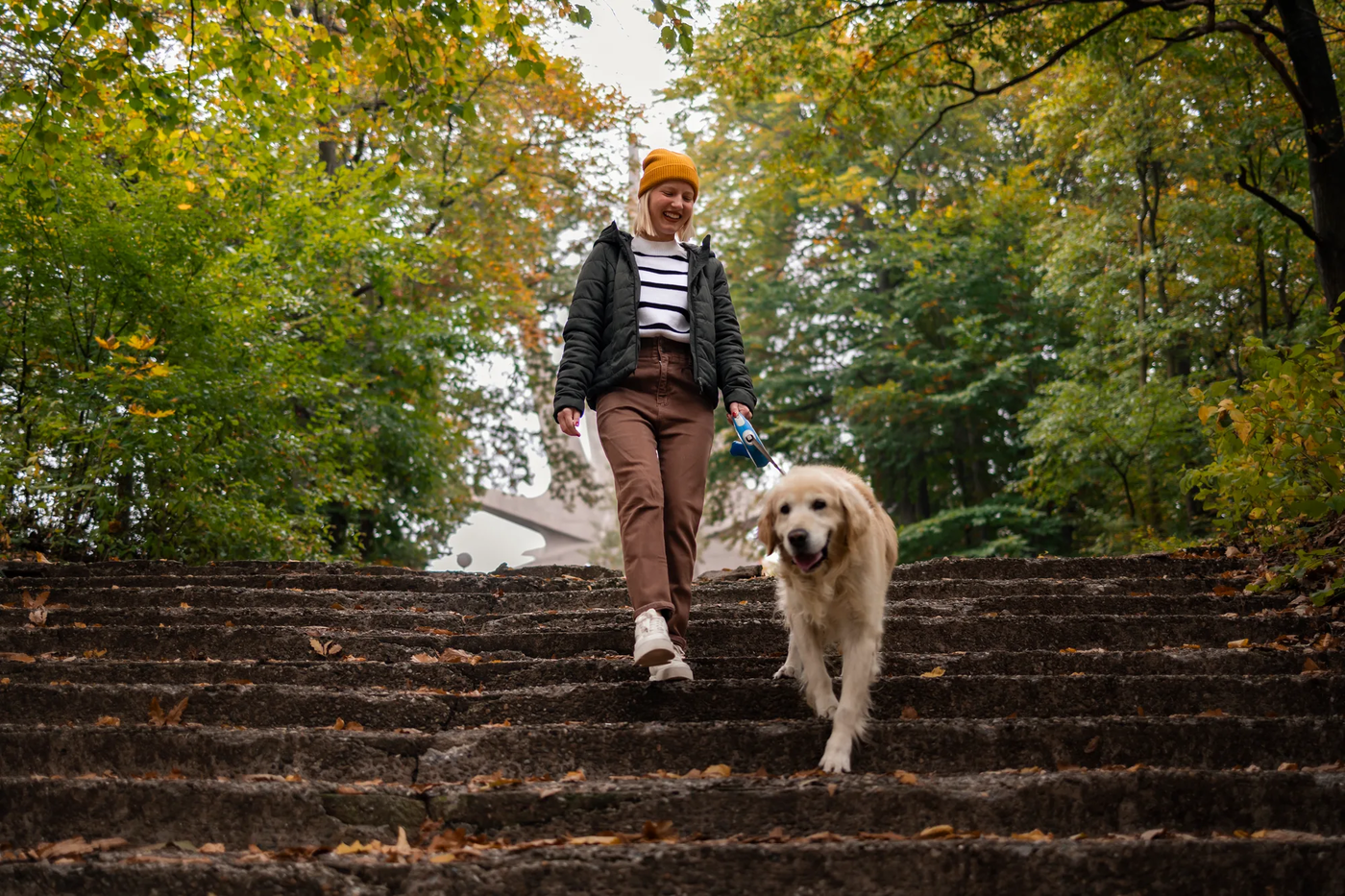
For a big dog, walk on the wall side with the leash short and loose, so you can steady it without being pulled down.
When it is not working
Three reasons a dog still will not do the stairs.
The first is footing. A dog that has slipped once on polished wood will remember it; add treads, go back to the bottom step and rebuild slowly. The second is going too fast. Owners often lure a willing dog up the whole flight on day one, the dog panics at the top, and the fear sets in. One or two steps per session is plenty for a nervous dog.
The third is pain. A dog that used to take the stairs and now refuses, especially an older dog or a large breed, may be sore. See your veterinarian before continuing, and carry or gate the dog in the meantime. A ramp to the couch or the car can take pressure off a sore dog while the vet works out what is going on.
- Slick steps with no grip
- Too many steps too soon
- Pain or stiffness in an older or large dog
- Pulling the leash instead of luring
Puppies, small dogs and the scared ones
Adjust the plan to the dog in front of you.
Young puppies can learn a few steps as part of confidence work, but their bodies are still growing. Ask your veterinarian how much stair work suits your puppy, especially a large breed, and carry it up and down the full flight until then. Small dogs may need you to break each step into two moves, front feet then back feet, with a treat for each.
A dog that is truly scared of stairs needs the smallest possible steps and lots of pay. Start on a single outdoor step or a curb, then a low deck, then the bottom indoor step. Let it watch another dog use the stairs if you have one. Never carry it halfway and set it down; that often builds more fear.
When to get help
A private lesson in your home or the puppy bundle usually covers stairs.
Stairs are a home skill, so a private lesson at home, $220, lets our trainer see the staircase and the dog's hesitation in place. A session at the Cypress facility, $160, suits a dog that also needs general confidence work. For puppies under four months, the Puppy Development Bundle, four sessions at $550 in Cypress or $750 in your home, builds confidence on new surfaces, steps included.
A dog that is fearful of many things, not only stairs, may be better served by a longer program. Platinum, three weeks at $3,750, includes behavior modification and graded field trips for dogs whose fear runs through the whole day. Our team can talk through the options on the free consultation call.
The programs
Help with stairs and confidence.
An in-home lesson for the staircase itself, the puppy bundle for young dogs, Platinum for a dog that is fearful far beyond the stairs.

Asked and answered
Questions people ask about this.
How do I get my dog to go down the stairs?
Start near the bottom. Stand below the dog on the second or third step and show a treat low, then pay each step down. Going down is harder than going up because the dog sees the drop. Add steps slowly, and use treads if the stairs are slick.
At what age can a puppy use stairs?
Puppies can learn a step or two early as part of confidence work, but how much stair use is right depends on the puppy's size and growth. Ask your veterinarian, especially for large breeds, and carry the puppy up and down the full flight until they say otherwise.
Why is my dog suddenly afraid of the stairs?
A sudden change is often pain, especially in older or larger dogs, or a single bad slip. See your veterinarian first. If the dog is healthy, add grip to the stairs and rebuild from the bottom step with food and short sessions.
Should I carry my small dog up and down the stairs?
For young puppies or dogs with health problems, carrying is often sensible. For a healthy small dog, teaching the stairs is usually better, because it gives the dog confidence and saves your back. Break each step into small moves and pay each one.
How do I stop my dog from rushing down the stairs?
Teach a wait at the top. Ask for a sit, release with a word, and walk down together at your pace. If the dog rushes, walk it back up and start again. A short, loose leash helps at first, especially with big dogs and older family members.
Keep reading
Free consultation · 10% off this fall
Stairs, one step at a time.
Tell our team what your stairs look like and where your dog stops. The free consultation is a direct call, and we will suggest a lesson or the puppy bundle.