
Cooperative care
How to teach a dog to tolerate nail trims: one paw at a time
Most dogs that fight nail trims were never taught to have their feet handled, then met clippers in a hurry. Soft lawns and cool indoor floors do little to wear nails down, so most Houston dogs need regular trims for life, and it pays to make them boring.
Last reviewed September 29, 2026 · by the Best Dog University Team
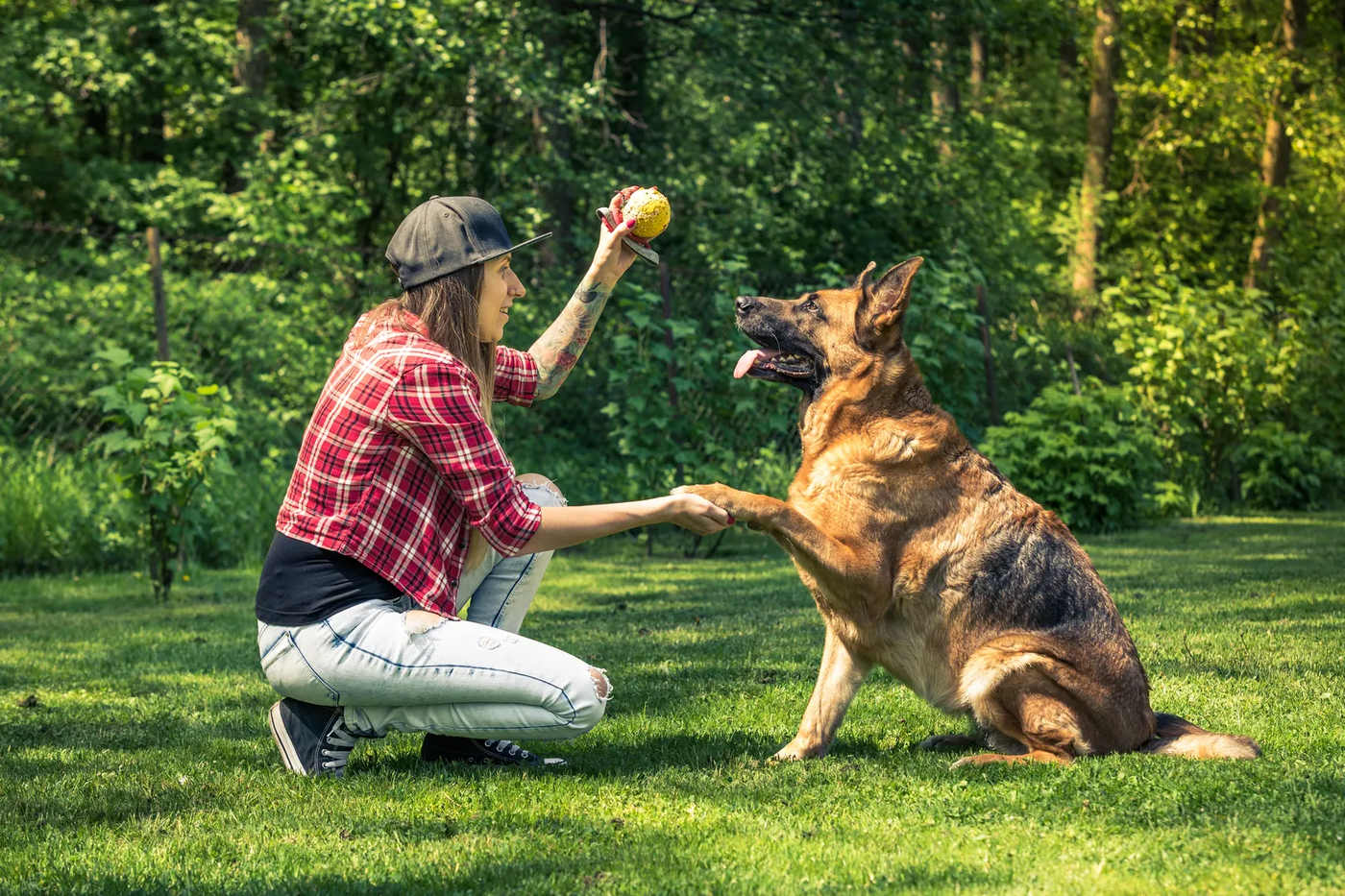
Before you start
Before you start: pick one tool, find the quick, and set up one quiet spot.
Choose a single tool and stay with it for a while: scissor clippers, guillotine clippers, or a grinder, which some dogs prefer once the noise is familiar. Keep styptic powder within reach in case a nail bleeds. Ask your vet or groomer to show you the quick in your dog's nails, the living part inside that bleeds if cut. It is easy to see in white nails and hidden in black ones, which are trimmed in thin slices. Lay a mat or towel in a quiet room and fill a jar with small, soft treats.
The Houston caveat is how summer dogs live. Paws spend July and August on soft grass and air-conditioned tile, and overgrown nails are often clicking on the kitchen floor by the end of summer. Paws matter here in other ways too: fire ant stings, grass burrs and hot pavement. A dog that lets you spread its toes and look between them lets you check for all of that, so handling practice is worth doing even when a groomer handles the trims.
- One tool: clippers or a grinder
- Styptic powder within reach
- The quick shown to you by a vet or groomer
- A mat, a quiet room and small soft treats
The steps
Six stages, one paw at a time, from a touch to a trimmed nail.
Each session lasts a minute or two and covers one paw, and on some days that means a single nail. Mark and pay the stillness, never the struggle, and finish while the dog is relaxed. If the dog pulls away, let go, wait a few seconds, and ask for less on the next try. Wrestling a paw teaches the dog to fight harder the next time the clippers come out.
Touch a front leg for a second, mark and pay, then slide your hand down to the paw, then hold the paw for a second, paying at each step
Hold the paw for three to five seconds while you press each toe gently, as you would to extend a nail, paying after each toe
Show the clippers or run the grinder a few feet away, paying the dog for looking at it calmly, then touch the tool to a nail without cutting
Trim the very tip of one nail, give a jackpot of several treats, and end the session right there
Trim one more nail each session until you can finish a whole paw, moving to the next paw only when this one is easy
Keep the habit with one paw a day or a short weekly session, so every trim stays small and quick
When it is not working
Pulling back, mouthing the hand, or a dog that hides when the clippers appear.
Pulling back nearly always means the step was too big: you held the paw longer or pressed harder than the dog was ready for. Go back one stage, hold for less time and pay faster. Mouthing the hand, a soft grab rather than a bite, is the dog telling you the same thing more loudly. Stop, lower the ask, and try a lick mat smeared with soft food on the floor, so the dog has a job while you work on its feet.
The dog that disappears when the clippers come out has probably been cut to the quick before, or held down for a trim, and the tool itself now predicts pain. Put that tool away, switch to a grinder or a different style of clipper, and start again from the first stage. A dog that growls, snaps or bites during handling is past a home project, and the answer is a trainer rather than a firmer grip.
- Pulling back: the step was too big
- Mouthing: stop and lower the ask
- A lick mat gives the dog a job
- Growling or snapping: call a trainer
When to get help
When to hand nail trims to someone else, and when to call our team.
There is nothing wrong with letting your vet or groomer do the trims while you build the handling at home. For a black-nailed dog or a nervous owner, it is the sensible choice. What matters is that nobody pins the dog down in the meantime if it can be avoided, so the training has a chance to work. Our cooperative care training teaches the paw hold, a chin rest and a start and stop the dog can predict.
Private lessons at $160 in Cypress or $220 in your home are the usual route. The Puppy Development Bundle, $550 or $750 for a puppy under four months, is the time to raise a puppy that never learns to fight its feet being touched. A dog that has snapped at a groomer or vet tech fits the Platinum Board & Train at $3,750, which includes behavior modification. On the free phone consultation, describe what happens when the clippers come out.
The programs
Programs for dogs who hate having their feet touched.
Private lessons for handling and trims, the puppy bundle to start early, Platinum for a dog that has snapped during grooming.

Asked and answered
Questions people ask about this.
How often should I trim my dog's nails?
Many dogs need a trim every few weeks, but it depends on the dog and the ground it walks on. A useful rule of thumb is that nails should not click on a hard floor when the dog is standing still. Ask your vet or groomer what schedule suits your dog.
Is a grinder better than clippers?
Neither is better for every dog. A grinder removes thin layers, which helps with black nails where the quick is hard to see, but the noise and vibration take training. Clippers are fast and quiet. Choose one, teach it slowly, and switch only if the dog has come to fear it.
What do I do if I cut the quick?
Stay calm, press styptic powder onto the nail for a minute, and end the session with a treat. Call your vet if the bleeding does not stop or the dog seems to be in real pain. Next time, trim thinner slices and look for the chalky center that appears as you near the quick.
Can I trim one nail a day?
Yes, and for a worried dog it is often the best plan. One nail a day after a meal covers the whole set every few weeks, with no session long enough to become a fight. Keep a note of which nail is next so none gets missed.
Sources
Keep reading
Free consultation · 10% off this fall
Make nail day a non-event.
Tell our team how your dog reacts when you reach for a paw. The free phone consultation is a direct call, free of charge.