
Soft mouth
How to teach a dog to take treats gently: in one session
A dog that snatches treats hard enough to catch fingers is not being aggressive; it has learned that grabbing is how food arrives. The fix fits into one short session, and it makes every later training session more pleasant for the whole family.
Last reviewed September 29, 2026 · by the Best Dog University Team
Before you start
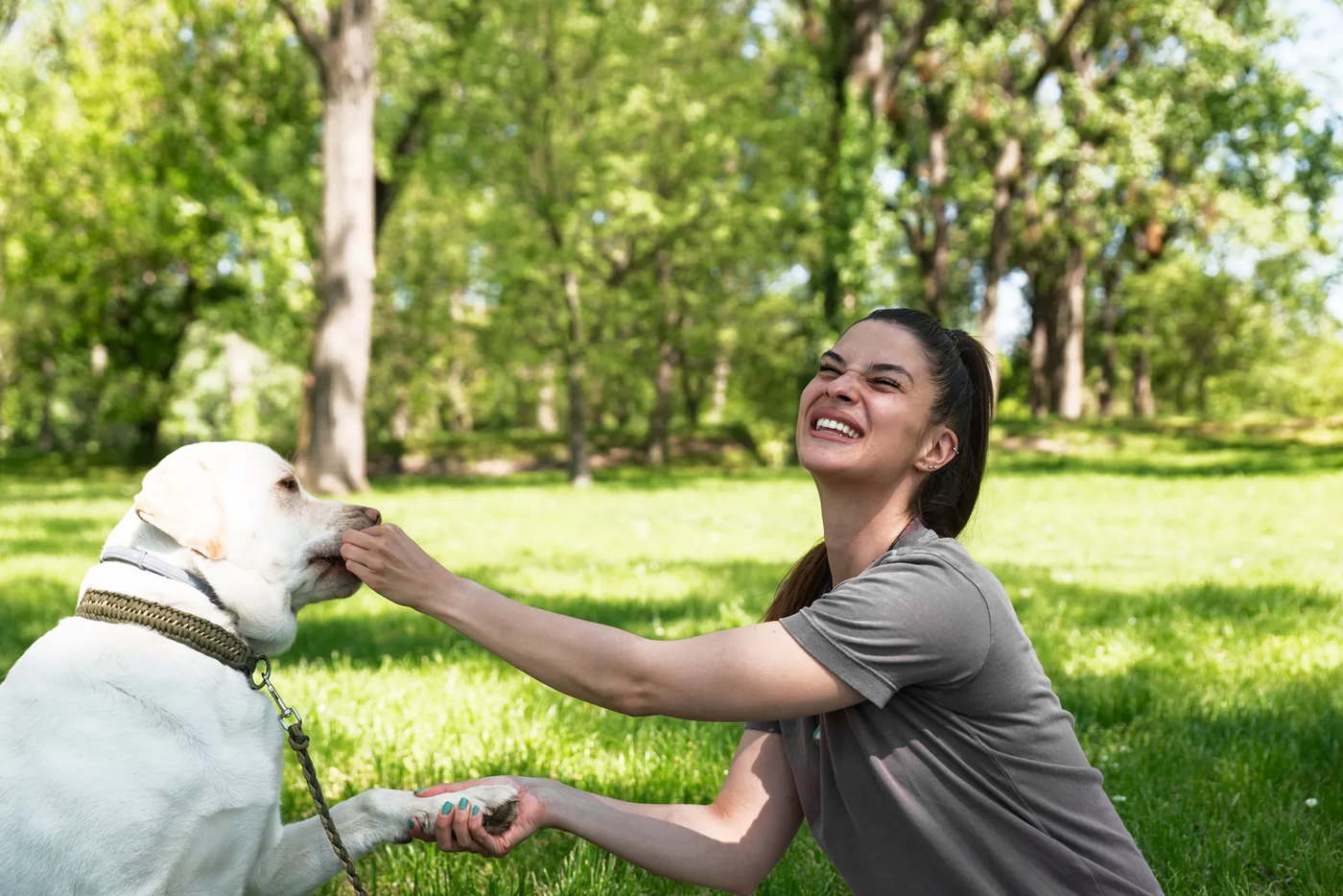
Before you start: dull treats, a calm dog and a pair of hands that can wait.
Use a dull treat for the first session, a piece of kibble rather than a piece of chicken, because high-value food makes the snatching worse. Pick a time when the dog has already had a walk and is not starving, and use a quiet room. If the grab is hard enough to hurt, wear light gloves for the first few minutes. Adults teach this first; children practice only once the dog backs off from a fist reliably.
The Houston caveat is where the treats come out. Outings here happen at the coolest hours, often in a busy store aisle along 290, on a patio, or at a park like Meyer Park at dawn, and those are exactly the places where a dog gets excited and grabs. Teach the soft mouth at home, then run a few repetitions in the car before you go in, so the dog walks into the store already knowing how food arrives.
- Dull treats for the first session
- A walked, calm dog that is not starving
- Light gloves if the grab really hurts
- Adults first, children once it is reliable
The steps
Six steps you can finish in a single session.
Most dogs get the idea within ten or fifteen minutes, spread across a few short rounds. Stay still and quiet, because pulling your hand away quickly makes the dog grab faster. Mark with yes or gentle the instant the mouth softens or the nose backs off, and open your hand as the reward, so a soft mouth is exactly what the dog earns each time.
Close a treat in your fist and hold it at the dog's nose, keeping your hand still while it licks, nibbles or paws
The moment the dog pulls its nose back or softens, say gentle, open your hand and let it take the treat from your palm
Repeat ten to twenty times, until the dog backs off almost as soon as the fist appears
Say gentle, then offer the treat on a flat open palm, closing your hand again if the dog lunges for it
Move to holding the treat between your fingertips at nose level, delivering it slowly, low and toward the dog's chest
Practice with a more exciting treat, then with another family member, then with an older child, adult hands close by
When it is not working
Excitement, fast hands, and treats held too high.
Excitement is the first reason. A dog that has been jumping, barking or playing tug grabs food as a continuation of the game. Settle the dog first with a sit, a few quiet seconds and slow praise, then offer the treat. The second reason is the person: hands that jerk away teach the dog to be quicker. Keep the hand still, and let the dog learn that the fist opens only for a soft mouth.
The third reason is height. A treat held high above the nose invites the dog to jump and snap at it, and a treat tossed in the air trains catching rather than taking. Deliver low and slow, at or below the chin. If the snatching comes with stiffness, a hard stare or growling over food, that is resource guarding rather than manners, and our guide to resource guarding is the one to follow.
- Settle the dog before the treat
- Keep the hand still; never jerk it back
- Deliver low and slow, below the chin
- Stiffness or growling means resource guarding
When to get help
When the grab needs a trainer, and what a lesson costs.
For most dogs, gentle is a one-session skill, and the only help needed is consistency across the household. For puppies under four months, the Puppy Development Bundle, four sessions for $550 in Cypress or $750 in your home, covers nipping and jumping prevention along with sit, place, stay and recall, and soft-mouth work fits naturally into it. A private lesson at $160 in Cypress or $220 at home sorts out an adult dog that still grabs.
A dog that bites hard at food, guards its bowl, or snaps when someone reaches near its treats is a behavior case, and it fits the Platinum Board & Train, three weeks at $3,750, where behavior modification is part of the program. On the free phone consultation, describe exactly how your dog takes food and from whom. Our team will tell you whether it sounds like manners or something more.
The programs
Help for grabby mouths and guarded food.
The puppy bundle for nipping and manners, a private lesson for an adult that grabs, Platinum when food brings out guarding.

Asked and answered
Questions people ask about this.
Why does my dog snatch treats?
Because snatching has always worked. Food arrived fast from hands that pulled away, often during exciting moments, and the quickest mouth won. It is a learned habit rather than a personality trait, and it changes quickly once the fist opens only for a soft mouth.
Can children practice the gentle cue?
Yes, once the dog backs off reliably from an adult's fist. Start with an adult's hand beside the child's, the treat on a flat palm, and a calm dog. Young children should not hand-feed a dog that still grabs, or one that has ever guarded food.
Does the closed fist method work with puppies?
Yes, and puppies learn it fast. Puppy teeth are sharp, so the closed fist saves your fingers during the nipping months. Keep sessions short and use kibble from the puppy's daily ration rather than extra treats, so training does not add to its meals.
Should I stop hand-feeding my dog if it bites my fingers?
No, teach it instead. Hand-feeding is one of the best tools for training and for building trust. Use the closed fist method for a session or two, and your dog will learn that a gentle mouth is the only way food leaves your hand.
Sources
Keep reading
Free consultation · 10% off this fall
Soft mouth, every treat.
Tell our team how your dog takes food today. The free phone consultation is a direct call with our team.