
Manners and obedience
How to teach a dog leave it and drop it
Leave it and drop it are the two cues that get used in an emergency, which is why they have to be built in a hundred boring repetitions first. Here is how our trainers teach each, the order that matters, and the Houston hazards that make them worth the work.
Last reviewed September 11, 2026 · by the Best Dog University Team
Why it matters
Two cues, two jobs, and a lot of things on a Houston sidewalk.
Leave it is the cue for the thing the dog has not yet got: the chicken bone under the bench, the cat on the fence, the toad on the patio, the fire ant mound, the dead squirrel on the trail. Drop it is the cue for the thing already in the mouth: the sock, the remote, the bone the dog found, the toad it picked up. They are taught separately because they ask for different things, and they are taught with rewards because a dog that is chased or pried open learns to run and to swallow. A dog with both cues can be walked past a bayou full of things it wants to eat and called off the one it has, and in Houston that is a safety skill, not a party trick.
- Leave it: the thing not yet taken
- Drop it: the thing in the mouth
- Taught separately, used together
- Rewards, because chasing teaches swallowing
- A safety skill in Houston
The method
Seven steps for leave it, then four for drop it.
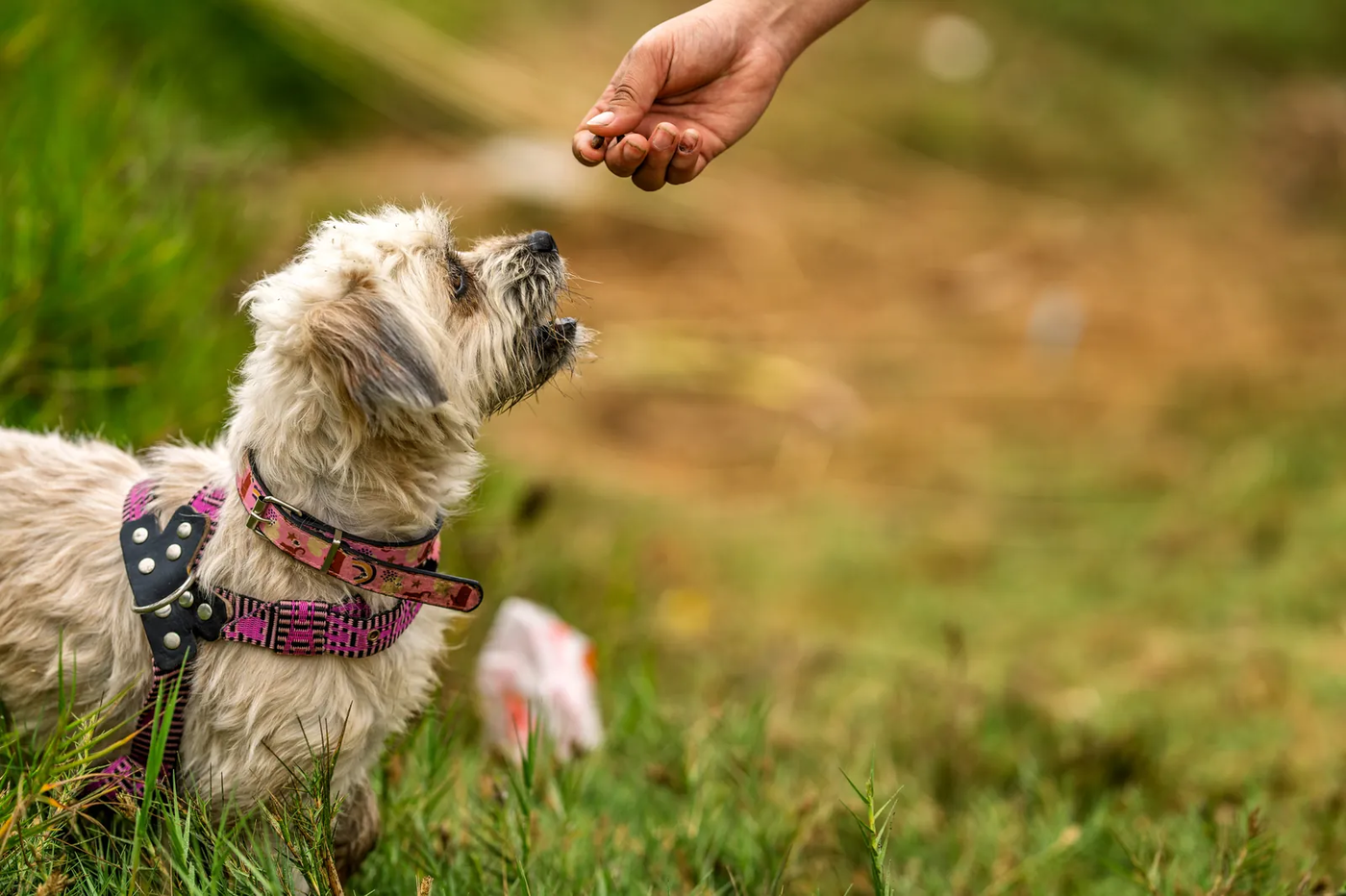
Leave it first, in two-minute sessions with two kinds of food: a boring one in the fist and a better one to pay with from the other hand. Drop it follows once the dog understands that giving up a thing makes something better appear.
Leave it, step one: food in a closed fist held low; the dog licks, paws and mouths; the instant it looks away, mark and pay from the other hand; repeat until the dog looks away immediately
Step two: say leave it as you present the fist; pay the look-away from the other hand; then present an open palm and close it if the dog dives, paying when it holds back
Step three: food on the floor under your shoe, then beside your shoe, then uncovered a foot away, with leave it said once and the dog paid for looking at you instead
Step four: moving things: a treat rolled across the floor, a toy dragged past, paid for the look-away, then a helper walking a dog past at a distance
Step five: real objects in real places, a chicken bone dropped on the sidewalk in your yard, a toad-sized toy on the patio, on a leash, paid heavily
Drop it, step one: with a toy in the dog's mouth, present a better treat at its nose; when the mouth opens, mark, pay, and give the toy back so giving up is not losing
Drop it, steps two to four: say drop it before the treat appears, fade the treat to a word with the toy returned as the reward, then proof with a real find on a walk, traded and paid
The mistakes
Chasing, prying, punishing the find, and never proofing on the real thing.
Chasing a dog with a sock teaches it that socks are the best game in the house. Prying a mouth open teaches the dog to clamp and, later, to swallow fast before you arrive. Punishing a dog for what it picked up teaches it to hide the find and to guard it, and guarding is a far worse problem than a chewed sock. And a leave-it that only ever met a treat in a fist fails on a chicken bone, because the bone is worth more; the cue has to be proofed against real objects at growing values until the dog leaves a bone on the word. The reward for both cues has to be real, and often the reward for drop it is getting the thing back.
A dog that will not drop a high-value item for any trade has started to guard, and that is the resource guarding page, not this one.
- Never chase; the sock becomes a game
- Never pry; the dog learns to swallow
- Never punish the find; the dog learns to hide and guard
- Proof on real objects at real values
- A refused trade is the start of guarding
Proofing around Houston
Toads, fire ants, bayou finds and the chicken bones outside every taqueria.
Houston gives leave it more work than most cities: Gulf Coast toads on every patio after a rain, which can make a dog seriously ill; fire ant mounds on every lawn; dead things and fishing line along every bayou trail; and chicken bones on the sidewalk outside every taqueria in the Heights and Montrose. Our trainers proof the cue on the store aisles first, then on the trails at Kickerillo-Mischer and along Cypress Creek, then on busy sidewalks, and the hazards guide on this site names the things worth leaving. In summer the proofing happens at dawn and dusk and the toads are out at exactly those hours, which is convenient.
- Toads after a rain
- Fire ant mounds on every lawn
- Fishing line and dead things along the bayous
- Chicken bones on the busy sidewalks
When to call
A dog that guards what it finds, or a dog that has eaten something dangerous.
A dog that growls, freezes or runs off with a find and will not trade is guarding, and that is a behavior case; the resource guarding guide covers the safe method and the Platinum program at $3,750 is where it is worked with a trainer. A dog that has eaten a toad, a bone or a sock is a veterinary emergency and the ASPCA poison control line is the first call, not this page. For the ordinary version, a Gold stay at $2,500 builds leave it and drop it into the foundation and proofs them on field trips, and an in-home lesson at $220 sets up the trades in your kitchen in an afternoon.
The programs
Programs that build both cues for you.
Gold for leave it and drop it inside the foundation, Platinum for the dog that guards its finds, lessons at home to set up the trades.


Asked and answered
Questions people ask about this.
What is the difference between leave it and drop it?
Leave it means do not take the thing you are looking at; drop it means open your mouth and let go of the thing you already have. They ask for different things and are taught separately, then used together on a walk when the dog finds something and then picks it up anyway.
How do I get my dog to drop something without chasing it?
Trade. Present something better at the dog's nose, mark the instant the mouth opens, pay, and give the item back if it is safe so giving up is not losing. After enough repetitions the word alone opens the mouth. Chasing teaches the dog that the item is a game.
Why does my dog leave a treat but not a chicken bone?
Because the bone is worth more and the cue was only ever proofed against treats. Leave it has to be built against real objects at growing values, on a leash, paid heavily, until the dog leaves a bone on the word. Until then the leash does the leaving.
What should my dog leave alone in Houston?
Toads, which can make a dog seriously ill; fire ant mounds; dead things and fishing line along the bayous; chicken bones on busy sidewalks; and any water it did not get from you. The hazards guide on this site names them, and leave it is the cue for all of them.
Keep reading
Free consultation · 10% off this fall
A fist, a trade, and a hundred boring repetitions.
Tell our team what your dog picks up. The free phone consultation is a direct call.