
Attention on cue
How to teach a dog to focus on you: eye contact on cue
A dog that can look at you on one word is a dog you can walk past a squirrel, a jogger or a barking fence. Focus sits underneath heel, recall and every calm greeting, and it is the first thing our trainers build with a new dog in Cypress.
Last reviewed September 29, 2026 · by the Best Dog University Team
Before you start
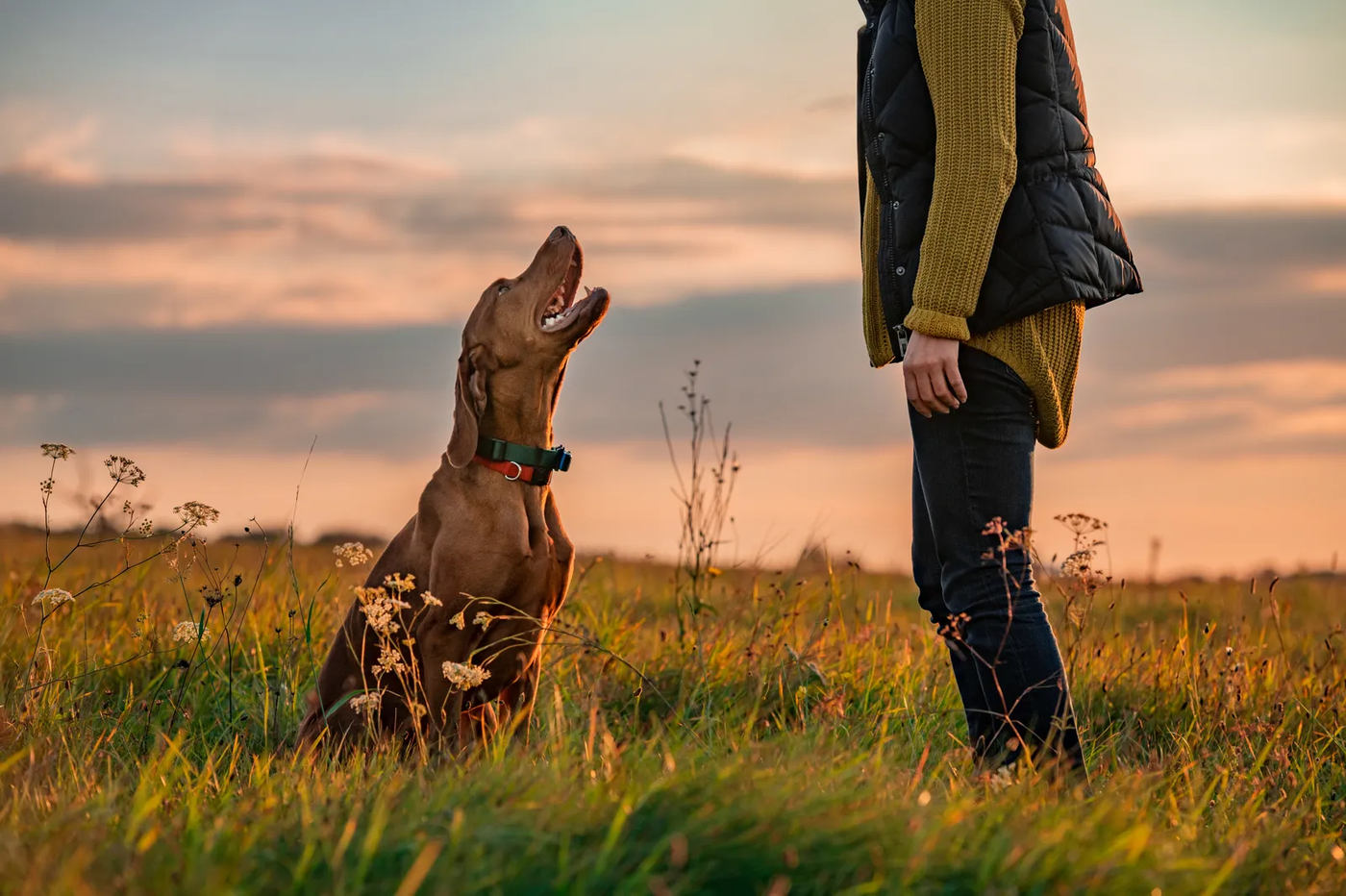
Before you start: soft treats, one marker word and a room where nothing is happening.
You need three things. Small, soft treats the dog loves, cut to the size of a pea so twenty of them are a snack and not a meal. A marker word, a short 'yes' said the same way every time, which tells the dog the exact moment it got it right. And a boring room: the kitchen after dinner, the television off, the other dog in its crate.
The Houston caveat is about when you practice outside. From May to September the outdoor stages belong to early morning and the last hour of light, when the pavement passes the hand test: your palm flat on the concrete for seven seconds without discomfort. A dog panting on a hot sidewalk will not hold eye contact with anyone, and that is not disobedience. Do the harder outdoor stages at dawn or in the cooler months, and keep the midday sessions indoors.
- Pea-sized soft treats, about twenty per session
- One marker word, said the same way
- A quiet room with nothing to watch
- Outdoor stages at dawn or dusk in summer
The method
Six steps from a glance in the kitchen to a look held on the sidewalk.
Keep each session to three to five minutes, twice a day, and stop while the dog still wants more. Every step below has one job, and you move on only when the dog gets the current one right about eight times in ten. If a step falls apart, drop back one step for a session and rebuild it there before moving on.
Hold a treat out to the side at arm's length. The dog will stare at the hand. Wait, silent, until its eyes flick to your face, then mark and pay from the other hand.
Repeat until the dog looks at your face the moment the hand goes out, usually within two or three sessions. The hand has become the reason to look away from it.
Stretch the look: count one second of eye contact before you mark, then two, then five. If the eyes drift, wait quietly and mark the moment they come back.
Add the cue. Say 'watch' once, just before you expect the look, and mark and pay when it comes. Within a week the word starts the look on its own.
Add movement: ask for the look while you walk across the room, while you sit down, while a family member walks through. Pay every look at first.
Take it outdoors in stages, the backyard, the driveway, a quiet street, then a store aisle, dropping back to short holds each time the place changes.
Using it
Put the look to work before the trigger appears, not after.
Focus pays off when you use it early. On a walk, say 'watch' the moment you spot the other dog at the far end of the street, while your dog is still loose and calm, and pay a run of looks as you pass. Waiting until the dog is already staring and stiff asks for a skill it cannot reach in that state. The same holds at the front door, the vet lobby and the patio table: ask for the look first, then release the dog to take in the scene.
Around Cypress our trainers use the pet and hardware store aisles along 290 as the middle stage, because they are cool in August, full of smells and quiet enough for a dog to succeed. A dog that holds five seconds of eye contact beside a pallet of dog food is ready for a sidewalk in Towne Lake or a trail with squirrels. Fireworks nights on July 4 and New Year are not training nights; use the look only as comfort then.
- Ask early, before the dog locks on
- Pay several looks in a row past a trigger
- Release the dog to look around afterwards
- Store aisles make a good middle stage
Troubleshooting
When it is not working: a dull reward, a place that is too hard, or a word said on repeat.
Three things stall focus training. The reward is too dull, so dry kibble loses to a lizard on the fence; switch to something soft and smelly. The place is too hard, so you are asking for five seconds on a busy trail when the dog only has it in the kitchen; go back a stage. Or the word has been said so often without a payoff that it has turned into background noise.
That last one is the most common. If you have been saying the dog's name or 'watch' over and over while it ignores you, retire the word, pick a new one and rebuild from step four. Say it once. If the dog does not look, make the moment easier rather than louder: more distance from the distraction, a better treat, a shorter hold.
- Food better than the distraction
- One stage easier than the one that failed
- Say the cue once, never on repeat
- A worn-out word gets replaced
When to get help
A dog that cannot look away from other dogs at any distance is a reactivity case.
Most dogs learn focus at home in two to three weeks of short sessions. A dog that fixates on other dogs, people or traffic and cannot break the stare even across a parking lot is not missing a trick; it is reacting, and that needs a trainer who reads the threshold. That is the three-week Platinum Board & Train at $3,750, which builds engagement on field trips and hands it over with unlimited private lessons. For a dog that simply drifts, a private lesson at $160 in Cypress or $220 at home usually fixes the timing.
The programs
Programs that build attention.
A private lesson to sharpen your timing, Gold for focus inside a full obedience foundation, Platinum when other dogs or people take the dog's eyes away.


Asked and answered
Questions people ask about this.
How long does it take to teach a dog to focus on you?
Most dogs offer eye contact in the kitchen within two or three short sessions and respond to a cue within a week. Holding the look outside with real distractions takes three to six weeks of practice in stages. Puppies get the first step fastest.
Should I use my dog's name or a separate word?
A separate word is usually better. Most dogs hear their name all day, often with nothing attached to it, so it has lost its meaning. A fresh word such as 'watch' or 'look' starts clean. Keep the name for calling and the focus cue for holding attention.
Do I have to use treats forever?
No. Food builds the habit fast, then you thin it: every second look, then every third, then mostly praise, a game or a release to sniff. Keep paying generously in new or hard places, and go back to food whenever the behavior slips.
My dog will not look at me outside at all. What now?
Go back inside and make sure the skill is solid there, then move out in smaller steps: the doorway, the porch, the backyard at a quiet hour. Use better food and stand farther from whatever the dog is watching. A dog that ignores you everywhere outdoors usually needs the stages it skipped, not a louder handler.
Can an older dog learn to focus on cue?
Yes. Adult and senior dogs learn eye contact as easily as puppies, and many rescues pick it up fastest because the payoff is so clear. Keep sessions short for older dogs, skip long holds in the heat, and expect the outdoor stages to take longer if the dog has years of tuning people out behind it.
Sources
Keep reading
Free consultation · 10% off this fall
Teach the look, then use it early.
Tell our team where your dog stops listening. The free phone consultation is a direct call, with no cost and no obligation.