
Nose to palm
How to teach a dog hand targeting: the most useful trick you will ever teach
Hand targeting is a nose touch to your open palm, and it takes about five minutes to start. Once a dog loves it, the touch becomes a short recall, a way to move the dog without grabbing it, and a way to turn its head away from trouble.
Last reviewed September 29, 2026 · by the Best Dog University Team
Before you start
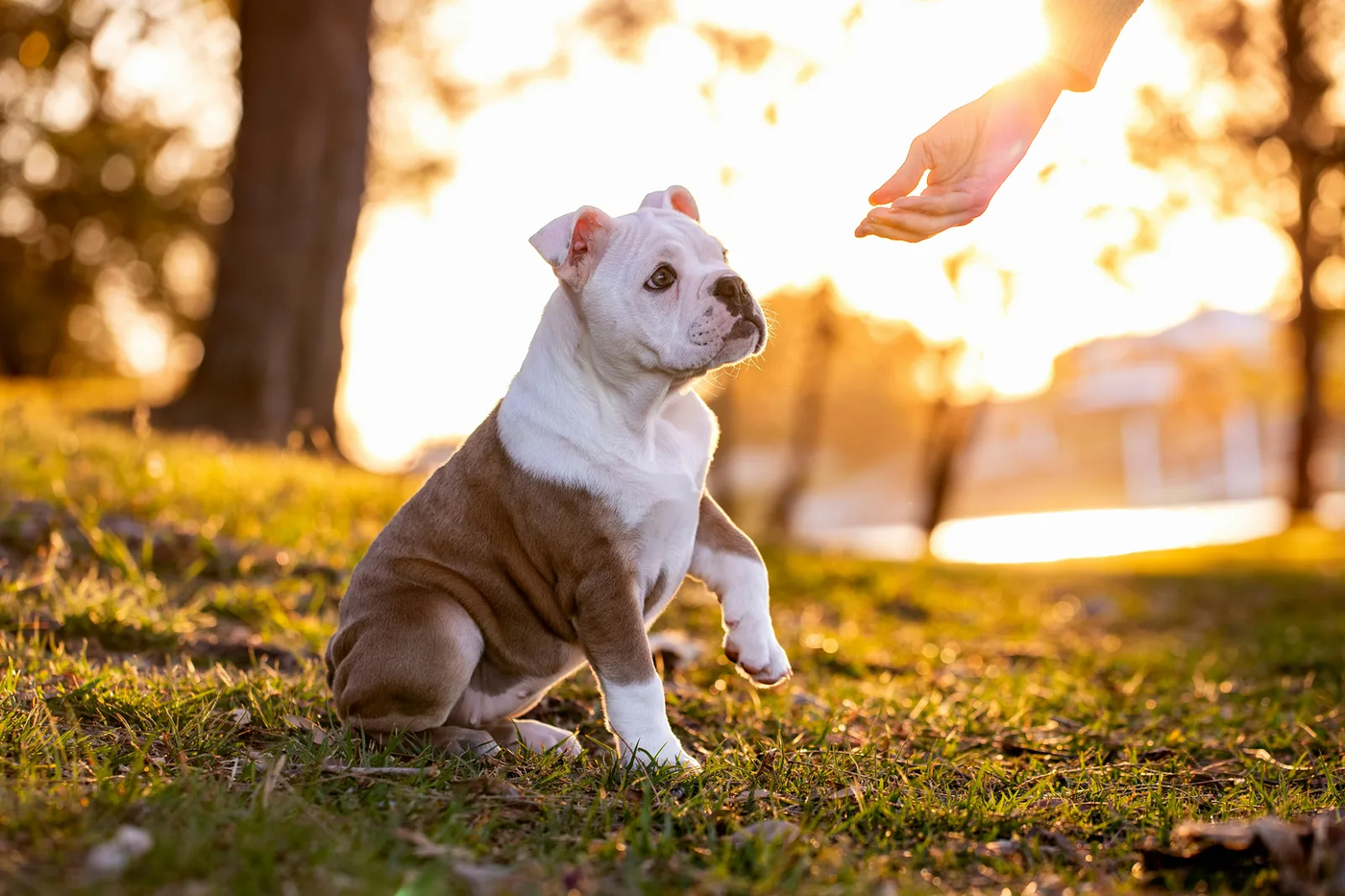
Before you start: one hand for the target, one hand for the food.
You need small, soft treats in one hand or a pouch, and the other hand free as the target, flat with the fingers together. Keep the target hand empty and as free of food smell as you can, or the dog will lick it looking for treats. Choose a cue word, touch or hand, and say it only once the behavior happens reliably. A marker word such as yes, or a clicker, makes the timing much easier.
The Houston caveat is how useful the touch becomes outside. On a summer walk at dawn, when a squirrel or a lizard appears on the sidewalk, a touch turns the dog's head back to you before the lunge. In a crowded store aisle along 290 or on a busy patio, it brings the dog tight to your leg without a pull on the leash. In an elevator or on a narrow trail, it moves the dog behind you with one word.
- Treats in one hand, the target hand empty
- A flat palm with the fingers together
- A marker word or a clicker
- The cue added only once it is reliable
The steps
Six steps, from a curious sniff to a touch across the yard.
Keep the first session to a minute or two and end with the dog wanting more. Present the palm, then take it away between repetitions, so each presentation is a fresh chance to touch. If the dog stares at the hand without moving, offer it a little closer, or rub a trace of treat on it for the first few tries, then stop doing that as soon as the dog starts to bump.
Hold your flat palm a few inches from the dog's nose, and mark and pay from the other hand the instant its nose bumps it
Repeat, moving the hand a little left, right, up and down between tries, so the dog follows the hand rather than one spot
Say touch as you present the hand once the dog bumps it nearly every time, and stop paying touches you did not ask for
Move the hand a foot away, then an arm's length, so the dog has to take steps to reach it
Practice the touch from across the room, then across the yard, turning it into a short recall to your hand
Use it in real moments: to call the dog off a couch, to move it past another dog on a walk, to bring it to your side at the door
When it is not working
Licking instead of touching, ignoring the hand, and a touch that fades outdoors.
A dog that licks or mouths the hand has learned that the hand is where the food lives. Keep treats in a pouch or the other hand, and mark a clean nose bump before the tongue comes out; pay quickly, so the touch ends before the licking starts. A dog that ignores the hand usually had it offered too far away, too soon. Go back to a few inches and make the first repetitions easy again.
The touch that works in the kitchen and fails in the park was never practiced around distraction. Take it to the yard, then a quiet street, then a park, making it easy again each time and paying very well outdoors at first. If a dog cannot take food or notice your hand at all outside, the problem is the environment, and our guide to walking past distractions starts right there.
- Licking: take food out of the target hand
- Ignoring: bring the hand closer again
- Fading outdoors: easier reps in new places
- No food outdoors: the setting is too much
When to get help
When to get help, and the program that turns tricks into a whole repertoire.
Hand targeting is a trick most families can teach at home, and it is the first step in plenty of more advanced work. Dogs with solid basic obedience that love to learn can go further in the Free-Style Board & Train, two weeks at $2,500, which builds tricks and engagement such as paw, spin, twirl, weave and center. Center, the dog stepping into position between your legs, uses the same idea of a dog moving to where your hand directs it.
If you plan to use the touch with a reactive dog, redirecting it away from other dogs on walks, do that with a trainer. The touch helps, but the reactivity itself needs its own plan. A private lesson at $160 in Cypress or $220 in your home is a good place to start, and on the free phone consultation you can describe what you want the touch to do for your dog.
The programs
Programs for dogs who love to learn.
Free-Style for tricks and engagement, a private lesson to build the touch into walks, the puppy bundle for an early start.
Asked and answered
Questions people ask about this.
What is hand targeting used for?
It is a nose touch to your palm with dozens of uses: a short recall, moving the dog off furniture or out of a doorway without grabbing its collar, positioning it at your side on walks, stepping onto a vet scale, and turning a dog's attention away from something that worries it.
How long does it take to teach a dog to touch my hand?
Most dogs offer the first touches within a few minutes and do it on cue within a few days of short sessions. Making it reliable at a distance and outdoors takes a few weeks of practice in new places, with the reward rate kept high at first.
Should I use my hand or a target stick?
Start with your hand, because you always have it with you. A target stick is useful later for guiding a dog onto a platform or into positions at a distance, but for everyday life the palm is the target that matters most.
Can hand targeting help a nervous dog?
It can give a nervous dog something familiar to do that it is paid for, which many dogs find settling. It is not a treatment for fear on its own, so a dog that shakes, hides or snaps around strangers or other dogs needs a trainer's plan as well.
Sources
Keep reading
Free consultation · 10% off this fall
Start with a nose touch.
Tell our team what you would like the touch to do for your dog. The free phone consultation is a direct call, free of charge.