
Fitting a prong collar
How to fit a prong collar: high, snug and used correctly
A prong collar is only as fair as its fit and the hand on the leash. These are the mechanics our trainers teach at the go-home session to families whose dog was chosen for one, and they match our answer on whether prong collars hurt dogs.
Last reviewed September 29, 2026 · by the Best Dog University Team
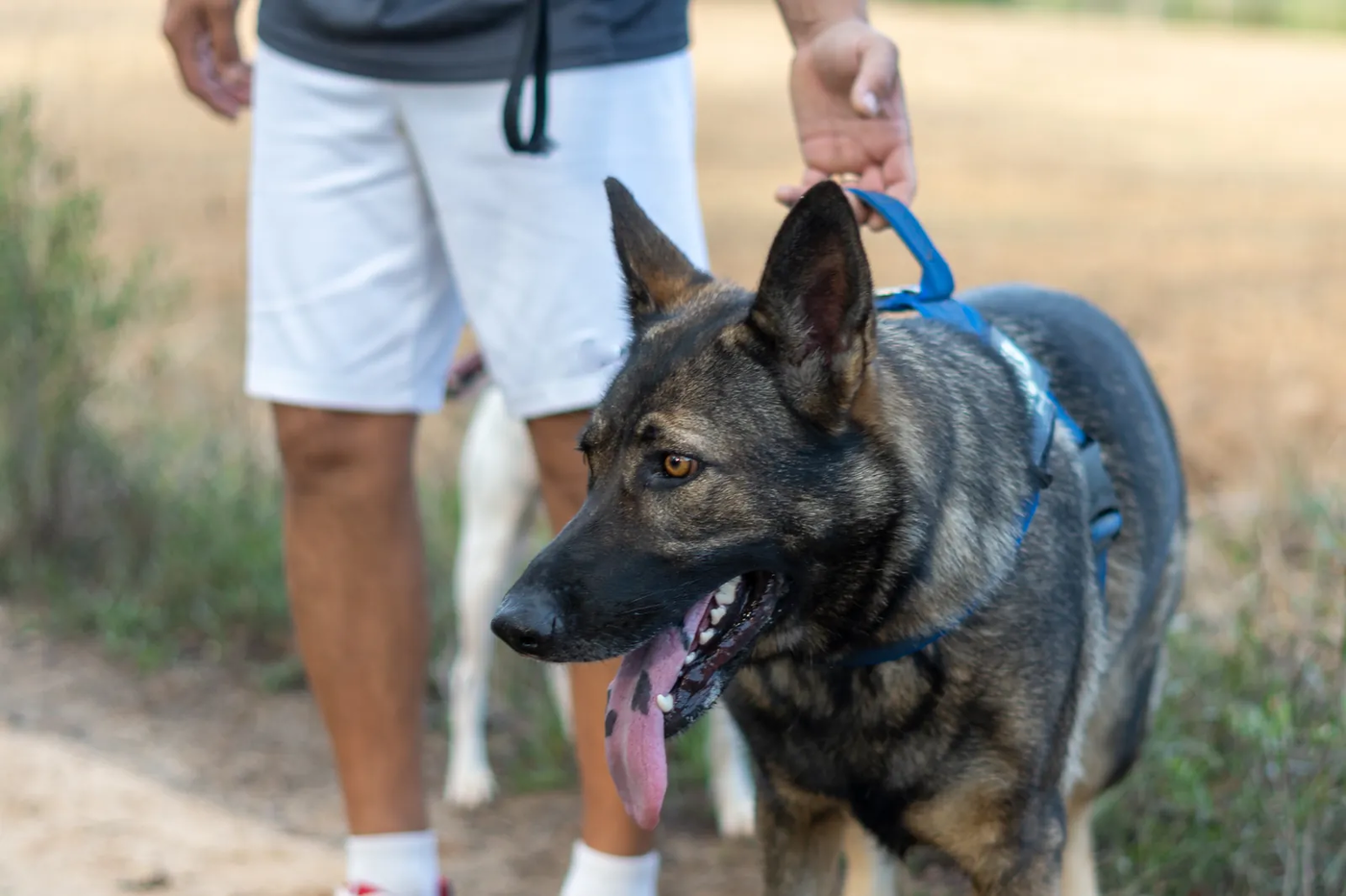
Before you start
Before you start: a dog that knows the walk, the right size and a trainer's view.
The prong comes after the teaching, not instead of it. Your dog should already understand where to walk from food and a loose leash on quiet streets, and a trainer should have seen the dog and agreed it needs a clearer signal when the world gets busy. Puppies under six months, fearful dogs and dogs with a neck or tracheal problem do not get one. If your dog has never been taught the walk, start with the leash pulling guide, not with hardware.
Buy a collar sized to the dog, not the biggest one in the store: smaller links on a small or medium dog, larger ones on a big, strong dog, following the maker's sizing guide. You also need a flat collar and a short clip to connect the two as a backup, because a link can come open. In Houston plan walks for early morning and evening from May to September, and check the skin under any snug collar after each summer walk.
- The walk taught first, with food
- A trainer has seen the dog
- Not for puppies, fearful dogs or neck problems
- Sized to the dog, with a backup clip
The steps
Seven steps to fit it, put it on and take it off correctly.
Do the first fitting indoors on a calm dog with a few treats, and expect to adjust it more than once. A prong that fits in the living room may need one link more or less once the coat is wet or the dog has filled out. The goal is a collar that stays exactly where you put it and does nothing at all while the leash is loose.
Open the collar by pinching the prongs of one link together and unhooking it; never force a fitted prong over the dog's head and ears
Wrap it around the neck just behind the ears and below the jaw, where the neck is narrowest, and hook the link closed
Check the fit: it should not slide toward the shoulders when you move it, and one finger should fit under a link without forcing
If it slides, remove a link; if it pinches or you cannot fit a finger, add one; recheck after every change
Turn it so the leash rings sit at the side or top of the neck behind the ear, not hanging under the throat
Clip the backup from the prong to the flat collar, then clip the leash to the prong's ring
Take it off after the walk by unhooking a link again and hang it up; it is never left on the dog in the house
Using it
Using it: a brief, even squeeze that says come back, released the instant the dog does.
With the collar fitted, the leash stays loose. When the dog drifts ahead or locks onto something, give a short, smooth tightening of the leash, about the pressure you would use to tap someone on the shoulder, and let go the moment the dog moves back toward you. Then mark and pay at your knee with the food and praise it already knows. That release and reward are the whole lesson: pressure switches off when the dog chooses you.
What you never do is yank, pop or hang on the leash. A sharp jerk turns a clear signal into a punishment, and steady tension teaches the dog to lean into it exactly as it did on a flat collar. You also never use the collar to punish lunging at another dog or to correct fear. A dog wearing a prong should look relaxed on a loose leash; if it looks worried, tight or frantic, stop and call a trainer.
- Brief and smooth, then released
- Paired with food at your knee
- Never yanked, popped or held tight
- A relaxed dog on a loose leash means it is working
Troubleshooting
When it is not working: too low, too loose, or a leash that never goes slack.
Almost every prong problem is one of three. The collar has slid down to the base of the neck, where the signal is dull and the dog pulls through it; move it back up and take out a link. The collar is loose enough to swing, so the pressure lands unevenly; resize it. Or the handler holds the leash tight for the whole walk, so the dog never feels the release that teaches it anything; relax your arm and let the leash hang.
If the fit is right and the dog still pulls hard, it probably does not understand the walk yet, and the answer is to go back to food on a quiet street. A prong also stops being useful once the dog walks well, so many dogs step down to a slip lead or a flat collar after a few weeks. The aim is always the lightest tool the dog needs.
- Slid down: move it up, remove a link
- Swinging: resize it
- A tight leash all walk teaches nothing
- Step down to a lighter tool when you can
When to get help
When to get help: a trainer chooses the tool, and the handover teaches the hand.
Our team decides whether a prong is right after meeting the dog, and many dogs never need one. Every stay teaches the walk first, the two-week Gold Board & Train at $2,500 or the three-week Platinum at $3,750, and the go-home session teaches the family the fit and the hand on whatever the dog goes home wearing. If your dog already wears a prong and the walks are not improving, a private lesson at $160 in Cypress or $220 in your driveway checks the fit and your timing.
The programs
Programs that teach the walk and the tool.
Gold and Platinum teach the walk first and fit the tool to the dog, with the handover teaching your hands; a private lesson checks a collar you already use.


Asked and answered
Questions people ask about this.
Where should a prong collar sit on the neck?
High on the neck, just behind the ears and under the jaw, where the neck is narrowest. That is where a small, even pressure is clear to the dog. A prong that has slipped down near the shoulders gives a dull signal and invites pulling, so check the position before every walk.
How tight should a prong collar be?
Snug enough that it stays high on the neck and does not slide down, with room to slip one finger under a link. If it slides, remove a link. If you cannot fit a finger, add one. Recheck the fit when the dog's coat is wet, freshly groomed or heavy.
Can I leave a prong collar on all day?
No. It goes on for the walk or the training session and comes off afterwards. It is never left on in the house, never hooked to a tie-out or a crate, and never worn unsupervised, because the links can catch. In summer, look at the skin after each walk.
Why should I not slip it on over my dog's head?
Because a prong loose enough to pass over the head is too loose to stay high on the neck, and forcing a fitted one over the ears is uncomfortable for the dog. Open a link, wrap it around the neck and close it. It gets quick with practice.
Does my dog need a prong collar forever?
Usually not. Many dogs wear one for a few weeks while the walk settles in busy places, then step down to a slip lead or a flat collar. Some strong dogs keep it for crowded outings. Our trainers tell you what the walk should look like before you step down.
Keep reading
Free consultation · 10% off this fall
Fit it high, keep the leash loose.
Tell our team what your walks look like and what your dog wears. The free phone consultation is a direct call, with no cost and no obligation.