
Summer exercise, indoors
How to exercise a dog indoors in the Houston summer: when it is 100 degrees at 6 p.m.
From June to September many Houston evenings are still hot enough at 6 p.m. to burn pads and push a dog toward heatstroke, and a young dog that has not been walked in days starts redecorating. The answer is not more fetch in the yard. It is a plan that works inside.
Last reviewed September 29, 2026 · by the Best Dog University Team
Before you start
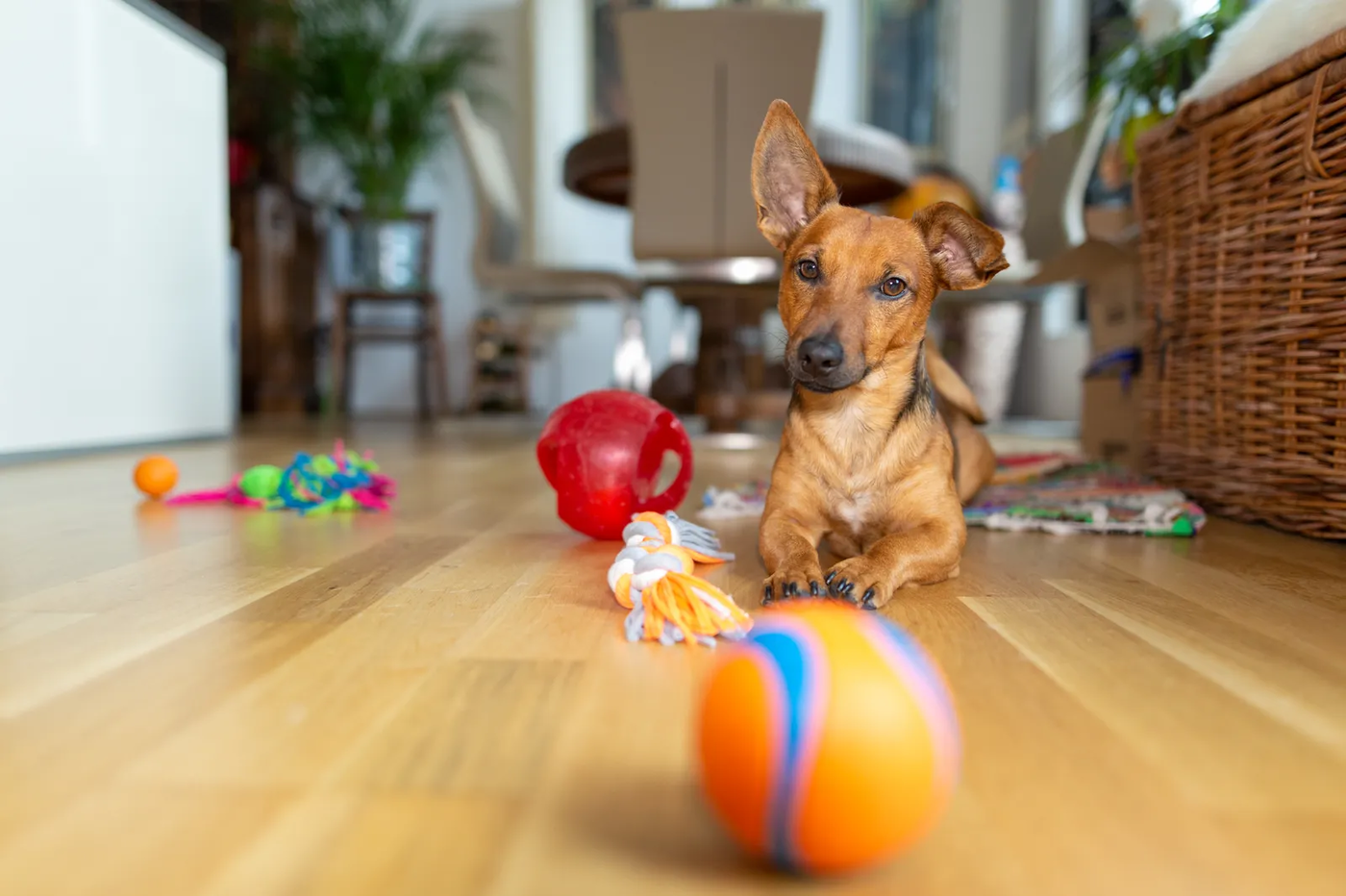
Before you start: a clear lane, grip on the floor, water, and a read on the heat.
Clear a lane through the longest stretch of the house, a hallway into a living room, and move anything a dog could skid into. Many Houston homes have tile or wood floors, and a dog sprinting on them can pull a muscle or slide into a door, so lay down rugs or yoga mats with grip for the running games. Keep water out, have the dog's place bed ready, and pick soft treats and one tug toy that only comes out for these sessions.
Then be honest about the outdoor hours. The National Weather Service Houston office posts heat advisories through the summer, and on many days the pavement fails the hand test well past sunset. Short-nosed breeds, seniors, heavy dogs and black-coated dogs overheat first. Heavy panting, a wide, curled tongue, stumbling or glazed eyes mean stop, cool the dog and call your vet. The AVMA's heat page lists the warning signs.
- A clear lane with rugs on slick floors
- Water and a place bed ready
- One tug toy kept for these sessions
- Know the heatstroke signs before you start
The circuit
A twenty to thirty minute circuit in seven steps, split across the day.
Run the circuit in two or three blocks rather than one long burst, for example before work, at lunch if someone is home, and after dinner. Each block mixes something physical with something that asks the dog to think and control itself, because a dog that only runs gets fitter at running. Stop any game the moment the dog starts panting hard; indoor air is cool, but a keen dog will still overdo it.
Recall ping-pong: two people at opposite ends of the house take turns calling the dog, paying each arrival with a treat and a touch on the collar; ten recalls each
Tug with rules: the dog takes the toy on a cue, tugs for ten to fifteen seconds, drops it on cue, sits, and gets the game back; three to five minutes
A hallway obedience set: sit, down, stand, a short stay, and heel to the end of the hall and back, paid quickly so it feels like a game
Find it: the dog waits on place while you drop treats around one room, then is released to search; add a second room once the first is easy
Cardboard course: boxes, a broom across two chairs and a couch cushion to walk over, done slowly on leash for balance, not speed
For healthy adult dogs only, a few slow trips up and down carpeted stairs on leash; skip it for puppies, seniors and any dog with joint trouble
Close with ten minutes of settle on place with a chew, so the session ends in calm instead of a dog wound up and looking for more
Outside, carefully
Dawn walks and air-conditioned stores keep the outside world in the week.
Indoor games replace the midday walk, not the world. In July the best walk of the day is the first hour of light, when the sidewalk has cooled overnight and the trails around Towne Lake or Cypress Creek are quiet. Keep it to twenty or thirty minutes on grass and shade where you can, carry water, and turn around early if the dog slows.
For a change of scene, our trainers take dogs into the pet and hardware stores along 290 through the hottest months. A slow loop of the aisles, with sits at the end of each and a greeting from a staff member who likes dogs, is air-conditioned exercise for the brain and the legs. Check each store's pet policy first.
- The first hour of light for the walk
- Grass and shade over pavement
- Turn around early if the dog slows
- Store aisles for a cool change of scene
Troubleshooting
When it is not working: too much excitement, the same games every day, or a breed that needs a job.
Three things go wrong with indoor exercise. The first is too much arousal: a dog wound up by chase games and endless tug starts mouthing, jumping and zooming, and bedtime gets harder instead of easier. Cut the running games, add more place, stays and find-it, and always finish with the settle. The second is sameness: the same three games every day bore a clever dog within a week, so rotate them and teach something new each weekend.
The third is a dog that genuinely needs more work than a living room can give, a young shepherd, a herding breed or a working Lab. That dog does best with a job: carry a backpack on the dawn walk, learn a new trick every few days, or work on a skill such as place with longer and longer duration. If the dog is still frantic after all of that, the problem is not exercise; it is calm, and that is trainable.
- Wound up: fewer chase games, more settle
- Bored: rotate games, add a new trick
- Working breeds need a job, not just laps
- Still frantic means calm needs teaching
When to get help
When to get help: a summer dog that cannot settle, or a family that needs the routine set up.
A dog that tears through the house every afternoon, cannot settle on a bed and gets worse with more exercise is a hyperactive dog, and the two-week Gold Board & Train at $2,500 builds place, impulse control and a daily routine that works in any weather. Our trainers run much of the summer work indoors and in air-conditioned store aisles, and the go-home session hands you the routine. A private lesson at $220 in your home lets our trainer set up the circuit in your actual hallway.
The programs
Programs for a summer dog with too much energy.
Gold for place, impulse control and a routine that works in the heat, a private lesson to set up your indoor circuit, Platinum when energy comes with reactivity.


Asked and answered
Questions people ask about this.
How much exercise does my dog need in summer?
It depends on age and breed, but most adult dogs do well with a short dawn walk plus twenty to thirty minutes of structured indoor games and training, split across the day. The training part matters as much as the running. A dog that is tired and calm has had enough; a dog that is tired and wired needs more settle, not more laps.
What temperature is too hot to walk my dog in Houston?
There is no single number, because humidity, sun, pavement and the dog all matter. Use the hand test: if you cannot hold your palm on the pavement for seven seconds, it is too hot for paws. Short-nosed, senior, overweight and dark-coated dogs need extra caution. Watch the heat advisories and walk at the first light.
My dog gets crazier after indoor play. Why?
Most likely the games were too exciting and ended too suddenly. Chase and tug raise arousal, and a dog left at that peak keeps going. Lower the intensity, add obedience and find-it between bursts, and finish every session with ten minutes of settle on place with a chew.
Can my dog play in the backyard in the evening?
Sometimes, if the grass is cool, there is shade and the dog is not a breed that overheats easily. In the middle of summer many Houston evenings stay too hot for running games. Keep yard time short, watch for fire ant mounds, and bring the energy work inside when in doubt.
Keep reading
Free consultation · 10% off this fall
Move the exercise inside, keep the calm.
Tell our team how your dog handles the summer. The free phone consultation is a direct call, with no cost and no obligation.