
Senior dogs
Training a deaf or aging-senses dog
Deafness comes to Dalmatians, white boxers and merle Aussies at birth, and to most dogs eventually with age. Sight goes in seniors and diabetics. A family that has always used its voice suddenly has a dog that ignores it, and thinks the dog has become stubborn. The dog has become deaf, and the training simply changes channel.
Last reviewed September 11, 2026 · by the Best Dog University Team
Find out what the dog still has
A vet check, and an honest test at home.
Before you train around a sense, confirm it is going. Clap behind the dog when it is looking away; drop keys on tile; watch whether it startles at a car door outside. For sight, move furniture and watch, or toss a treat and see whether the dog tracks it. Then the vet, because ear infections, some medications and thyroid problems mimic deafness, and some vision loss has treatable causes. The AVMA and your own vet are the sources; do not diagnose from this page.
Then decide what channel you have. A deaf dog with good eyes learns hand signals in days. A blind dog with good ears keeps every verbal cue and learns a few new ones for obstacles. A dog losing both needs touch cues and a house that does not change.
- Clap, keys, a car door: does the dog react?
- A vet check for infections, medication effects and thyroid
- Eyes: does the dog track a tossed treat?
- Decide the channel: hands, voice or touch
Hand signals for a deaf dog
One clear signal per cue, taught with food, the same from everyone.
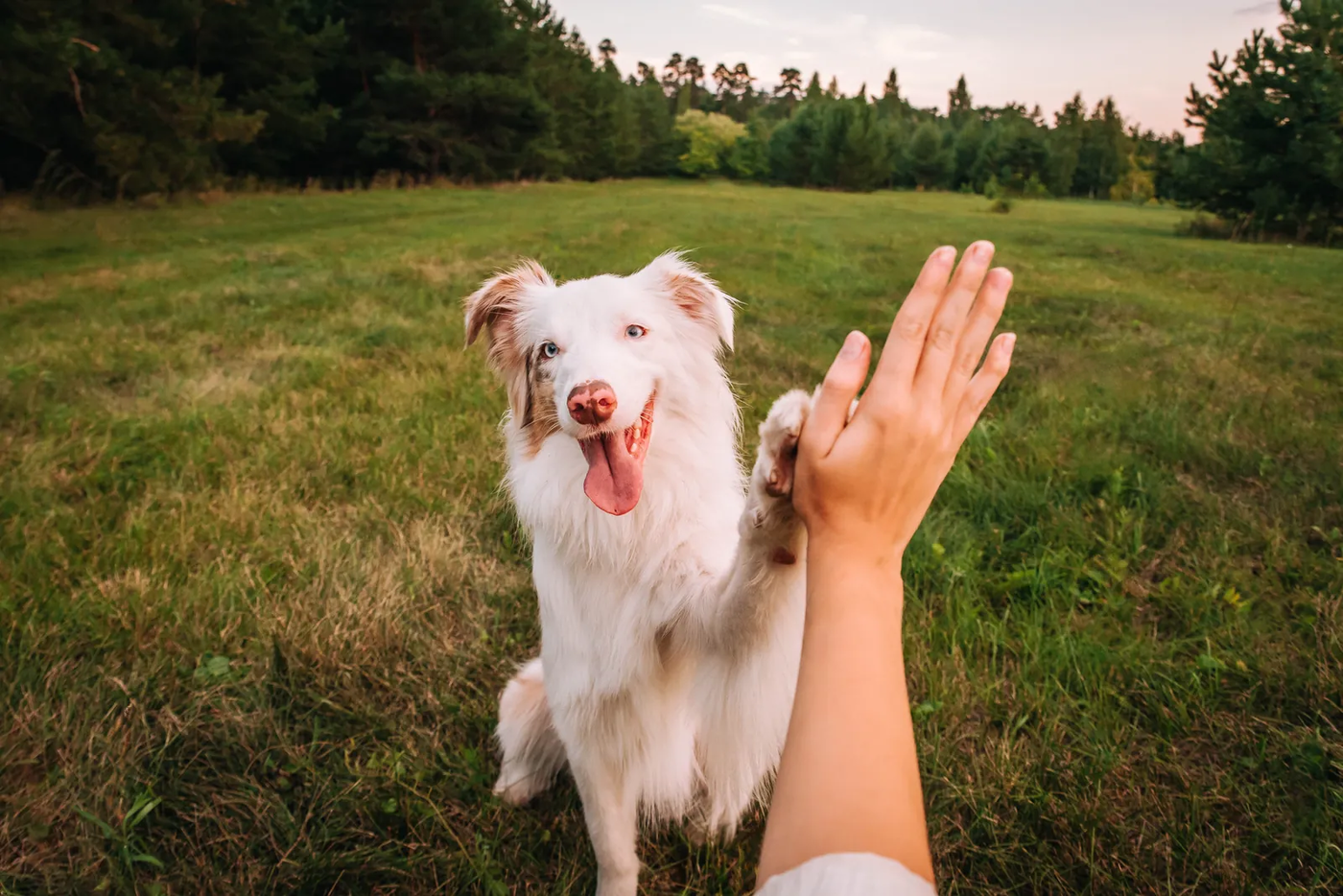
Deaf dogs watch their people, which makes them easy to teach visually. Pick one clear signal per cue: an open palm raised for sit, a flat hand lowered for down, a point at the bed for place, a thumbs-up as the marker that means the reward is coming, a beckoning arm for come. Teach each with food exactly as you would with a word, marker signal first, then the treat. Every member of the house uses the same signals; a deaf dog cannot cope with three versions of sit.
The marker signal is the most important one, because it is the deaf dog's version of a yes. A thumbs-up or a flash of an open hand, followed by food a hundred times, becomes a word the dog reads from across the yard.
- One signal per cue, the same from everyone
- A visual marker taught first, like a thumbs-up
- Signals taught with food, exactly like words
- Big, clear signals for distance; small ones up close
Week 1: the visual marker, a hundred times with food
Week 2: sit, down and place by hand signal
Week 3: the attention cue, a touch on the shoulder that means look at me, always rewarded
Week 4: come, on a long line, with the beckoning arm and the marker
Ongoing: a vibration collar as a name, paired with food, never as a correction
The startle and the safety rules
A touch from behind always means something good, and the leash stays on outdoors.
The thing families fear with a deaf dog is the snap when it is startled awake or from behind. Prevent it by teaching, on purpose, that a touch on the shoulder or the rump from behind is always followed by a treat, dozens of times, until the dog turns with a wag instead of a flinch. Wake a deaf dog by putting your hand near its nose or a treat by its face, or by stamping the floor so it feels the vibration, not by touching its head.
Outdoors a deaf dog is on a leash or a long line, always, because it cannot hear the car or your voice. A vibration collar, introduced with food and never used to correct, gives you a name you can say from across the field, but it does not replace the line.
- Touch from behind paired with food, dozens of times
- Wake with a hand near the nose or a stamp on the floor
- A leash or long line outdoors, always
- A vibration collar as a name, never as a correction
Sight loss and the house
Do not move the furniture, and teach three words.
A dog losing its sight maps the house and walks it from memory, which works until someone moves the ottoman. Keep the layout fixed, put a rug at the top of stairs and a scent marker at the doors, and block the pool and the stairs with gates. Teach three verbal cues the dog did not need before: step, for a curb or a stair; wait, for a stop; and easy, for slow. Walk the same route so the dog learns it, and let it sniff more, because the nose is doing the eyes' job now.
A dog losing both senses is guided by touch and routine, and a lesson at home is the right way to set that up for a particular dog and a particular house.
Deaf and blind dogs in Houston
Thunder the dog cannot hear, fireworks it cannot see, and a summer it feels.
A deaf dog is spared the sound of a Houston storm and often sleeps through fireworks, but it feels the pressure change and the vibration of thunder, and some are more anxious for not knowing why. A blind dog hears every firework with no context. Both do best with the crate routine our storm and fireworks pages describe, adapted to the channel the dog has. Summer heat affects a senior losing its senses more than a young dog, and the walk is at dawn on grass with the pavement test done for a dog that will not tell you its pads hurt.
The programs
Programs for a deaf or aging dog.
A lesson at home to set up the signals, the safety rules and the house, then short daily practice.
Asked and answered
Questions people ask about this.
Can a deaf dog be trained?
Yes, as fully as a hearing dog. The cues become hand signals and a visual marker, the name becomes a touch or a vibration collar, and the dog learns in days. Deaf dogs watch their people closely, which makes visual training fast.
Is a vibration collar the same as an e-collar?
No. A vibration collar buzzes without stimulation and is used as a name for a deaf dog, paired with food until the buzz means look at me. It is never used as a correction with a deaf dog, and it does not replace a leash outdoors.
My old dog has started snapping when touched. Is it going deaf?
Possibly, and a vet check comes first because pain does the same thing. If it is hearing loss, the fix is teaching that a touch from behind always predicts food, dozens of times, and waking the dog with a hand near its nose or a stamp on the floor instead of a hand on its head.
Can my blind dog still go for walks?
Yes, on a leash, on the same route so it learns it, with three new cues: step for a curb, wait for a stop and easy for slow. Let it sniff more than before; the nose is doing the eyes' job.
Sources
Keep reading
Free consultation · 10% off this fall
Tell our team about the dog.
The free phone consultation is a direct call: what the dog has lost, what it still has, and how a lesson at home would set up the signals and the house.