
Breed training guides
How to train a rottweiler
The rottweilers that come to the training home are usually wonderful dogs whose families waited a year too long. The breed does not need a hard hand; it needs an early one. Here is the plan our trainers run, and the summer calendar that runs through it.
Last reviewed September 11, 2026 · by the Best Dog University Team
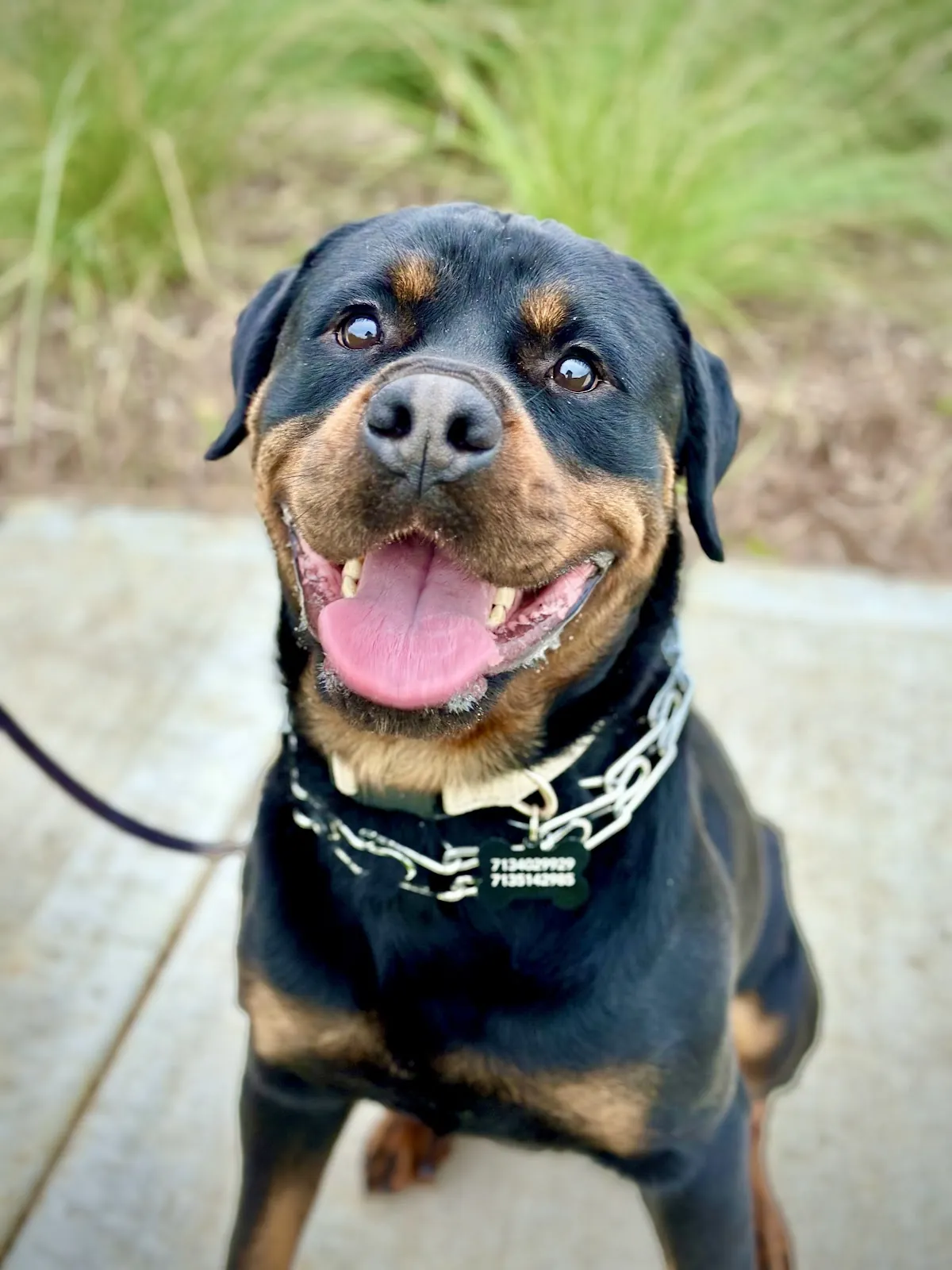
The breed in Houston
A working guardian in a black coat, in a hot city with a lot of front doors.
The rottweiler was bred to drive cattle and guard the cart, and both jobs show up in a Houston living room: a dog that positions itself between the family and the door, that watches the street, that leans on the people it loves and pushes the ones it does not. It is a thinking breed, slow to mature, deeply attached and prone to testing whoever it lives with. The black coat and the heavy frame make the summer harder than it is for most dogs; a rottweiler on a Cypress sidewalk at two in the afternoon is absorbing heat and it will not show distress until it is serious.
What our trainers see most: a dog with no structure that has become the household's decision-maker, guarding at the door and the gate, pulling like a truck, and a family that is a little afraid of it. None of that is the breed's fault, and all of it changes with rules.
- A guardian's instinct at the door and the gate
- Slow to mature, and tests boundaries until two
- A black coat that overheats quietly
- Deeply attached, and leans on its people
- Needs an early hand, not a hard one
The puppy months
Eight weeks to six months: manners installed before the weight arrives.
A rottweiler puppy is a chubby, clownish thing for about three months and then it is sixty pounds, so everything the family wants at two years is taught at three months: the crate, place, a wait at every door, a greeting with four paws on the floor, food taken gently from a hand, and handling of the paws, ears and mouth by every family member. Socialization is neutrality, not play: the puppy sees people, dogs, traffic and store aisles at a distance it can handle and learns that none of it is its business. A rottweiler puppy that learns to greet every stranger with enthusiasm is easier to live with than one that learns to be suspicious, but calm is the goal in both directions.
- Crate, place and a wait at every door by twelve weeks
- Handling of paws, ears and mouth by everyone in the house
- Food from a hand, gently, with a trade for anything it holds
- Neutrality to people and dogs, not a party
- The walk taught at the knee before the dog can outpull you
Adolescence
Eight to twenty-four months: the testing phase that decides the adult.
A rottweiler tests. Between eight months and two years it will ignore a cue it knows, hold a stare a second too long, plant its feet on the walk, and guard a bone or a couch to see what happens. The families that hold the rules calmly and consistently through that stretch get a magnificent adult; the families that back off get a dog that runs the house by two. The answer is never a fight and always a consequence the dog understands: the leash back on, the couch off limits, place instead of the doorway, the bone traded rather than taken. Our trainers see more rottweilers at fourteen months than at any other age, because that is when the testing peaks and the families call.
Eight to twelve weeks: crate, place, name, handling, food from a hand
Three to five months: the wait at doors, the greeting rule, the walk at the knee, the puppy bundle if you want help
Five to eight months: the structured heel on the street, store trips, recall on a long line
Eight to twelve months: the first tests, met with the leash and place, never a fight
Twelve to eighteen months: the door and the gate worked with real arrivals, neutrality proofed on trails
Eighteen to twenty-four months: freedom earned, the recall proofed with the Mini-Educator if the dog will be loose
Every day for life: a job, a structured walk and place with duration
The problems we see
Guarding at the door, pulling, resource guarding and a dog that has appointed itself.
The door and the gate are the rottweiler's job in its own mind, and the fix is to give the job back to the humans: a wait behind a line, place with duration through real deliveries, and a greeting the dog performs on release. Pulling is a structured heel taught from a standstill, with the dog paid at the knee and stopped the moment the leash tightens, and it takes weeks with a dog this strong. Resource guarding, over a bowl, a bone or a couch, is trades and a rule about where the dog eats and rests, and a bite history changes the plan to a Platinum stay with an consultation first. A rottweiler that has appointed itself head of the household needs the whole foundation rebuilt, and that is a stay.
What we do not do is treat the breed as dangerous. A rottweiler with rules is one of the steadiest family dogs we train.
- The door and the gate handed back to the humans
- A structured heel from a standstill
- Trades and a rule about bowls, bones and couches
- A Platinum stay and an consultation for any bite history
- Steady with rules, unsteady without them
Summer and enrichment
A black dog in a Houston July, and a mind that needs work more than miles.
A rottweiler in summer walks at dawn and dusk, rests on a cool floor in the afternoon and does its thinking indoors: obedience sessions with duration, a search for kibble, trick work, a chew. The pavement test at the door is the rule for the walk, and a rottweiler that looks fine at the end of a hot walk can be in trouble twenty minutes later, so the walks are short and the water is constant. The breed does not need miles; it needs a job and a leader. A half-hour structured walk and twenty minutes of obedience beat an hour of fetch for a rottweiler every day of the year, and doubly so in August.
- Dawn and dusk outdoors, short, with water
- A cool floor and indoor sessions in the afternoon
- Obedience with duration as the daily job
- Trick work and searches for the mind
- Miles matter less than structure
Which program
Platinum most often, Gold for the young dog with manners to learn, VIP for the finished guardian.
Platinum, three weeks at $3,750, is the rottweiler program at the training home, because the breed usually arrives with the door, the gate and the testing already underway and the unlimited lessons afterwards are what keep a strong dog's rules in place. Gold, two weeks at $2,500, suits a young rottweiler that simply needs the manners installed before the weight arrives. VIP, six weeks at $10,000, produces the rottweiler that is reliable off leash on acreage and steady at a gate, with the Mini-Educator and the in-home handover included. The rottweiler training page covers each in Houston terms, and the puppy bundle at $550 or $750 in-home is the right start for a puppy under four months.
The programs
Programs rottweilers usually need.
Platinum for the door, the gate and the testing, Gold for the young dog, VIP for the finished guardian on acreage.



Asked and answered
Questions people ask about this.
Are rottweilers hard to train?
No, they are easy to train and hard to live with untrained. The breed learns fast, tests every rule it is given and settles under the ones that hold. The difficulty comes from waiting: a rottweiler taught at three months is a joy and one taught at eighteen months is a project.
When do rottweilers stop testing?
Around two years, with structure, and never without it. The testing phase runs from eight months to two years and the families that hold calm, consistent rules through it get a steady adult. Our trainers see more rottweilers at fourteen months than at any other age.
Is a rottweiler a good family dog in Houston?
With rules and early training, one of the best: attached, steady, patient with the family's children and quiet in the house. Without them, a ninety-pound dog making its own decisions at the door. The summer heat needs managing because of the black coat, and the door needs rules from the first week.
How do I stop my rottweiler guarding the door?
Give the job back to the humans: a wait behind a line, place with duration through real deliveries and guests, and a greeting the dog performs only on release. A rottweiler that has guarded the door for a year needs a stay to rebuild the foundation; a puppy needs the rules from week one.
Keep reading
Free consultation · 10% off this fall
Start the rules before the weight.
Tell our team how old your rottweiler is and what it does at the door. The free phone consultation is a direct call.