
Breed training guides
How to train a boxer
Boxers are the most cheerful dogs in the training home and the ones with the least sense of their own size, and every family says the same thing: it is wonderful and it will not calm down. It will. The plan below is the one that gets it there, and the heat runs through all of it.
Last reviewed September 11, 2026 · by the Best Dog University Team
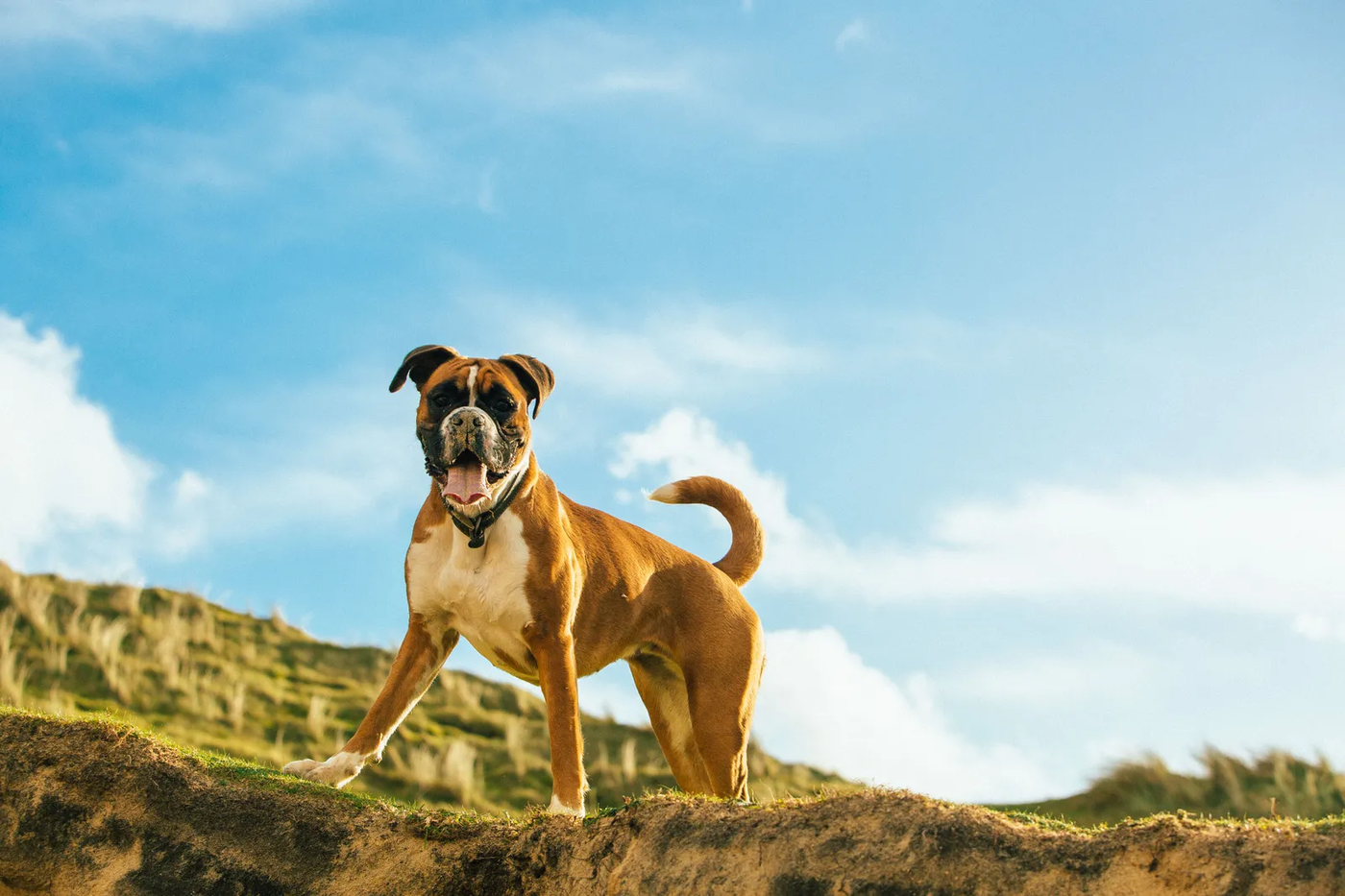
The breed in Houston
An athlete with a short face, in the one climate that punishes both.
The boxer was bred as a working and guarding dog and kept as a family clown, and it carries both: a body that can run and jump all day, a heart that belongs to its people, a guarding instinct at the door, and a face short enough that breathing in Houston's humidity is real work. The short muzzle means a boxer cannot cool itself efficiently, and a boxer on a July sidewalk at midday is in danger long before it looks tired. What our trainers see: a dog that bounces on every guest with its whole body, mouths hands like a puppy at four years old, drags on the walk, cannot settle for a minute and barks at the door with a guardian's conviction.
- A short face that limits summer to dawn and dusk
- A puppy until three without an off switch
- Bounces on guests with its whole body
- Guards the door with conviction
- Sensitive under the clowning; harshness backfires
The puppy months
Eight weeks to six months: the off switch and the greeting rule before the bounce is a habit.
A boxer puppy is a wind-up toy, so the first lesson is stillness: place with duration from the first week, the crate for real rest with meals inside it, and naps enforced, because an overtired boxer puppy bounces harder. The greeting rule starts immediately and every visitor keeps it: four paws on the floor before anyone says hello, because a boxer that learns jumping works at ten pounds jumps at seventy. The mouth is redirected to a toy and the game ends when teeth touch skin. The walk begins at the knee in the yard, and socialization is calm exposure at the stores and on quiet sidewalks, never a free-for-all. The heat rule starts now too: a boxer puppy in summer is walked before seven and after eight.
- Place with duration and the crate from week one
- The greeting rule kept by every visitor
- The mouth redirected, the game ended
- The walk at the knee in the yard
- Summer walks before seven and after eight, even for a puppy
Adolescence
Six months to three years: the longest adolescence in dogs, and the settle is the whole job.
A boxer's adolescence runs until it is nearly three, and it looks like a dog that has forgotten every rule: the bounce returns, the walk becomes a drag, the door becomes a performance and the settle disappears. The mistake is to answer with exercise, because a fitter boxer is a bouncier boxer. The answer is structure: place with an hour of duration built patiently, the leash back on the walk with the dog paid at your knee, a start and a stop to every game, the door handed back to the humans with a wait and a release, and a job for the body that has rules, like fetch with a wait or a flirt pole at dusk. A boxer worked this way through the long stretch arrives at three as the dog the family imagined.
Eight to twelve weeks: crate, place, the greeting rule, the mouth, the name
Three to six months: the walk at the knee, the door wait, store trips, the puppy bundle if you want help
Six to twelve months: the structured walk on the street, place through guests, recall on a long line
Twelve to twenty-four months: the bounce and the drag met with place and the heel, games with rules
Two to three years: neutrality proofed on trails and at a patio, the settle for an hour, the door with real arrivals
Three years on: the dog everyone imagined, kept with a daily job and a walk
Every summer for life: dawn, dusk and the air conditioning
The problems we see
The bounce, the mouth, the door, the drag and a dog that cannot settle.
The bounce is a greeting rule and place with duration, and a boxer learns it in two weeks if nobody breaks it. Mouthing as an adult is a rule about what the mouth is for, taught with trades and a chew always available, and it rides along with over-arousal, so the settle fixes half of it. The door is a wait behind a line and place through real deliveries, with the guarding instinct given rules rather than a fight. The drag is a structured walk from a standstill with the dog paid at the knee. And the dog that cannot settle needs place with an hour of duration, a family that stops trying to tire it out, and a game with a start and a stop. Separation anxiety is common in a breed this attached, and the crate and alone time on purpose from puppyhood prevent most of it.
- A greeting rule and place for the bounce
- Trades and a chew for the mouth
- A wait and place for the door
- A structured walk from a standstill
- An hour of place for the dog that cannot settle
Summer and enrichment
The short face sets the rules, and the body needs a job with a stop button.
A boxer in a Houston summer is walked at dawn and after dark, briefly, with the pavement test at the door and water at every stop, and it lives in the air conditioning the rest of the day, because the short face cannot shed heat; a boxer that is panting hard with a wide tongue is a boxer to get inside now. The body still needs a job, so the afternoons are for a flirt pole in the shade at dusk, tug with a start and a stop, obedience with duration, a search for kibble and a chew. Fall and winter are when the miles come back, on the Cypress Creek trails and the Bridgeland paths on a leash, and the boxer is the happiest dog in Houston in November.
- Dawn and after dark, briefly, in summer
- The pavement test and water at every stop
- Inside at the first sign of heavy panting
- Games with a start and a stop as the job
- The miles in fall and winter
Which program
Gold for the settle and the manners, Platinum for the door guarder or the anxious one.
Gold, two weeks at $2,500, is the boxer program most often: place with real duration, the calm greeting, the structured walk and impulse control, handed over in a go-home session that teaches the family the settle and the game rules. Platinum, three weeks at $3,750, is the program for the boxer that guards the door seriously, lunges on the walk or panics alone, with unlimited lessons afterwards. The Puppy Development Bundle, $550 in Cypress or $750 at home, is the right start for a puppy under four months, and the boxer training page covers each in Houston terms.
The programs
Programs boxers usually need.
Gold for the settle and the bounce, Platinum for the door guarder or the anxious one, the bundle for the puppy.


Asked and answered
Questions people ask about this.
When do boxers calm down?
Around three years, with training, and later without it. The breed has one of the longest adolescences in dogs, and the settle is taught rather than waited for: place with an hour of duration, games with a start and a stop, and a family that stops trying to tire the dog out.
Can a boxer handle Houston summers?
Only with strict management. The short face cannot shed heat, so a boxer is walked at dawn and after dark, briefly, and lives in the air conditioning the rest of the day from May through September. Heavy panting with a wide tongue means inside now. The breed is one of the most heat-sensitive we train.
Why does my boxer jump on everyone?
Because it is the breed's greeting and it works. A greeting rule every visitor keeps, four paws on the floor before anyone says hello, and place with duration during arrivals end it in a couple of weeks. A boxer that has bounced for years learns the new rule as fast as a puppy if nobody breaks it.
Are boxers good with children?
Usually wonderful, and usually too rough until they are trained. A boxer bounces, mouths and body-checks in play, and small children get knocked over. The greeting rule, the settle and a rule about play with the kids make the breed one of the best family dogs we see.
Keep reading
Free consultation · 10% off this fall
Teach the settle; the clown stays.
Tell our team what your boxer does at the door and how it handles the heat. The free phone consultation is a direct call.