
Why does my dog
Why does my dog lunge at people?
The lunge at a person is the call that frightens families most, because a person can be knocked down or bitten, and because it usually happens on a sidewalk in front of neighbors. Our trainers start with the same question every time: what did the dog's body look like a second before?
Last reviewed September 11, 2026 · by the Best Dog University Team
The short version
Three lunges that look alike from the outside and feel different to the dog.
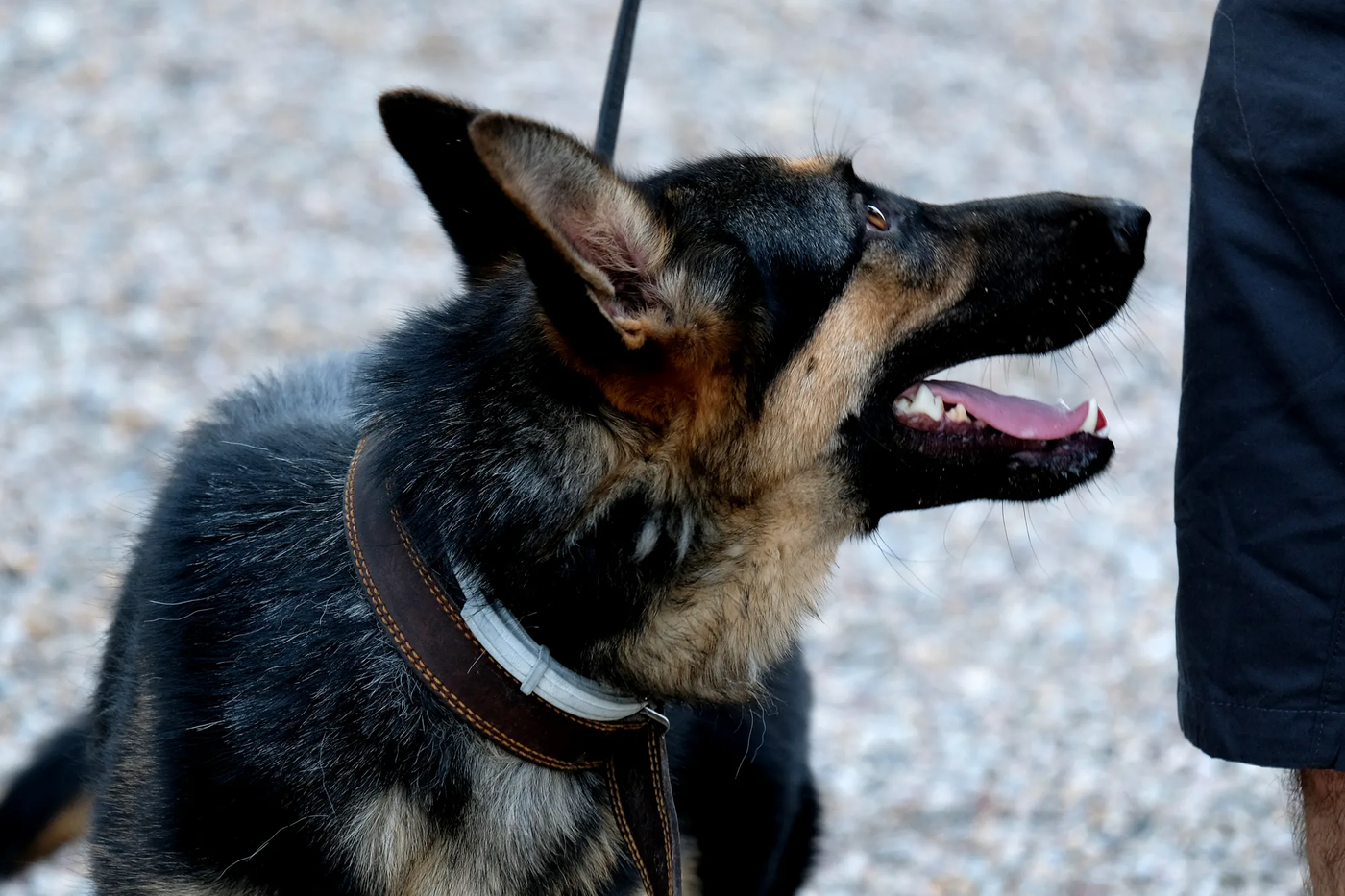
The fearful lunge is the most common: the dog sees a stranger, especially a man, a hat, a child on a scooter or someone who moves oddly, stiffens, barks, and lunges to make the person go away, and it works because the person keeps walking. The excited lunge is the doodle or the Lab that wants to greet everyone and has never learned it cannot; it wags, whines and pulls. The guarding lunge is quiet and forward: the shepherd, the Doberman or the mix that has decided strangers near its people are a problem. The method for all three is neutrality: the dog learns that people passing are none of its business, at a distance it can handle, closing over weeks, with a handler it looks to instead.
- Fear: stiff, barking, wanting the person gone
- Excitement: wagging, whining, wanting the person
- Guarding: quiet, forward, protecting its people
- One method: neutrality at a distance, over weeks
The reasoning
Why it grows, why the leash matters, and why the handler is the answer.
Every lunge that makes a stranger keep walking teaches the fearful dog that lunging works, every lunge that ends in a greeting teaches the excited dog the same, and every stranger who backs away teaches the guarding dog it was right. The leash adds frustration and removes the option to leave, so a dog that would have moved off drives the person off instead. Under it all is a dog with nobody to look to: a dog that has never been taught to check in with its handler makes its own decisions about strangers, and under pressure its decisions are bad.
Structure at home is the first move, because a dog that holds place through the doorbell and waits at the door has a habit of looking to a person for the answer. The walk is the second: a structured walk gives the dog a job at your knee, and a dog with a job has less attention for the stranger.
- Lunging works, so it grows
- The leash removes the exit and adds frustration
- No handler to look to means the dog decides
- Structure at home builds the check-in
- A walk with a job leaves less attention for strangers
What it means for your dog
Puppies, adults and the dog that has bitten a person.
A puppy that barks at strangers is unsure, and the answer is calm exposure at a distance where it can eat, paid for looking at you, never flooded and never forced to be petted. An excited adult is a manners case: a structured walk, place with duration, a rule that people on walks are not for greeting, and it changes in weeks. A fearful adult needs more time and more distance and often a stay. A guarding adult needs structure, neutrality and a handover that includes everyone in the house. A dog that has bitten a person is assessed first, managed with a muzzle it is taught to love and a leash everywhere, and worked with the same method more carefully; most can be made safe in public on a leash, and our team says on the phone if one cannot.
- Puppies: distance, food, no forced petting
- Excited adults: a manners case, weeks
- Fearful adults: time, distance, often a stay
- Guarding adults: structure and the whole household
- A bite: consultation, a muzzle, a leash for life
The Houston factor
Runners at speed, delivery drivers all day, and a stranger every thirty seconds on the loop.
Houston's sidewalks put a stranger in front of a fearful dog every thirty seconds in the Heights, West U and Montrose, with runners and cyclists at speed on the Memorial Park loop and the bayou trails, which is the hardest version for a dog that lunges at movement. The suburbs put a delivery driver at the gate ten times a day and a lawn crew in the yard weekly, which is where guarding dogs practice. The work starts where the dog can succeed, quiet streets and the store aisles along 290, moves to trails at off hours, and only then to the loop at nine on a Saturday, and it runs at dawn and dusk in summer because a hot dog has a short fuse.
Stop the rehearsals: no greetings on walks, no window or gate time during delivery hours
Build structure at home: place through the doorbell, a wait at the door
Find the distance at which the dog can see a stranger and still eat
Pay calm at that distance daily and close it a little each week
Move from quiet streets to store aisles to trails at off hours to busy hours
Add a muzzle the dog loves if there is any bite history
Keep a leash and a rule about greetings for life
The program
Platinum for the fearful or guarding dog, Gold for the excited one.
A fearful or guarding lunge is a Platinum case, three weeks at $3,750: structure in the training home, exposure to strangers at distances the dog can handle, closer every day, field trips to the sidewalks and stores where it will be tested, and unlimited lessons afterwards so the family learns the handling on their own street. An excited lunge is usually a Gold case, two weeks at $2,500, because it is manners. A bite history means an consultation before any stay. The fear of strangers page and the aggressive dog training page describe both programs in full.
The programs
Programs for a dog that lunges at people.
Platinum for the fearful or guarding dog, Gold for the excited one, lessons at home for the handling afterwards.


Asked and answered
Questions people ask about this.
Is my dog aggressive if it lunges at people?
Not necessarily. An excited dog lunges to greet and a fearful dog lunges to make the person leave, and neither is aggression in the sense of wanting to hurt anyone. A guarding lunge is closer to it. All three need the same neutrality work, and a bite history changes the plan.
Why does my dog only lunge at men or people in hats?
Because those are the people it is unsure about, often from a lack of exposure as a puppy or one bad experience. Fear is specific. The work is exposure to that type of person at a distance the dog can handle, paid for calm, closing over weeks, and never forcing a greeting.
Should I let people pet my dog to socialize it?
Not if it lunges. Forced petting floods a fearful dog and rewards an excited one. The dog needs to learn that people passing are none of its business first; greetings, if they ever come back, are the last step and only on your word.
Can a dog that bit a person be trained?
Usually to safe on a leash in public with a muzzle plan and management, yes, with an consultation first and a program that changes the feeling about strangers over weeks. Our team says plainly on the phone when a dog's history is beyond what training can safely change.
Keep reading
Free consultation · 10% off this fall
Read the body, then build the check-in.
Tell our team what your dog looks like the second before it lunges. The free phone consultation is a direct call.