
The six-month checkpoint
What should a puppy learn by 6 months?
At six months the puppy skills move out of the kitchen and onto the street, and the dog in front of you starts to look like the adult it will be. Here is what our trainers expect at this age, and what the next year asks of the family.
Last reviewed September 29, 2026 · by the Best Dog University Team
The shift
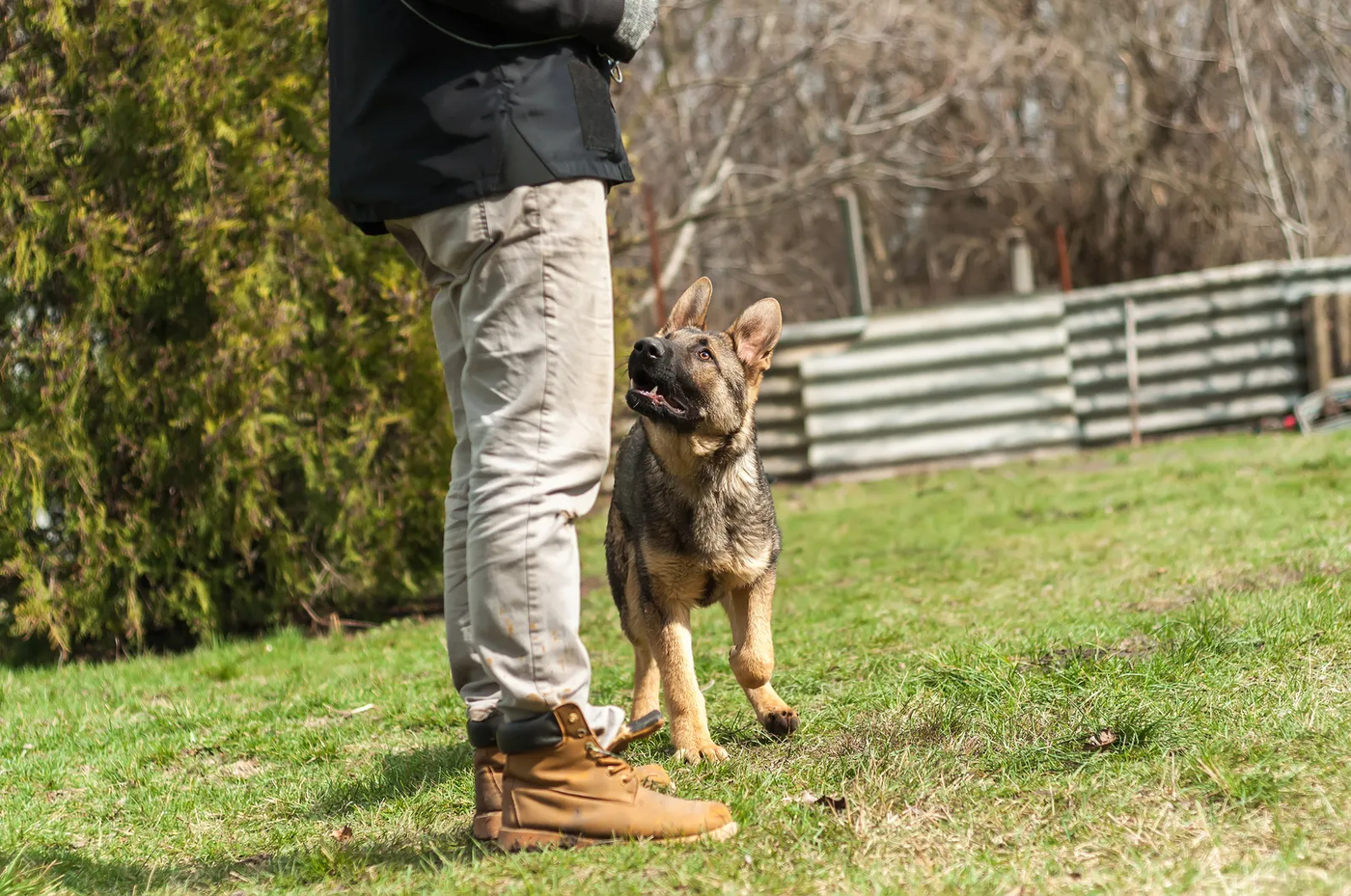
Six months is the handoff from home habits to real-world manners.
The four-month list was about routines inside the house. The six-month list takes those routines outside, adds a little distance and a little time, and asks the puppy to do them with something interesting nearby. A sit that worked in the kitchen now has to work at the mailbox, and a place bed that held for three seconds now holds while dinner is served.
The vaccine series is usually finished by now, so the sidewalk, the store aisle and the patio are open, with your veterinarian's approval. That is good news and a new risk: the first months on the street decide whether this dog pulls, greets and chases for the rest of its life.
- A sit at the mailbox, not just in the kitchen
- Place held through a family meal
- The sidewalk and store aisle are now the classroom
On the street
A loose leash, a door that waits and no greetings on the leash.
A six-month puppy should walk a quiet block beside you with the leash slack most of the time, stopping when it pulls and paid when it returns. It should wait at the front door and the car door until released, which is a safety skill on any street off FM 1960 or Mason Road. And it should watch other dogs and strangers pass at a distance without lunging to meet them.
That last one surprises families. Greeting every dog on a walk feels friendly at four months and becomes pulling, frustration and sometimes reactivity by ten. A puppy that learns dogs on walks are for looking at, not reaching, walks past them calmly as an adult.
- A quiet block with the leash mostly slack
- Front door and car door wait for a release
- Dogs and strangers watched, not greeted
- Recall in the yard and on a long line
At home
A minute of place, a crate for a work morning and a house with very few accidents.
Inside, the targets stretch. A six-month puppy should lie on its place bed for about a minute while you move around, nap in its crate through a four or five hour stretch, and be close to reliable on potty, with an accident now a rare event rather than a weekly one. Jumping on guests should be fading because it has been prevented and never paid.
Mouthing should be mostly finished as the adult teeth settle in. A six-month puppy that still grabs hands and sleeves has been paid for it somewhere, usually in rough play, and that habit is easier to end now than at a year.
Adolescence
The list will wobble after six months, and the rules have to stay exactly where they are.
Around six months many puppies stop answering, forget the recall and discover the neighbor's dog. That is adolescence, and it is normal. The answer is less freedom rather than more: the long line goes back on, the distances shrink, and the rules stay the same until the dog proves it again. A Houston puppy born in spring hits this in the fall, just as the parks fill up and the weather invites everyone outside.
A week of tightening, done calmly, usually brings the skills back. Here is how our trainers run it.
Put the long line back on for every outdoor recall
Shorten walks and pay every return to your side
Ask for place during meals, doorbells and guests
Hold the door wait every time, including the car
Pass other dogs at a distance with food, never a greeting
Train at dawn or dusk from May to September, on grass
What we do at Best Dog University
Six months is when a board and train stay starts to fit.
The Puppy Development Bundle is for puppies under four months, so a six-month puppy is past it. From about four to five months a stay makes sense: Silver, one week at $1,500, for loose leash walking, door boundaries and basic structure; Gold, two weeks at $2,500, adding sit and place stays, jumping, pulling and impulse control; and Platinum, three weeks at $3,750, when the first reactivity has appeared.
The honest fit: a puppy that is mostly on track and only needs a coach for the family does well with private lessons at $160 in Cypress or $220 in your home. On the free phone consultation, our trainers will tell you which of those fits your puppy.
The programs
Programs for a six-month puppy.
Silver or Gold to install the foundation, Platinum if reactivity has started, and lessons for a family that wants a coach.



Asked and answered
Questions people ask about this.
Is six months too late to start training?
No. Obedience, leash skills and impulse control are wide open at six months, and the adult habits are still forming. You have missed part of the early socialization window, so exposure should be calm and gradual. A focused week or two now saves a year of wrestling an adolescent later.
Why did my six-month-old stop listening?
Adolescence. The puppy is testing whether the rules are real, with a bigger body and a new interest in the world. It has not forgotten. Put the leash and long line back on, shrink the distances and keep every rule exactly where it was. Most dogs come back within weeks when the family holds steady.
Should a six-month-old puppy be off leash?
Not in open spaces. A six-month recall is still young, and adolescence is about to test it. Off-leash freedom in a fenced yard is fine; parks and trails call for a long line until the dog comes away from other dogs and wildlife reliably. That usually takes well into the second year.
Can a six-month puppy do board and train?
Yes. From about four to five months a puppy can hold a full day of structure, and six months is a common age for a first stay. Gold at $2,500 fits most puppies; Silver at $1,500 suits one that just needs leash and door manners; Platinum at $3,750 fits a puppy already reacting to dogs or people.
Sources
Keep reading
Free consultation · 10% off this fall
Six months in, set the adult habits now.
Tell our team what your puppy does well and where it has slipped. The free phone consultation is a direct call with our trainers.