
Where thinking stops
What is threshold in dog training?
If you live with a reactive or fearful dog, threshold is the most useful word in dog training. It explains why the same dog is fine at one distance and frantic at another, and it tells you where the work has to happen.
Last reviewed September 29, 2026 · by the Best Dog University Team
Under and over
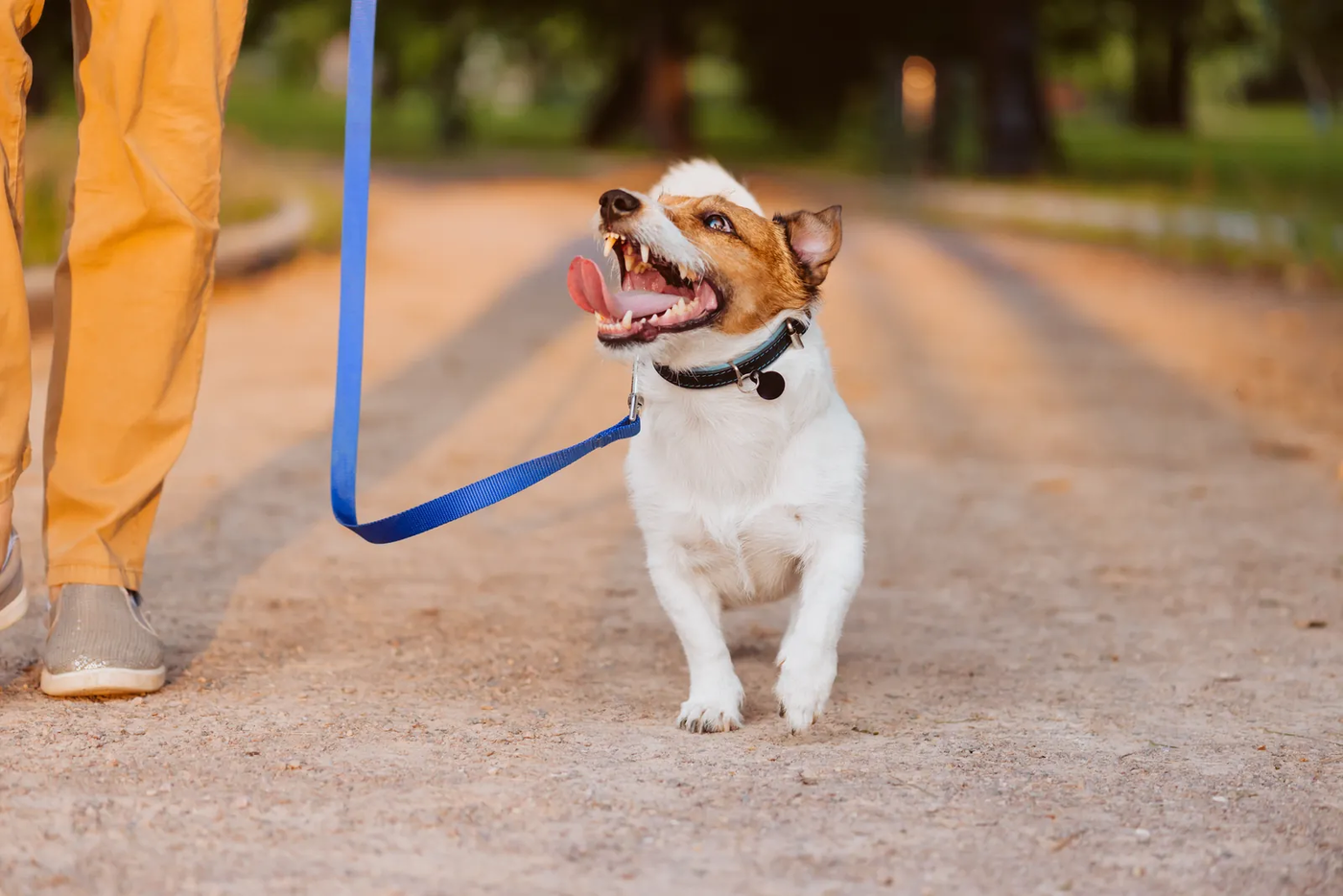
Under threshold the dog can learn; over threshold it can only react.
A dog under threshold notices the other dog, the jogger or the bicycle, and can still take food, look back at you and answer its name. Its body is loose and its mouth may be soft. As it approaches threshold, things change: the body stiffens, the stare fixes, the mouth closes and food suddenly stops mattering. Over threshold, the dog is lunging, barking, spinning, frozen or trying to leave.
Nothing useful is learned over threshold. The dog is in survival mode, and a correction or a command at that moment adds noise rather than information. The skill is spotting the early signs and acting while the dog can still think.
- Under: takes food, looks back, answers its name
- Approaching: stiff body, fixed stare, closed mouth
- Over: lunging, barking, freezing or bolting
- Nothing is learned over threshold
It moves
Threshold is a distance, and it changes with the trigger and the day.
A sleeping dog behind a fence is easier than a barking one at the end of a leash. A child standing still is easier than one on a scooter. So the threshold distance depends on what the trigger is doing, as well as how far away it is. It also depends on the dog's day. Stresses add up, and a dog that has already heard a storm, met the lawn crew and been walked in the heat has less room left.
Houston stacks these up in predictable ways. A July afternoon walk puts a hot, uncomfortable dog near other dogs; the days after July 4 or New Year fireworks leave many dogs on edge; a week of hurricane-season storms keeps them indoors and restless. On those days, choose a bigger distance, a quieter route or a training session at home instead.
- A moving trigger needs more distance
- A stressful day shrinks the room
- Heat, fireworks and storm weeks count
- Bad day: more distance or stay home
Working under it
Find the distance where your dog can still eat, and pay calm there.
This is the core of most reactivity work, and it happens at the edges of parking lots and quiet parks rather than on the busiest trail.
Pick a spot where triggers appear at a distance, such as the edge of a big lot or a quiet park.
Find the distance where your dog notices a trigger and still takes food.
Each time the dog looks at the trigger calmly, mark it and feed.
If the dog stiffens or stops eating, calmly move further away; do not correct it mid-reaction.
End the session while the dog is still relaxed.
Over the following weeks, close the distance a little at a time, only when the dog is easy at the current one.
At the door
At the door, threshold means something different: the dog waits until it is released.
Many trainers talk about threshold training when they mean door boundaries. Here the threshold is literal: the line of the doorway. The dog learns to stop and wait at any open door, gate or car door until it hears a release word, rather than bursting through.
In Houston that skill matters. A dog that shoots out the front door toward a busy street, a delivery van or a neighbor's dog is in real danger, and fireworks season is when the most dogs slip out and go missing. A dog that waits at the threshold, every time, is simply safer.
- The doorway, gate or car door is the line
- The dog waits until released
- Guests and deliveries become calm
- Fewer dogs lost on fireworks nights
At Best Dog University
Reactivity is Platinum work, and door boundaries start in every stay.
For a dog that reacts to other dogs, people or traffic, the three-week Platinum program at $3,750 is the honest fit. It includes behavior modification for reactivity, field trips where our trainers work at the right distance and close it gradually, and unlimited private lessons afterward so you learn to read your dog's threshold on your own streets. Reactivity is reduced and managed, not deleted, and we say so on the first call.
Door boundaries are built from the one-week Silver program at $1,500 upward, and the two-week Gold program at $2,500 adds impulse control. Private lessons, $160 in Cypress or $220 at home, help a family that wants to learn threshold work with a trainer beside them.
The programs
Reactivity needs time; doors need rules.
Platinum does the threshold work for reactive dogs; Gold and Silver build door boundaries; lessons teach you to read your dog.


Asked and answered
Questions people ask about this.
How do I find my dog's threshold distance?
Watch whether your dog takes food. Start far from a trigger and move closer slowly over several sessions. The point where it stops eating, stiffens or fixes its stare is at or near threshold. Work a little further back than that, where the dog is aware but relaxed.
Can a dog's threshold distance get smaller?
Yes, that is the goal of the work. With repeated calm experiences at a comfortable distance, many dogs can be closer to triggers over weeks and months. How far it shrinks varies by dog, and some dogs always need more space than others. Pushing too fast usually sets it back.
What is trigger stacking?
It is when several stresses pile up close together, such as a storm, a visitor and a loud truck, and the dog reacts to something it would normally handle. The threshold effectively drops. On stacked days, keep walks short and quiet and give the dog a calm day to recover.
Should I correct my dog when it goes over threshold?
A dog that is already over threshold cannot learn from a correction or a command at that moment. Calmly move away and reset. Clear, fair boundaries do have a place in balanced reactivity work, but they are taught under threshold, after the dog understands what is being asked.
Is threshold training at the door the same thing?
It is a different use of the same word. Door threshold training teaches the dog to wait at doorways until released. Reactivity threshold is about distance from triggers. Both matter, and both are part of how our trainers build a calmer, safer dog.
Keep reading
Free consultation · 10% off this fall
Living with a reactive dog?
Tell our team what your dog reacts to and at what distance on a free phone consultation. We will say whether Platinum or lessons fits, and a $250 deposit reserves a stay.