
The method, defined
What is balanced dog training?
Balanced training is often described by what people fear about it rather than what it is. Here is a plain definition, what a session looks like, and how it compares with the other approaches you will hear about.
Last reviewed September 29, 2026 · by the Best Dog University Team
The four parts
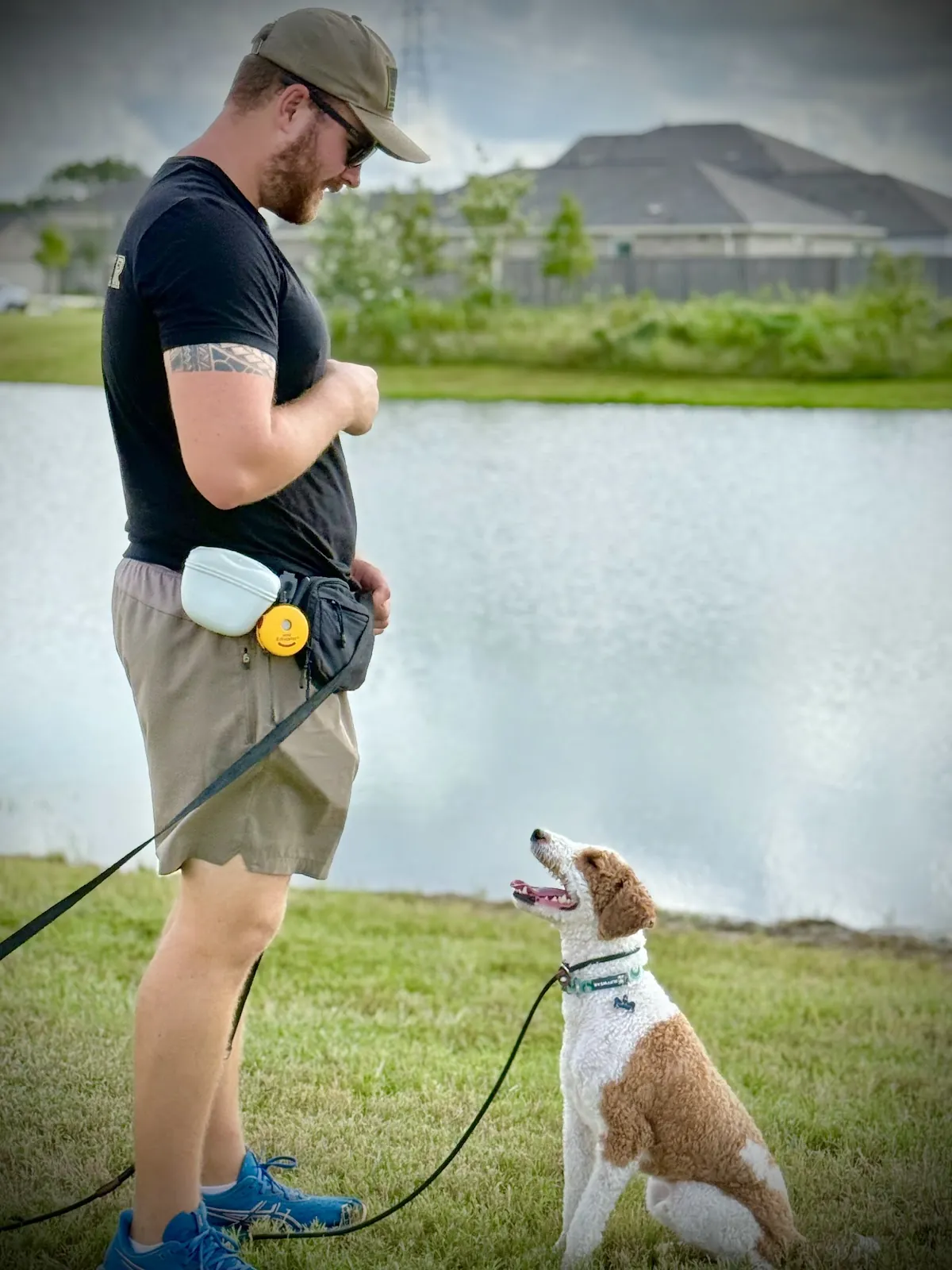
Rewards, boundaries, the right tool and real places.
Rewards come first. Every new skill is taught with food, praise and play, marked at the moment the dog gets it right, until the dog understands it. Boundaries come second. Once the dog knows what is asked, a boundary is a fair, predictable consequence for ignoring it, such as the leash stopping the walk, a return to the place bed, or a brief signal on a collar the dog has already learned.
The third part is the tool. A soft young dog and a strong adult do not need the same equipment, and the tool is picked for the dog, fitted properly and taught to the family. The fourth part is real places. A skill that only works in a kitchen is not finished, so practice moves to sidewalks, stores and parks.
- Rewards: food, praise and freedom for wanted behavior
- Boundaries: fair, predictable consequences after teaching
- Tools: chosen per dog and taught to the family
- Real places: sidewalks, stores and parks
A session
Here is how a balanced session teaches a dog to wait at the door.
Teaching a dog to wait at an open door shows the method clearly. First, the dog is taught to sit and hold still with food, in a quiet room, with the door closed. Then the door opens a crack, and the dog is paid for staying. As the dog understands, the door opens wider and the reward comes for holding position.
Only when the dog clearly knows the skill does a boundary appear: if it breaks, the door closes and the leash calmly returns it to its spot. The dog gets a clear yes when it stays and a clear no when it bolts, and within a few days most dogs hold the wait happily.
Teach the behavior with food in a quiet place.
Add small distractions and keep paying for success.
Once the dog understands, introduce a fair, predictable boundary for ignoring the cue.
Keep rewarding generously for the right choice.
Move the skill to real places with real distractions.
Teach the family the same routine at the handover.
How it compares
It sits between reward-only training and force-based training.
Reward-only training uses rewards and management, and avoids corrections. It is excellent for teaching new skills and for puppies, and our trainers use the same rewards. Old-style force-based training relies heavily on corrections, often before the dog understands. Balanced training takes the teaching of the first and adds fair boundaries, while rejecting the force of the second.
| Approach | How it teaches | Where it struggles |
|---|---|---|
| Reward-only | Rewards and management, no corrections | Stopping behavior the world rewards, like chasing or lunging |
| Balanced | Rewards first, then fair boundaries, tools per dog | Depends on a skilled, calm handler |
| Force-based | Corrections first, often before teaching | Fear, confusion and a shut-down dog |
In Houston
Real Houston places and a heat calendar shape how the method is practiced.
Real places matter in a big, busy city. Dogs in our programs practice at the pet and hardware stores along 290, on neighborhood sidewalks in Cypress and at the lake, so the calm you see at home holds up on a busy Saturday. Platinum and VIP dogs go on those field trips as part of the program.
Summer changes the schedule. From May to September, outdoor sessions happen early in the morning and in the evening, and pavement is tested with a hand before a dog walks on it. The middle of the day is for place work and indoor skills.
- Field trips to stores and sidewalks
- Early and late outdoor sessions in summer
- Pavement tested before walks
- Indoor place work in the heat of the day
At Best Dog University
Every program is balanced, explained and shown at the go-home session.
Every program uses the same balanced method: Silver at $1,500, Gold at $2,500, Platinum at $3,750, and VIP at $10,000, which includes the Mini-Educator e-collar. Private lessons, at $160 in Cypress or $220 in your home, teach the same method, and the Puppy Development Bundle at $550 or $750 is almost entirely rewards and management.
The method is explained on the free phone consultation, and the go-home session shows exactly how your dog was trained and how to keep it going. The honest fit depends on the dog: Platinum for behavior problems, Gold for manners, VIP for off-leash reliability.
The programs
Programs built on balanced training.
Gold for manners, Platinum for behavior modification, VIP for service-dog-level obedience and off-leash reliability.



Asked and answered
Questions people ask about this.
Is balanced training the same as using an e-collar?
No. An e-collar is one possible tool, and many balanced-trained dogs never wear one. The method is about teaching first, rewarding generously and adding fair boundaries. At Best Dog University the e-collar is included in VIP and introduced only after the dog knows the command.
Is balanced training cruel?
Not when it is done properly, with teaching before correction and tools used as communication rather than punishment. Cruelty is force without teaching, and it can happen under any label. A balanced-trained dog should look relaxed, engaged and confident.
Do balanced trainers use treats?
Yes. Food is how a dog learns what a word means, and it is used for every new skill. It fades as the skill becomes reliable and is replaced by praise, play and freedom, so the behavior holds when your pockets are empty.
Is balanced training right for a fearful dog?
The balanced approach adjusts to the dog. A fearful dog gets structure, distance and rewards, and pressure tools are not used on fear. The boundaries for a nervous dog are mostly management, such as the leash, the place bed and the closed door.
Keep reading
Free consultation · 10% off this fall
Want to see the method in person?
Talk to our team on a free phone consultation. We will explain exactly how your dog would be trained and which program fits.