
Recall on a long line
How to teach recall with a long line
Off-leash reliability starts on a leash you cannot feel. A long line lets a dog make choices with the freedom of an open field and the certainty that the word still works. This is how our trainers build recall at the lake and the parks around Cypress, and how you can build the first stage yourself.
Last reviewed September 10, 2026 · by the Best Dog University Team

Why a long line
The long line makes recall enforceable, and enforceable is what makes it reliable.
A recall fails for one reason: the dog learned that the word is a suggestion. He heard it, weighed it against the squirrel, and chose the squirrel with no consequence. Every ignored call makes the next one weaker. The long line ends that. When you say the word, one of two things happens: he comes and gets paid, or the line brings him in and he gets paid anyway. The word always ends at your feet.
- A 20 to 30 foot biothane or flat nylon line, never a retractable
- A flat collar or back-clip harness, no slip or prong on the long line
- Gloves, so a running dog does not burn your hands
- High-value food you do not use anywhere else
- A recall word that is not his name and has never been wasted
The method
Six steps from a drifting dog to a dog who turns on one word.
Pick a word you have never used casually. Most people have ruined "come" by saying it forty times a day at the back door, so our clients often start fresh with "here". Say the name to get attention, the word once, and then act. The first week is about making the word predict good things at your feet, not about distance.
Attach the line, drop it on the grass and let him wander toward the end of it. Step on the line when you need to; do not hold it tight.
When he is mildly distracted, say his name and "here" once, in a normal voice. Then move backward a few steps.
If he turns, mark with "yes" immediately, keep moving back so he chases you, and feed at your feet. Then release him with "break" to go sniff again.
If he ignores you, pick up the line and bring him in with steady pressure, no yanking. Feed him anyway when he arrives. The word always ends at you.
Repeat ten times a session. Call from farther away and while he is sniffing something better each time.
Add a collar grab before the food. A dog who comes but dances out of reach has not finished the recall.
Where in Houston
Practice in open grass, away from water edges and roads.
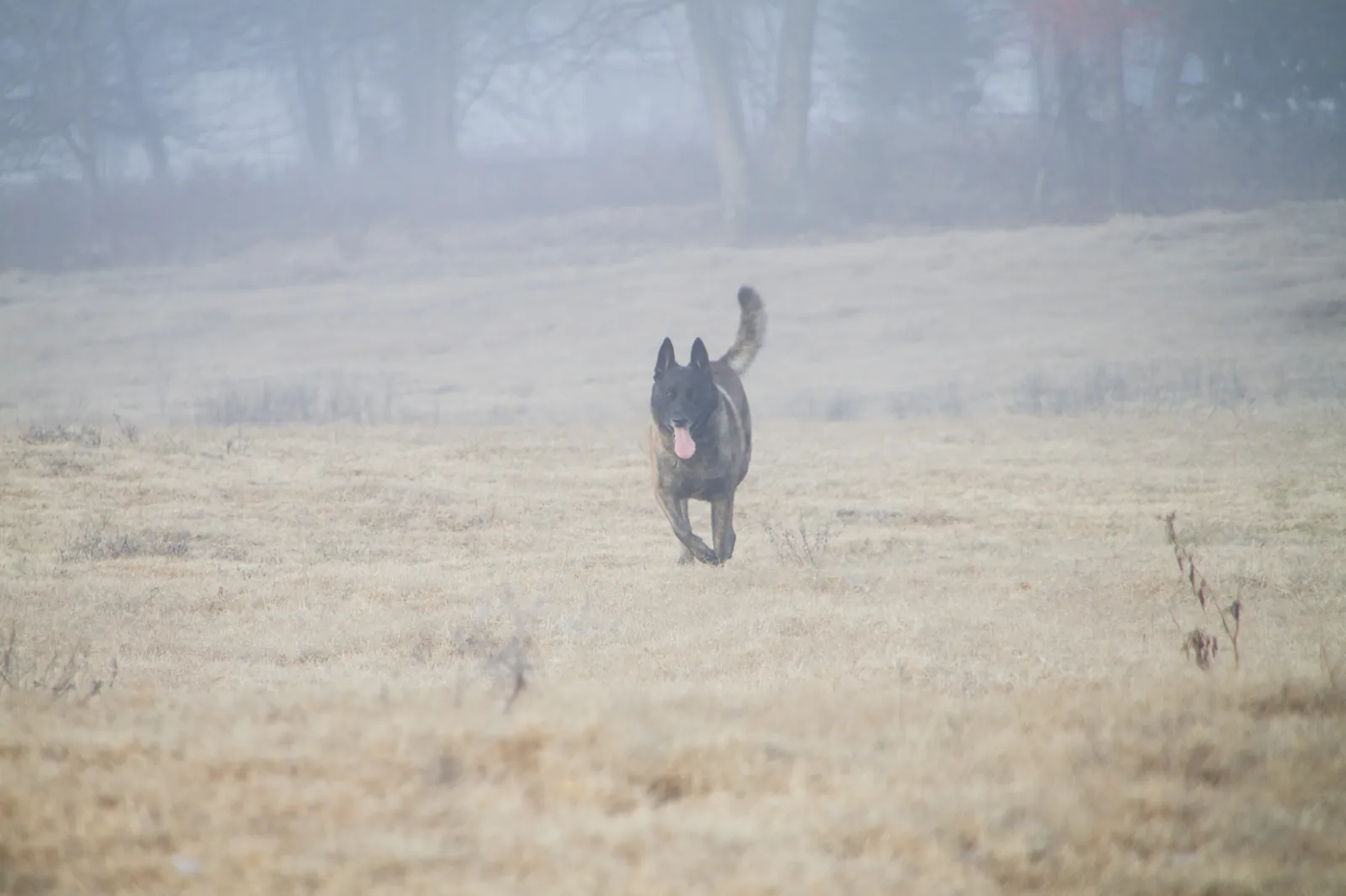
The best long-line ground is a flat, mowed field with sight lines and nothing to wrap the line around. The larger Harris County Precinct 4 parks around Cypress have open lawns that work well early on a weekday morning, before the soccer teams and the heat arrive. Fenced dog parks are for the finished dog; an empty one at 7 a.m. can be useful, but a full one is a test your dog is not ready for.
- Open fields at Harris County Precinct 4 parks, early on weekday mornings
- Fenced dog parks only when empty; off leash is only allowed inside them
- Well back from bayou and lake edges, where alligators live
- Grass checked for fire ant mounds before the line goes down
- Nothing outdoors from late morning to early evening, May through September
Mistakes
The mistakes that teach a dog the word is optional.
The most damaging mistake is calling the dog to end the fun. If "here" always means the leash goes on and the car door opens, a smart dog learns to avoid it. Call him ten times for a piece of food and a release for every one time you call him to leave. The second is repeating the word. Three "here"s, each softer than the last, teach him that the first two are free.
- Calling him only to end the fun, so the word means the car
- Repeating the word, each time softer than the last
- Calling mid-chase with the line out of reach
- Correcting him when he finally arrives
- Going off leash after one good week
From line to off leash
Drop the line before you remove it, and expect the transition to take weeks.
The line comes off in stages. First it drags and you never touch it. Then you cut it to ten feet, then five, then a short tab that hangs from the collar. Each stage runs for weeks in different places, at different times of day, with different distractions. If the recall fails at any stage, go back one, not to zero.
Even a finished dog stays on a line near roads and water in Houston. Retention ponds sit behind half the fences in Bridgeland, the bayous run through every part of the city, and the leash law applies outside designated dog parks. Off leash is a level of trust you build in fields and use with judgment.
When it is more than recall
Prey drive, bolting and a dog who has never come back are a case for our team.
Some dogs come every time until a squirrel, a deer on a Tomball trail or a cat in Towne Lake flips a switch. Others have escaped so many times that the word means nothing at all. A dog with strong prey drive is not being disobedient. He is running a program older than training, and a treat at the end of a line does not compete with it at fifty yards.
The programs
Recall built by our trainers, from the line to off leash.
Platinum builds the foundation on a long line at the lake and the parks. VIP takes it to complete off-leash reliability with an e-collar included.


Asked and answered
Questions people ask about this.
How long should a long line for recall training be?
Twenty to thirty feet is the useful range. Shorter than fifteen feet and the dog never gets far enough away to practice a real recall. Longer than thirty and the line tangles, wraps trees and becomes hard to step on in time. Biothane is easiest to handle when wet or muddy, which around Houston is most of the year.
Can I use a retractable leash instead of a long line?
No. A retractable keeps constant tension, so the dog never feels the difference between slack and a cue. The thin cord can also cut hands and legs when a dog hits the end at speed. A flat long line lies on the ground, can be stepped on, and gives you a real handhold when you need to follow through.
Where can I let my dog off leash in Houston?
At the time of writing, only inside designated off-leash dog parks. The City of Houston lists its parks and rules on the Parks and Recreation site, and Harris County Precinct 4 lists its own. Everywhere else, including trails and neighborhood greenbelts, a leash is required. A long line keeps you legal while you train.
How long until my dog is reliable off leash?
Longer than most people hope. The word itself can be strong in a few weeks. Reliability around real distractions, in new places, at distance, usually takes months of long-line work followed by a careful transition. A dog who comes every time in the yard is not off-leash ready. Our VIP program spends six full weeks on it.
Do I need an e-collar for recall?
Not for the long-line stage, and many dogs never need one. An e-collar becomes useful when a dog with high prey drive needs the word to reach him at distance, beyond what a line can cover. Our trainers use the Mini-Educator in the VIP program after the foundation is built, never as a shortcut around it.
Keep reading
Free consultation · 10% off this fall
Want a recall you can trust at the lake?
Call us for a free phone consultation. Tell our team what your dog runs after and where, and they will say whether Platinum or VIP is the right road to off leash.