
Breed training guides
How to train a Mini goldendoodle: small size, full doodle energy
The mini goldendoodle is the doodle we see most in Midtown apartments and Montrose townhomes, and the calls are about jumping, mouthing and crying when alone. Small size is not a training plan.
Last reviewed September 29, 2026 · by the Best Dog University Team

What the cross was made from
Two retrievers, one small body: the golden's mouth and the poodle's spring.
The golden retriever was bred to fetch shot birds from cold water and carry them gently, and the poodle, before it was a show dog, did the same job. The mini comes from a golden and a miniature poodle, or from smaller doodles bred together, and has a wavy, low-shedding coat that needs a groomer. From both sides it inherits a mouth that wants to hold something, a body that bounces, a deep need for people and a friendliness toward every stranger on the sidewalk.
Nothing in that history involves herding, guarding or hunting alone, which makes this one of the easiest temperaments we train. The problems come from size. A small dog that jumps is picked up, a dog that mouths is laughed at, a dog that cries in the crate is brought into the bed, and by a year the family has a sweet dog with no rules. Balanced training treats the mini like its bigger cousin: rewards for calm, clear boundaries for the rest, four paws on the floor.
- Retriever mouth: carries socks, shoes and hands
- Bounce and friendliness toward every stranger
- Small enough to be carried, which is the trap
The first year
The first twelve months: floor rules, alone time, and the adolescent that forgets them.
A mini goldendoodle puppy learns the greeting rule on day one: nobody touches it while its paws are off the floor, and nobody picks it up to stop a behavior. The crate is covered and in a quiet room, meals are eaten inside it, and the puppy spends its first short stretches alone while someone is still home, so that being alone is normal before it is necessary. The mouth is redirected to a toy every single time, and the game ends when teeth touch skin twice.
By four months the puppy holds a place bed while the door opens, walks at your knee along the block before eight in the morning, and has ridden an elevator or sat under a patio table without being lifted. Adolescence starts around seven months and runs to fourteen: the jumping returns, the recall wobbles and the dog tests the couch rule. The answer is the same rules with less freedom, the house leash back on, and place sessions shortened rather than abandoned.
Eight to twelve weeks: four paws on the floor, covered crate, a toy for the mouth
Three to four months: place as the door opens, the walk at the knee, the first elevator
Four to six months: alone time in growing doses, a light long line in the yard
Six to seven months: the greeting proofed with guests, a settle on a coffee shop patio
Seven to fourteen months: adolescence, the leash back on indoors, rules unchanged
Fourteen months on: freedom earned, fetch with a wait and a release
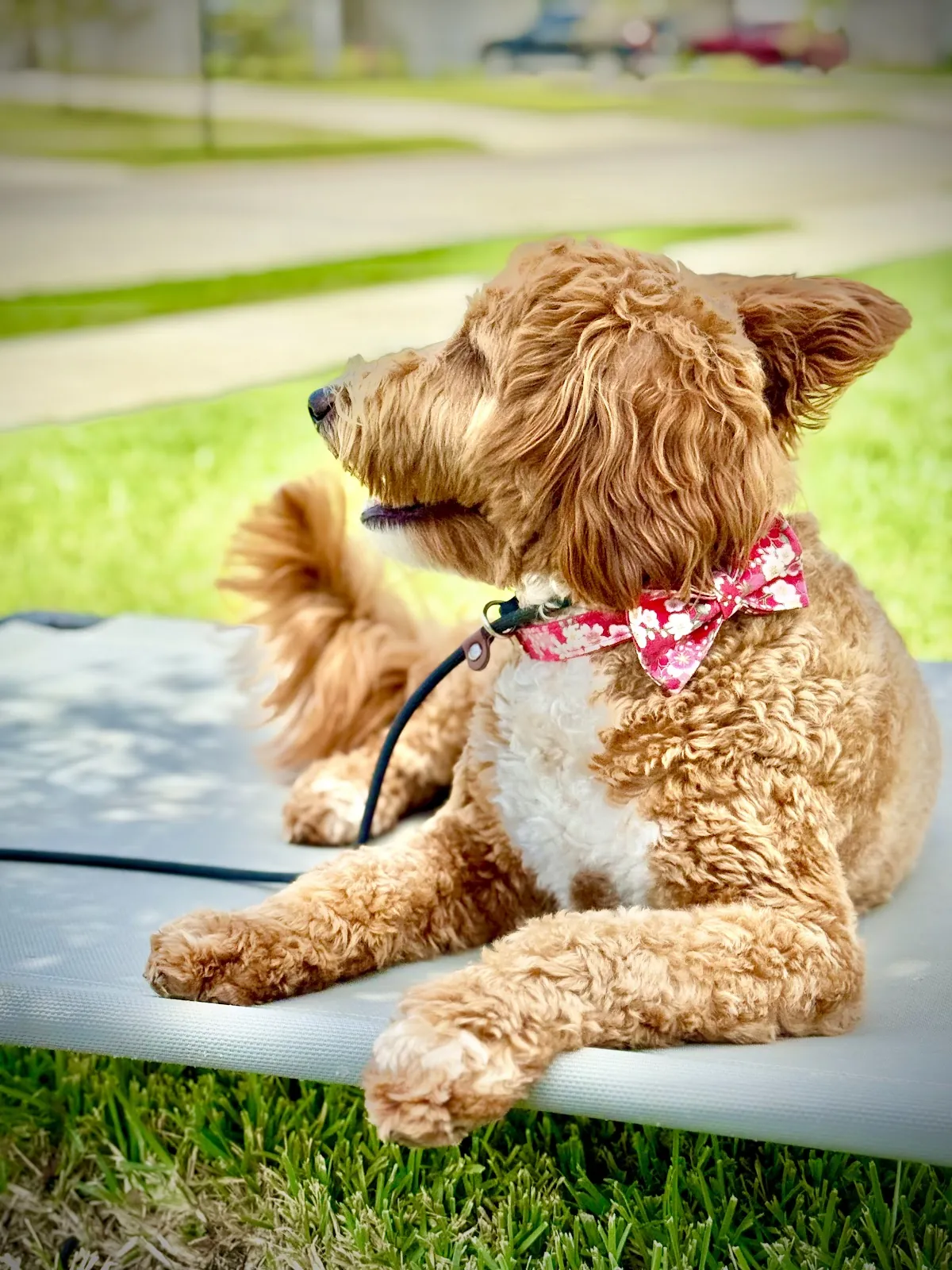
The three problems
Jumping that gets rewarded, a mouth on everything, and crying when the door closes.
Jumping is the first problem because it works: a small dog that jumps gets picked up, cuddled or laughed at. The method is a greeting from a place bed, guests who turn away until four paws are down, and a family that never scoops the dog up to stop a behavior. Mouthing is the second. A retriever cross wants something in its mouth, so give it something legal: a chew always available, a trade taught with treats, and a leave-it for socks and the remote.
Separation is the third and hardest. A mini that has slept in the bed and been carried everywhere has never learned to be alone. We build it in doses: crate calm while you shower, then a short errand, then a half day, always with a chew and a routine. Crying that continues for an hour after you leave, or a dog that damages a door or a crate, is past the home plan and needs a Platinum stay with the follow-up lessons.
- Greeting from place, guests turn away from the jump
- A legal chew and a trade for the mouth
- Alone time in doses, always with a routine
Houston specifics
A small doodle in a Midtown elevator, a Montrose patio, and a July 4 that needs a plan.
The mini is built for Houston apartment life if the rules exist: it fits an elevator, a rooftop dog run and a patio table. The elevator is where the greeting gets proofed, since every ride has a stranger in it, and a mini that rides in someone's arms never learns. Buffalo Bayou Park and the Discovery Green dog runs are the field trips; the Bagby Street sidewalks are the daily walk. Fireworks on July 4 and New Year's Eve are loud in dense neighborhoods, so set up a covered crate and white noise weeks before.
Heat is less of a problem for a clipped coat than for a double coat, but a small dog is close to the pavement and heats up fast. From May through September the walks are early and late, with the pavement test at the door and water on every outing. Mosquitoes carry heartworm year-round in Houston, so monthly prevention is part of the routine rather than a summer thing.
When to get help
Ask for help when the small dog is running the apartment.
The Puppy Development Bundle, four private sessions for $550 at our Cypress home or $750 at yours, fits a mini under four months while everything is still easy. A dog past six months with jumping and mouthing in full swing is a Gold stay, two weeks at $2,500, and comes home with place, the calm greeting and a follow-up lesson. Separation panic is Platinum, three weeks for $3,750, with the unlimited lessons that make the plan stick.
The mini goldendoodle training page covers each program in Houston terms. Central Houston to the training home is about 30 to 45 minutes outside rush hour, and the $250 transportation service is the usual choice for apartment families without a car. The free consultation call is where it starts: tell our team what the dog does when guests arrive and when you leave.
The programs
Programs mini goldendoodles usually need.
The puppy bundle while it is easy, Gold for jumping and the mouth, Platinum for the dog that panics alone.


Asked and answered
Questions people ask about this.
Are mini goldendoodles easy to train?
Yes. The cross has two soft, people-focused parents and no herding or guarding instinct, so it takes to rules quickly. Families rarely set any, because a small dog that jumps or mouths seems harmless. Treat it like a big dog from the first week and it is a delight.
Do mini goldendoodles bark a lot?
Some do, mostly out of excitement at the door or loneliness when left. It is not an alert breed the way a terrier or a herding cross is. A calm greeting routine, alone time taught in doses and a chew for the quiet hours handle most of it. Persistent barking after you leave is a separation sign worth a call.
Can a mini goldendoodle be left alone in an apartment?
A trained adult can manage a workday with a walk before and after and a midday break if possible, in a crate or room it has learned to rest in. The cross bonds hard, so alone time has to be taught from puppyhood in small steps. Skipping that is how most separation cases begin.
When does a mini goldendoodle calm down?
Usually between eighteen months and two years, with training. Adolescence from seven to fourteen months is the bouncy, forgetful stretch, and holding the greeting rule and the place bed through it is what brings the calm. A mini that was carried and excused for a year stays a puppy much longer.
Does the mini's size change how it is trained?
Only in the temptation to skip it. The method is the same as for a standard goldendoodle: place, a four-paws greeting, alone time, a structured walk. The one real difference is heat: summer walks are short and early, because a small dog rides close to hot pavement.
Keep reading
Free consultation · 10% off this fall
Put the small dog on the floor.
Tell our team what your mini goldendoodle does at the door and when you leave. The free consultation call costs nothing and takes a few minutes.