
Only on the leash
Why is my dog aggressive on leash but fine off leash?
It is one of the most common patterns our trainers see, and one of the most misread. The dog that plays well at the park is not necessarily fine with dogs; it may simply be fine when it can choose.
Last reviewed September 29, 2026 · by the Best Dog University Team
The answer
The leash takes away the dog's choices and adds pressure, so the reaction happens there.
Off leash, dogs meet in curves. They approach at an angle, sniff from the side, look away and move off when they want to. A leash on a four-foot sidewalk forces a straight-on approach with no room to turn, which in dog terms is rude and can feel threatening. A nervous dog that cannot move away may decide the best option is to bark and lunge first. That is fight when flight is not available.
Frustration is the other half. A social dog that has always been allowed to greet may pull toward every dog, get stopped at the end of the leash, and boil over into barking and lunging. From across the street it looks like aggression; it is often a dog that wanted to say hello and was not allowed. Add a handler who sees a dog coming, shortens the leash and holds their breath, and the dog learns that other dogs predict tension at the other end of the leash, which makes the next meeting more charged still.
- No escape route: flight becomes fight
- Face-on sidewalk meetings feel rude to dogs
- Frustration at being held back from greeting
- A tight leash and a tense handler add pressure
About off leash
Fine off leash usually means the dog can avoid, not that every meeting is safe.
A dog that plays happily at the dog park may be managing well because it can leave, pick its friends and ignore the dogs it does not like. That is a useful sign that it has social skills. It does not mean the leash problem will go away if you let the dog off leash more, and it does not mean every off-leash meeting will go well, especially with an unfamiliar or pushy dog.
Letting a leash-reactive dog loose to sort it out is also unsafe, since leash laws apply in most public places around Houston and an unfamiliar dog may be on leash for a reason. Check BARC or your city's rules for the current requirements. The safer reading of a dog that is fine off leash is this: it has the social skills to build on, and the work is to give it the same calm on a leash that it already finds when it has room to choose.
- It shows social skill, which is good news
- It does not fix the leash problem
- Not every off-leash meeting will go well
- Leash rules apply in most public places
What to do on walks
No greetings, a loose leash and space given early.
The first change is the easiest: stop all on-leash greetings, even with friendly dogs, so the dog stops expecting to reach every dog it sees. The second is the leash. Keep it loose, and when you see a dog coming, change direction or cross the street before your dog locks on, rather than tightening up and hoping. A calm U-turn, taught at home first, is the most useful move a reactive-dog handler has.
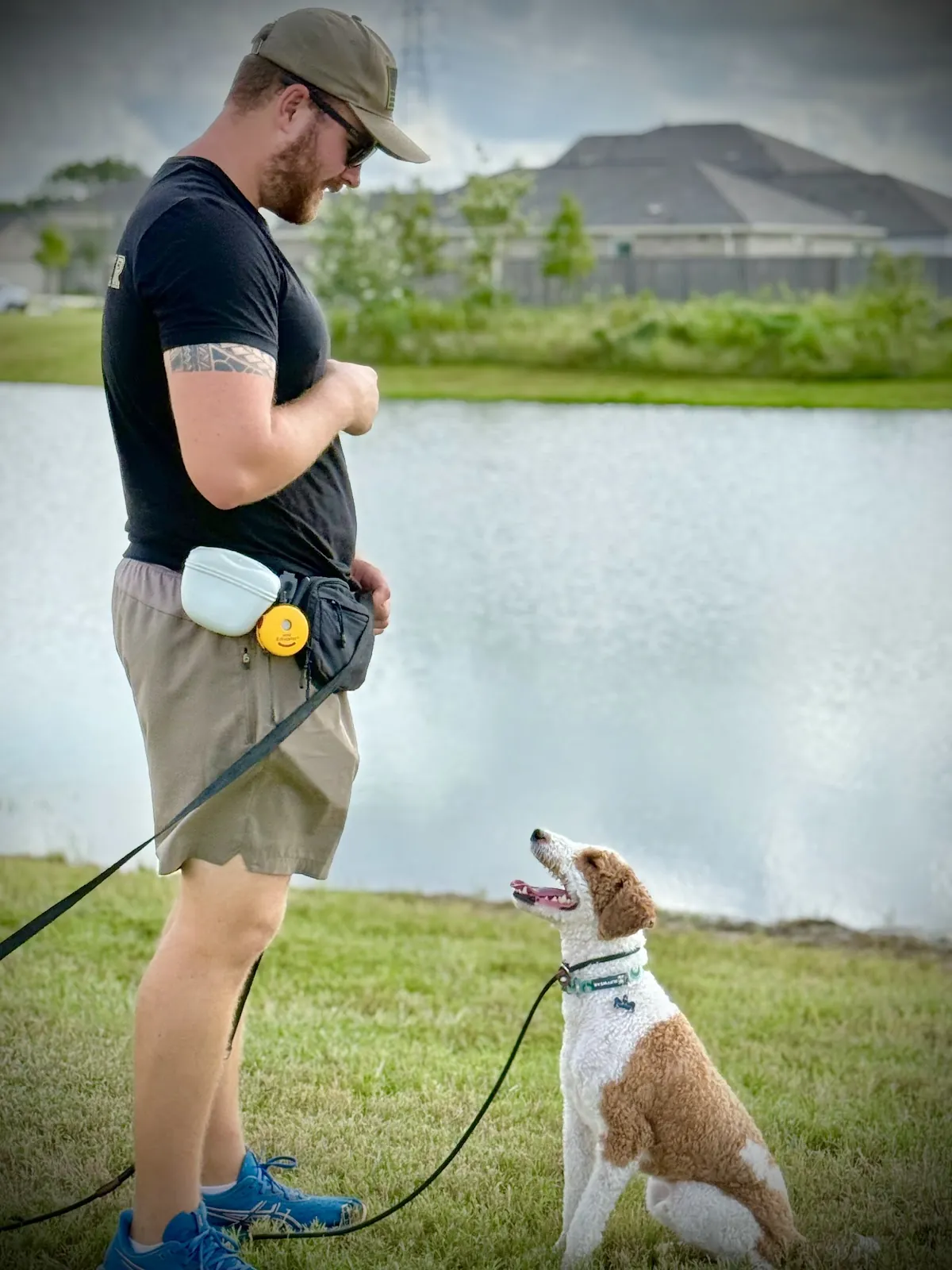
Then build the structured walk: a heel where the dog walks beside you, checks in with you and follows your turns. A dog with a clear job on the leash has less room to fixate on other dogs, and it trusts you to handle the space. Practice it first where there are no dogs at all, in the driveway and on quiet streets, until the turns are smooth and the dog is watching you, and only then take it to places where another dog might appear.
Stop all on-leash greetings, even with dogs you know
Keep the leash loose and your own body relaxed
Practice a cheerful U-turn at home and in quiet streets first
Turn or cross early, before the dog fixes on the other dog
Reward looks at another dog followed by a look back at you
Build a structured heel so the dog follows your lead
Increase exposure slowly, at distances the dog can handle
The Houston factor
Narrow sidewalks, busy weekend trails and apartment hallways leave no room to curve.
Many Houston walking routes leave nowhere to go. Older neighborhoods like the Heights and Montrose have narrow sidewalks with cars parked along them, the trail loops at Memorial Park and Terry Hershey Park fill up on weekend mornings, and apartment and townhome dogs meet other dogs head on in hallways, elevators and parking garages. In summer everyone walks at the same cool hours, so the dog density goes up just as tempers shorten in the heat.
Pick your routes and times on purpose while you train: wider streets, quieter hours, open spaces where you can see dogs coming from far off. Early morning in October is a very different walk from a Saturday in July. A parking lot at a quiet time, with a clear view in every direction, is often a better training spot than a crowded trail, because you can see dogs coming from far enough away to act early.
At Best Dog University
Platinum is the usual fit for leash reactivity, and VIP adds off-leash reliability.
Leash reactivity and leash aggression are the core of the three-week Platinum program at $3,750. The dog learns a structured heel, place and impulse control, then meets other dogs on purpose, at distances it can handle, on field trips to real sidewalks, stores and parks, and you get a comprehensive handover and unlimited private lessons afterwards. The six-week VIP program at $10,000 adds complete off-leash reliability. A mild case, frustration without real intent, can start with private lessons at $160 or $220. We do not promise a cure; we build a dog you can walk.
The programs
Programs for the dog that reacts on the leash.
Platinum for most leash-reactive dogs, VIP when off-leash reliability matters, private lessons for mild frustration.


Asked and answered
Questions people ask about this.
Should I drop the leash if my dog is better off leash?
No. Dropping the leash in public is unsafe, often against local leash rules, and does not teach the dog anything about meeting dogs calmly on a leash. The work is to make the leash feel less restrictive, through a loose leash, space and structure, not to remove it.
Is a leash-reactive dog an aggressive dog?
Not always. Many leash-reactive dogs are frustrated or afraid and would not start a fight off leash. Some are genuinely aggressive. A trainer watching the dog at a safe distance can usually tell you which, and it changes the plan and the program.
Does a harness help with leash reactivity?
A well-fitted harness or a properly used training collar can give you better control, which makes walks safer. No tool changes the reason the dog reacts. The fix is still distance, a loose leash, no greetings and a structured walk, with the tool chosen to suit the dog.
Why does my dog react more when I am walking it?
Dogs are sensitive to handler tension. If you tighten the leash, hold your breath or shorten your stride when you see another dog, your dog notices and expects trouble. Practicing a relaxed U-turn and planning your routes helps you stay calm, and your dog follows.
Keep reading
Free consultation · 10% off this fall
Loosen the leash, then teach the walk.
Tell our team where your walks go wrong and how close the other dogs get. Talk to our team on a free consultation call.