
Tools after the stay
Do I need a prong collar after board and train?
Families ask this on the consultation call and again at pick-up, usually because a neighbor has an opinion about the collar. The honest answer depends on your dog, so here is how the decision gets made and what it means for your walks in Cypress or across Houston.
Last reviewed September 29, 2026 · by the Best Dog University Team
The short answer
You need it only if your dog trained on it, and only while the walk still depends on it.
Nobody at Best Dog University puts a prong collar on a dog by default. The walk is taught first with food, a loose line and a clear picture of where the dog should be. Equipment is chosen after that, for the individual dog, and plenty of dogs never need more than a flat collar or a slip lead placed high on the neck.
The collar is not what made your dog good. What changed during the stay is that your dog learned where to walk, what a slack leash means and that pulling does not get it anywhere. A prong, when it is used, is simply a clearer and quieter signal for a dog that knows the picture and loses it when a squirrel, a jogger or another dog appears.
- Most dogs: a flat collar or a slip lead
- Strong pullers on busy streets: sometimes a prong for a while
- VIP graduates: the Mini-Educator e-collar
- Puppies and fearful dogs: never a prong from us
Three graduates
A soft young dog goes home on a flat collar, a strong puller may keep the prong for a season, and a VIP dog goes home on an e-collar.
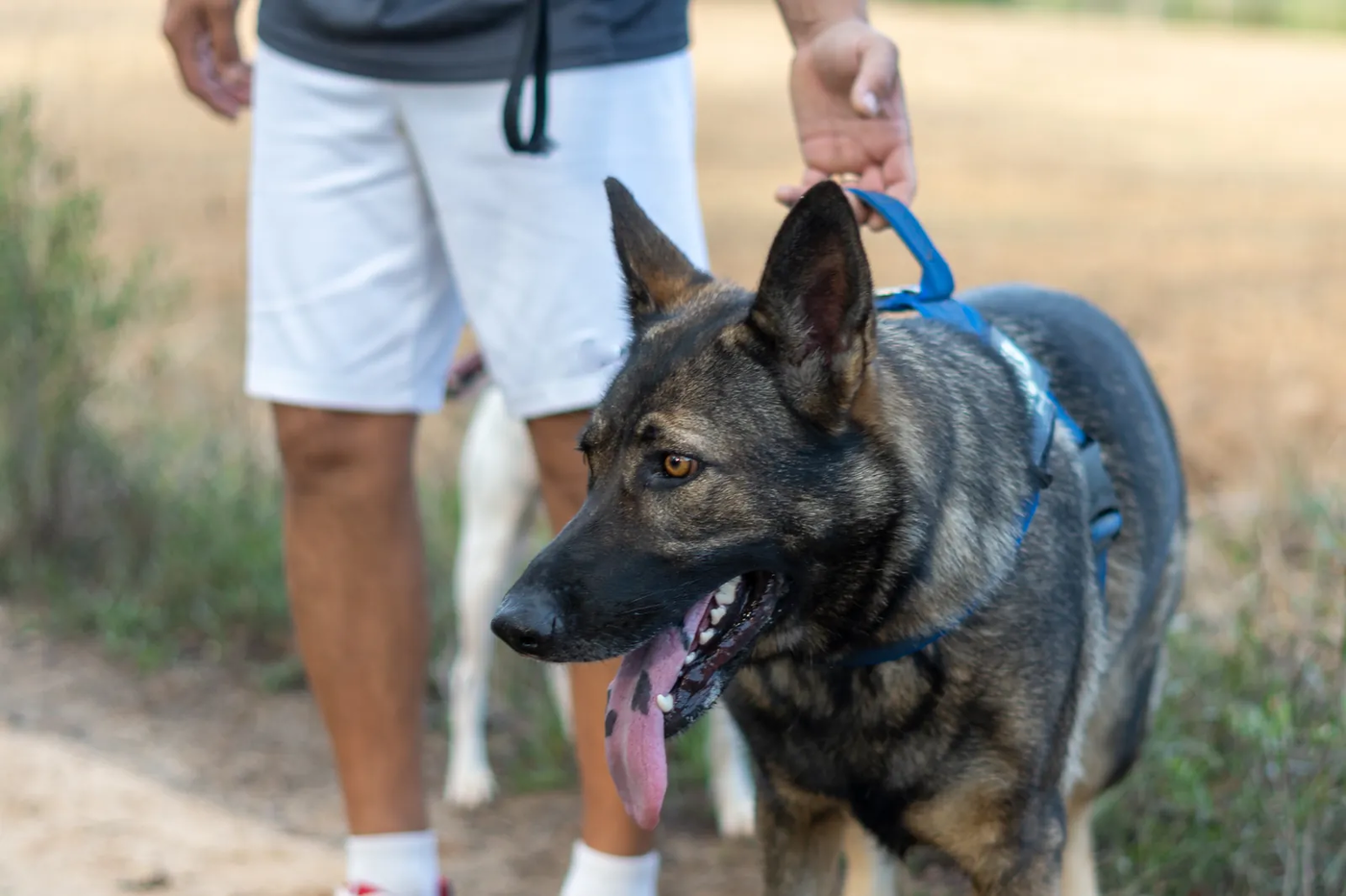
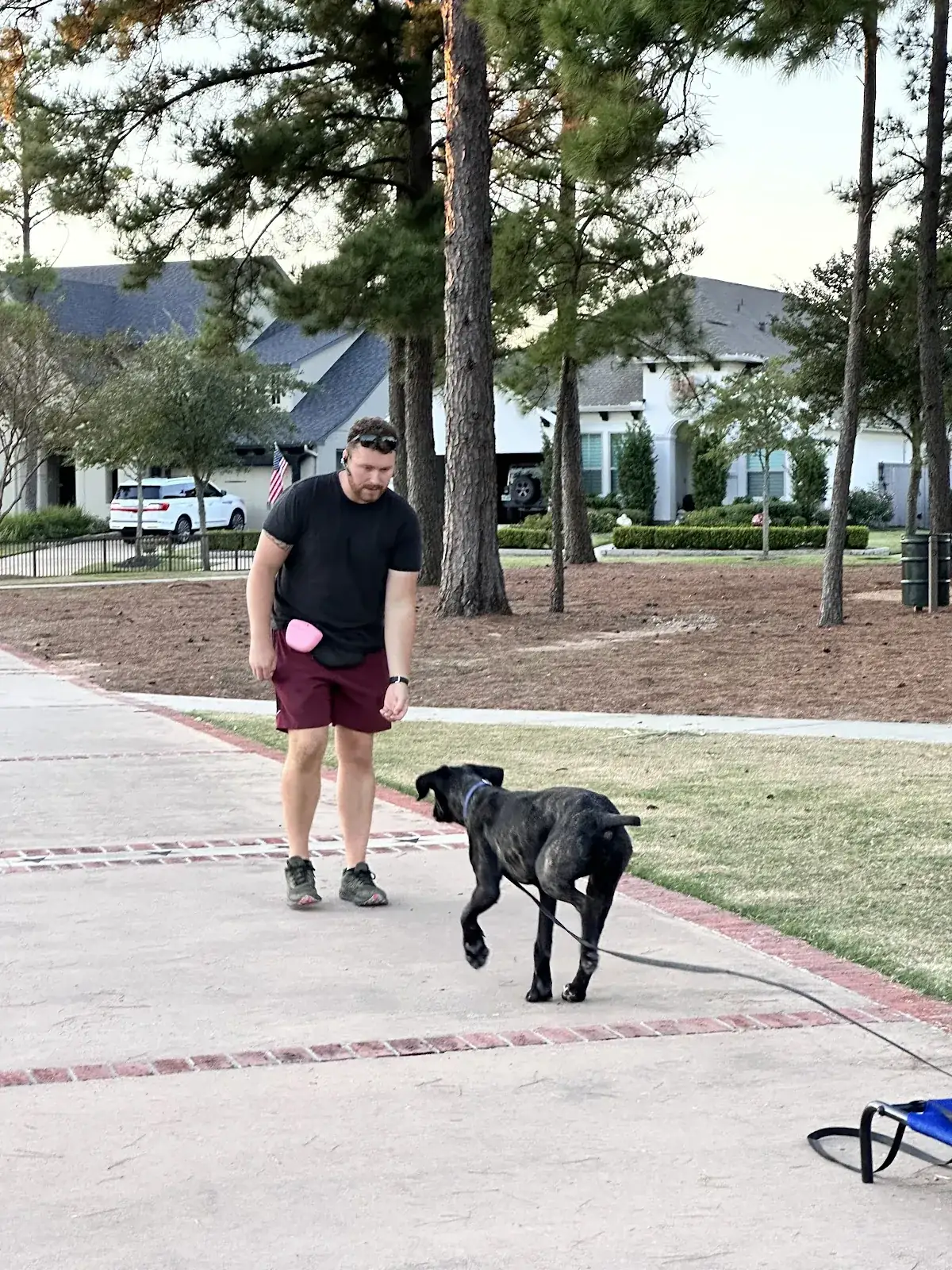
A one-year-old Lab from a Gold stay walked nicely on a slip lead by day eight and goes home on it. A ninety-pound shepherd from Platinum, who used to drag his owner toward dogs on the sidewalks of Fairfield, trained on a prong because his owner could not physically hold him otherwise, and he goes home on it with a plan. A VIP graduate goes home with the Mini-Educator included, taught to the family in the in-home handover.
Two kinds of dogs never get a prong from our trainers. A puppy needs the walk taught at the knee with food before pulling ever becomes a habit. A fearful dog needs distance and confidence, because pressure on a frightened dog confirms the fear. For either one, the prong question never comes up.
If it comes home
A prong that comes home is fitted high and snug, worn for the walk, and taken off afterwards.
The go-home session covers the collar in the same detail as the commands. You fit it yourself while our trainer watches, you walk the sidewalk outside the training home or the street outside your own house, and you practice the small, brief pressure that is released the instant the dog moves with you, until it feels ordinary in your hand.
Houston adds a few rules of its own. A snug collar on a panting dog in July needs checking for rubbing, and from May to September the walks move to early morning and evening anyway, after you test the pavement with the back of your hand. The collar comes off indoors and is never left on in a crate, a car or a yard.
Fit it high on the neck, just behind the ears, snug enough that it does not slide down
Clip the leash to the live ring and keep the line slack
Use a brief, even pressure only when the dog drifts, and release it the moment the dog comes back
Praise the return every time, so the dog hears what was right
Take it off as soon as the walk is over
Check the neck for rubbing after summer walks and give the coat a day off if it looks sore
Stepping down
The goal is the lightest tool that keeps the walk, and your handling sets the pace.
A dog that walks on a slack line past the mailboxes, the kids on bikes and the barking fence on your street for a few weeks is usually ready to try the next tool down. Try it on a quiet morning first, not on the busiest trail in Towne Lake on a Saturday, and go back a step if the walk falls apart.
When pulling returns, the cause is almost always the handling rather than the equipment: a leash that has gone tight and stayed tight, a dog allowed to sniff forward on its own schedule, a walk that skipped the calm start at the door. A bigger tool does not fix that. A lesson does, because a trainer can see the leash hand and the timing in a few minutes.
- Weeks of a slack line on your own street first
- Test the lighter tool on a quiet morning
- Step back one tool if the walk falls apart
- Look at the leash hand before blaming the collar
What we do at Best Dog University
Every stay teaches the walk first, chooses the equipment for your dog, and teaches you whatever it goes home in.
Gold, two weeks at $2,500, builds the loose leash, sit, place and door manners, and ends with the go-home session, one additional lesson and lifelong support. Platinum, three weeks at $3,750, adds the structured heel, behavior modification and field trips for the dog that pulls toward triggers, with unlimited private lessons afterwards to work the step-down on your own street. VIP, six weeks at $10,000, includes the Mini-Educator and unlimited in-home lessons.
If you would rather your dog did not use a prong at all, say so on the free phone consultation. Our team will tell you honestly how that changes the plan for your dog. For a family that simply wants to learn the handling, private lessons at $160 in Cypress or $220 in your home cover the fit and the walk without a stay.
The programs
Programs that teach the walk first.
Gold and Platinum choose the tool for your dog and teach it to you; lessons cover the handling and the step-down.


Asked and answered
Questions people ask about this.
Do I need to buy a prong collar before drop-off?
No. Bring a flat collar with an ID tag and a standard six-foot leash, and leave the training equipment to us. Our team advises on equipment during the stay and at the go-home session, so you are never guessing about sizing or fit. You do not need to buy anything in advance.
Will my dog start pulling again if I stop using the prong?
Not if the walk was taught and you keep the handling. Dogs pull again when the leash stays tight, the walk loses its calm start or the dog is allowed to choose the direction. Step down gradually, on quiet streets first, and book a lesson at the first sign of drift rather than waiting months.
My dog came home on a slip lead. Is that a lesser result?
No, it is often the better one. A slip lead means your dog learned the walk well enough that a simple tool is all it needs. The equipment reflects the dog in front of our trainers, not the size of the program. Many graduates of every program, Platinum included, finish on a slip lead or a flat collar.
Is a prong collar safe to use in the Houston summer?
Used correctly and for a short, cool walk, yes, but check the neck afterward for rubbing, especially on a dog that pants heavily. The bigger risk in summer is the heat itself: walk before the sun is high or after it sets, test the pavement, carry water and keep outings short on hot evenings.
Can I use the prong for jogging or at the dog park?
No. It is a walking tool for a dog on a leash at your side, fitted and removed for each walk. It should never be worn in off-leash play, where links can catch on another dog, and a dog that is jogging beside you should already be walking well without it.
Sources
Keep reading
Free consultation · 10% off this fall
Not sure what your dog should walk in?
Tell our team how your dog walks today on the free phone consultation. We will tell you what the stay would use and what would go home. A $250 deposit reserves the dates.